Watch the film
| Size in ft: | Width: 9'2" x Length: 11'6" |
| Size in Inch: | Width: 110" x Length: 138" |
| Size in meters: | Length: 3.51 x Width: 2.79 m |
| Colors: | Maroon, Navy Blue, Teal Blue, Ivory, Salmon Pink, Camel |
| Shape: | Rectangular |
| Woven: | 100% Hand-knotted | Handmade |
| Foundation: | Cotton |
| Pile: | |
| Design: | Lilihan | All-over floral field | Navy blue main border |
| Origin: | Persian Lilihan | Made in Persia |
| Condition: | Excellent | Solid even pile throughout |
9'2" x 11'6" Persian Lilihan Rug | Semi-Antique All-Over Floral | Hand-Knotted Wool, Excellent Condition
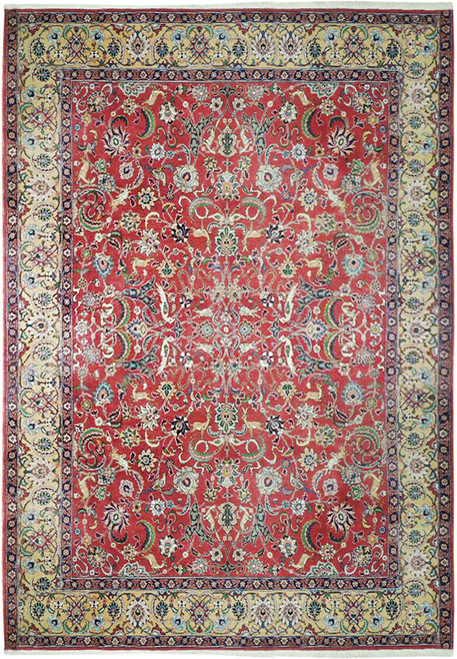
This is a village-woven Lilihan of the older type, hand-knotted in wool on a cotton foundation, and at 9'2" x 11'6" it lands squarely in the classic 9x12 Persian rug footprint that most American living and dining rooms were drawn around. The field is a deep maroon-red carried edge to edge with detached floral sprays, framed by a dark navy main border and a narrow camel outer band. The pile is solid and even across the whole surface, the sides and ends are intact, and the ivory fringe is full, as the corner and back photographs show. The wool has that slight sheen that only comes from decades of settling, not from any finishing treatment. Every rug we ship leaves Freeport with a certificate of authenticity naming origin, materials, size and weave.
Please Note About the Photographs:
The first image was shot under studio light and reads deeper and cooler than the rug is in person. The showroom floor photographs and the close-up detail are the truer record of the color: a raspberry-leaning maroon field with navy, teal blue and ivory drawing. Screens vary, so judge the tone from the daylight floor shots.
Design and Motifs
There is no medallion here. The field is built entirely from detached floral sprays, small vases, curling serrated leaves and stacked blossom clusters, each one drawn separately and repeated in mirrored halves down the length of the rug, which is the drawing habit that identifies Lilihan work within the wider Sarough group. Look at the close-up: ivory palmettes sit in tight pairs with a navy bud between them, teal leaves curl back on themselves, and tiny 5 petal rosettes fill the gaps so that no patch of open ground is left. The main navy border runs a heavier version of the same vocabulary, with large rose heads, ivory vine scroll and upright vase forms stepping around all 4 corners, and the corners resolve honestly rather than being cut off mid-motif. A thin salmon guard stripe on both sides of the main border is what keeps the navy from swallowing the field.
Reading the Maroon, Navy and Teal Palette
The ground is a maroon red that tilts toward raspberry where the light hits the pile and toward true burgundy in the shadow, and that shift across the width is natural abrash from the dye lots rather than fading. Against it the weaver set two distinct blues: a hard midnight navy used for outlines, bud centers and the main border ground, and a softer teal blue-green used for leaves and vine work, which is the color that gives an older Lilihan its slightly antique cast. Ivory and cream appear in the palmettes and in the scrolling border vine, salmon pink in the rose heads, and a muted camel gold in the outer band and in scattered leaf tips. The overall read from standing height is deep red and dark blue, warm rather than bright, which makes it forgiving against oak floors, mahogany furniture and cream walls alike.
Lilihan Weaving and the Sarough Tradition
Lilihan is a weaving village in the Malayer district of west central Persia, near Arak, and its output has always been sold and collected within the Persian Sarough family. What separates a Lilihan from a town Sarough is the hand: a single wefted, slightly looser village weave with a heavier wool pile, floral drawing that is bolder and less mathematical, and a palette built on raspberry red rather than the rose madder of the Arak workshops. The back photograph shows exactly that structure, an even cotton warp and weft grid with clean rows and no repair work, which is why rugs of this type survive generations of use in halls and dining rooms. These were the room size Persians that furnished American houses in the first half of the last century, and a clean one in this size with full pile is harder to find each year.
9'2" x 11'6" Persian Lilihan Rug | Semi-Antique All-Over Floral | Hand-Knotted Wool, Excellent Condition
Ask about this rug
This piece is the only one of it, so the things worth knowing about it are particular to it. If you want to talk through the size, the colour in your own light, or the weave, speak to someone here first.