Watch the film
| Size in ft: | Width: 9'3" x Length: 12'8" |
| Size in Inch: | Width: 111" x Length: 152" |
| Size in meters: | Length: 3.86 x Width: 2.82 m |
| Colors: | Antique Red, Blue, Ivory, Green |
| Shape: | Rectangular |
| Woven: | 100% Hand-knotted | Handmade |
| Foundation: | Cotton |
| Pile: | |
| Age: | 1970's |
| Design: | Heriz Sherabian | Star medallion with corner spandrels |
| Origin: | Persian Heriz | Made in Persia |
| Condition: | Excellent |
9'3" x 12'8" Persian Heriz Rug | Sherabian Medallion Design | 1970s Wool Pile, Excellent Condition
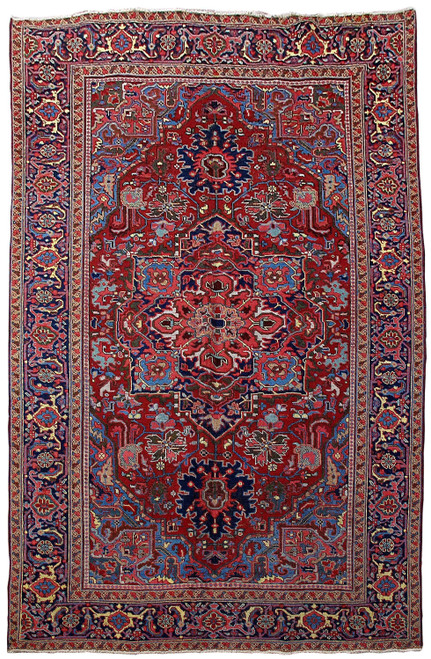
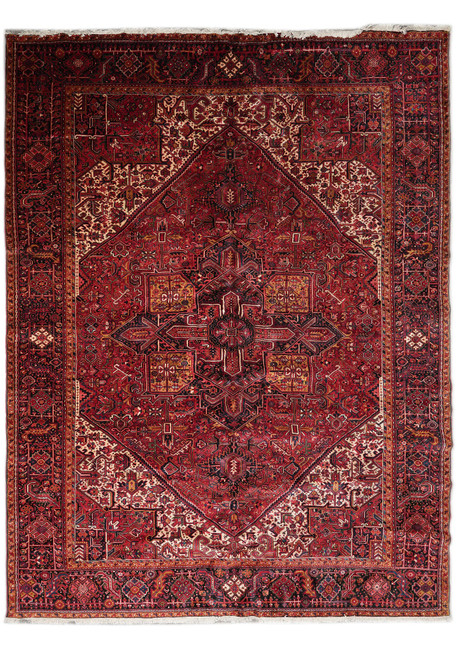
A 1970s village weaving from the Heriz district, this 9'3" x 12'8" Heriz carries the Sherabian drawing: an 8 point star medallion held inside a navy frame of gold arabesques, with the whole field crowded with serrated leaves and palmettes. The wool has the dry, glossy handle that Heriz is known for, and half a century of settling has softened the reds into that antique tone collectors look for while the pile itself remains full and even. It is a true room size piece, comfortable under a dining table or a full seating group, and it ships with a certificate of authenticity. For buyers comparing the format, it sits with our 9x12 Persian rugs.
Please Note About the Photographs:
The first image was shot under studio light and reads a deeper, cooler red than the rug actually is. The floor photographs taken in our Freeport warehouse are the accurate reference: the field is a brighter brick red with natural abrash, the soft light and dark bands that occur when a village weaver moves from one dye lot to the next. The shading visible in the upper field of the wide shots is camera shadow and abrash, not wear and not fade.
Design and Motifs
The center holds an 8 point star medallion on a coral ground, outlined in ivory, with a dark green rosette at its heart and radiating sprays of pale blue, saffron and cream leaf tips. Around it runs a navy cartouche belt filled with small vases and blossoms, then a pair of gold scrolling arabesques that hook away from the medallion top and bottom into long navy pendants. The 4 corner spandrels repeat the same vocabulary in ivory and deep indigo, their edges drawn in the straight, stepped lines that mark true village work rather than city curvilinear drawing, which is why this piece belongs squarely with geometric Persian rugs. Between medallion and border the field is packed with big serrated palm leaves, hooked vines, cypress forms and rosette clusters, all mirrored across both axes. The main navy border alternates ivory 8 petal rosette medallions with gold and rose palmettes, framed by a saffron vine minor border and narrow candy stripe guard stripes.
A Field of Antique Red Against Indigo and Ivory
The field is a warm brick red that shifts from tomato to a dusty terracotta across the width, the honest abrash of hand dyed wool, and it has mellowed with age into what dealers call antique red. Against it the main border reads as a deep indigo blue that drops almost to black along one end, giving the rug a heavy, grounded frame. Ivory does the structural work: it outlines the medallion, fills the corner spandrels and forms the rosette medallions in the border, keeping the composition legible from across a room. Green appears in two registers, a bottle green in the medallion core and a bright teal through the leaves and vine work, and it is the color that gives this Heriz its unusual liveliness. Supporting those four are strong saffron and gold accents, soft rose and salmon in the border blossoms, and touches of pale blue grey in the leaf tips. The overall effect is jewel toned and busy at close range, but resolves into red, blue and ivory when you stand back.
Heriz: The Weaving Villages of Northwest Persia
Heriz is a cluster of villages east of Tabriz, on the slopes below Mount Sabalan, and its reputation rests on two things: mineral rich water that fixes dye with unusual depth, and famously tough local wool with a high lanolin content that resists crushing. Sherabian is one of the named drawings that came out of this district, a more articulate, better proportioned version of the standard Heriz medallion, and this 1970s example follows it faithfully. The knotting is the medium count, heavy handed weave typical of the district rather than a fine workshop count, which is exactly the point: a thick wool pile on a cotton foundation, beaten down hard, is what lets a Heriz take decades of foot traffic and still show a full nap, as the reverse and knot photographs here demonstrate. If you want to understand what the wool, the colors and the wear pattern tell you about a piece like this, our guide on how to date an Oriental rug walks through the same signals we use.
9'3" x 12'8" Persian Heriz Rug | Sherabian Medallion Design | 1970s Wool Pile, Excellent Condition
Ask about this rug
This piece is the only one of it, so the things worth knowing about it are particular to it. If you want to talk through the size, the colour in your own light, or the weave, speak to someone here first.