Watch the film
| Size in ft: | Width: 9'4" x Length: 13'1" |
| Size in Inch: | Width: 112" x Length: 157" |
| Size in meters: | Length: 3.99 x Width: 2.84 m |
| Colors: | Magenta Red, Navy Blue, Turquoise Green, Beige, Gold |
| Shape: | Rectangular |
| Woven: | 100% Hand-knotted | Handmade |
| Foundation: | 100% Cotton |
| Pile: | |
| Age: | 1980's | Semi-Antique |
| Design: | Kerman Open Field | Central Medallion | Floral Spandrels |
| Origin: | Persian Tabriz | Made in Persia |
| Condition: | Excellent | Full even pile |
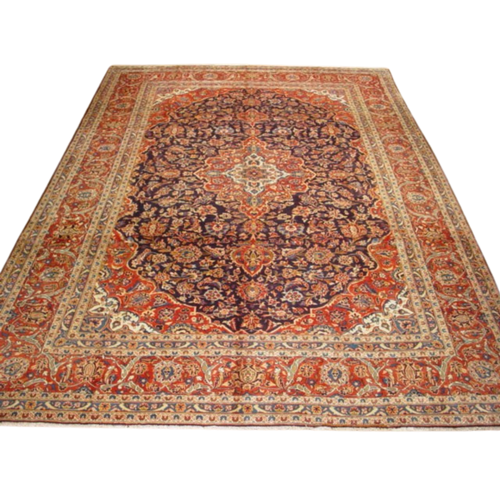
9'4" x 13'1" Persian Tabriz Rug | Kerman Open Field Design | 1980s Wool, Excellent Condition
This is a Tabriz weave carrying a Kerman open field design, woven in the 1980s and kept in excellent condition with a full, even wool pile from end to end. The drawing is confident and the color is anything but timid: a wide open magenta field, a navy pendant medallion drawn in miniature detail, and turquoise spandrels packed with flowering vines. At 9'4" x 13'1" it sits squarely in the group of large Persian rugs that anchor a whole room rather than float in it. Every rug we ship leaves Freeport with a certificate of authenticity recording origin, materials, age and knotting.
Please Note About the Photographs:
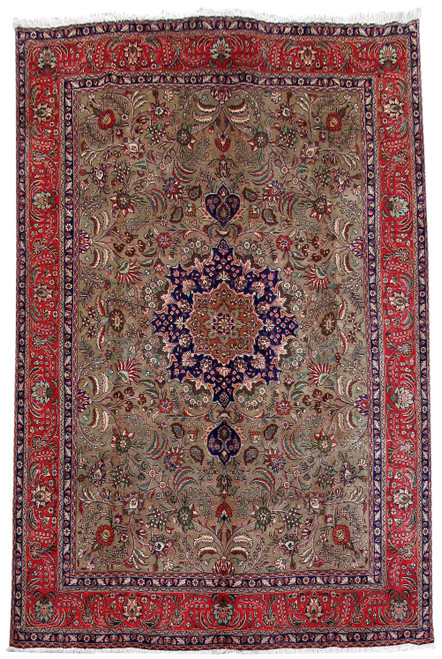
The tone shifts between shots. The overhead studio image reads cooler and more crimson, while the daylight floor photographs show the field as it actually is, a deep magenta rose. The soft light streaking across the open field in a few close-ups is natural abrash, the gentle dye-lot variation that hand-dyed wool always carries, and it is not wear, fading or damage.
Design and Motifs
The composition follows the classic Kerman open field formula. A large lobed medallion sits dead center, its navy ground filled with scrolling vine, palmettes and small rosettes, and at its heart a gold and ivory 8 petal rosette ringed by pale green leaf forms. Two pendants, one above and one below, hang from the medallion on thin stems ending in small trefoil drops. The field itself is left almost entirely open, which is the whole point of the design: the eye rests on plain wool and the pattern reads all the more clearly for it. Only 4 small floral sprays break that emptiness, one set near each shoulder of the medallion. The spandrels then reverse the logic completely, densely drawn with sunflower heads, serrated leaves, carnations and curling stems. Three borders finish the rug, a broad navy main band of palmettes and cypress-like sprays between two ivory guard stripes carrying a running vine and small reciprocal hooks at the outer edge.
Color: Magenta Rose Against Navy and Turquoise
The field is a saturated magenta rose, a pink-leaning red with real depth in the wool, and it shifts a shade lighter or deeper as the light moves across the pile. Against it the medallion and main border read as a dark indigo navy, almost black in the shadows and clearly blue where light hits the face. The spandrels are the surprise: a bright turquoise green, the color of shallow water, which cools the pink and keeps the whole rug from feeling one-note. Inside that turquoise sit pale beige, apricot, soft rose, brown and olive florals, while the medallion carries gold, cream, seafoam, deep pink and touches of teal. The guard borders are a warm beige, almost sand, with pink and green hooks that echo the field. It is an unusually bold palette for a Persian rug of this period, and it works because the 3 main colors, magenta, navy and turquoise, are each given clear territory.
Tabriz Weaving and Quality
Tabriz in northwest Persia has been the country's most versatile weaving city for centuries, and its workshops have always been willing to weave another town's design better than that town does. Here the weavers have taken the Kerman open field and built it on a Tabriz foundation: a taut cotton warp and weft, a wool pile clipped low enough to hold the fine outlines in the medallion and border, and edges and ends that have stayed straight and square after 40 years. Tabriz quality is measured in Raj, the knot count across a gereh of about 2.75 inches, and this piece sits in the solid workshop range rather than the ultra-fine collector grades, which is exactly right for a room-size rug meant to be walked on. The open field is the real test of a weaver, because nothing hides an uneven knot or a wandering line, and this field is clean.
9'4" x 13'1" Persian Tabriz Rug | Kerman Open Field Design | 1980s Wool, Excellent Condition
Ask about this rug
This piece is the only one of it, so the things worth knowing about it are particular to it. If you want to talk through the size, the colour in your own light, or the weave, speak to someone here first.