Watch the film
| Size in ft: | Width: 9'4" x Length: 13'4" |
| Size in Inch: | Width: 112" x Length: 160" |
| Size in meters: | Length: 4.06 x Width: 2.84 m |
| Colors: | Red, Blue |
| Shape: | Rectangular |
| Woven: | Hand-Knotted |
| Pile: | 3/8" Dense Wool |
| Origin: | Persia |
| Design: | Esfahan |
| Age: | 1980's |
| Condition: | Perfect |
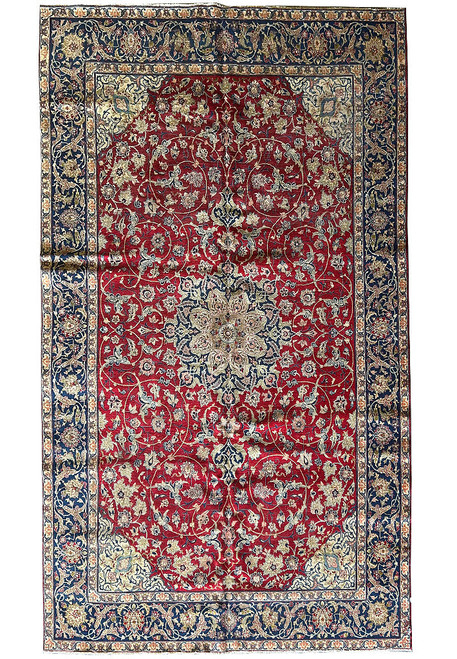
9'4" x 13'4" Persian Isfahan Rug | Red Field, Navy Floral Borders | Circa 1980s Dense Wool
This Persian Isfahan rug measures 9'4" x 13'4" and was woven in the 1980s on a cotton foundation with a 3/8" dense wool pile. Four decades on it remains in perfect condition, with full pile from edge to edge, straight selvedges, intact ends and no wear, stains or repairs anywhere in the body. The scale puts it squarely in the room-filling bracket that buyers search for as 10x13 Persian rugs, long enough to run a full seating group or a 10 seat table without the furniture crowding the border. Every rug we ship leaves Freeport with a certificate of authenticity recording origin, materials, age and exact measurements, so the piece on your floor is documented as what it is.
Design and Motifs
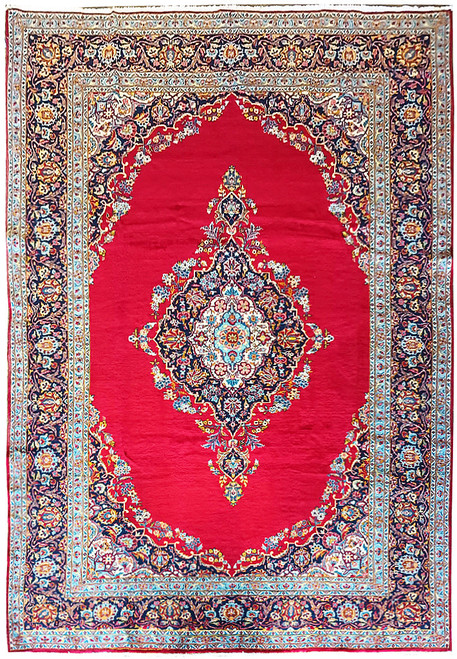
The drawing is classic Esfahan: a navy lobed medallion sits dead center on the red field, built around a layered 8 petal rosette in peach, gold and pale blue, with a ring of small cloud bands and split leaves around it. Above and below the medallion a pendant finial drops into the field, and the 4 corners carry ivory and light blue spandrels filled with arabesque vine. Between those anchors the field is covered in a continuous curvilinear system of palmettes, lotus blossoms, serrated leaves and fine spiraling vines, all of it drawn with the flowing line that Isfahan workshops are known for and that only holds up at a high knot count. Five borders frame the field: a wide navy main border carrying alternating palmettes and rosettes on a scrolling vine, flanked by narrow ivory and gold guard stripes with a running flower and leaf meander, and a thin red outline at the very edge. The symmetry is close but not mechanical, and small variations in the repeating flowers confirm the whole thing was read off a cartoon knot by knot rather than stamped out.
A Red Field Under Deep Navy Borders
The field reads as a clear crimson red, warm rather than orange, and it holds that tone evenly across the full 13'4" length with only the gentle abrash you want to see in naturally dyed wool. Against it the main border is a deep inky navy that almost goes black in low light, which is what gives the red its punch in photographs and in person. The secondary colors do the real work: ivory and soft cream in the spandrels and guard stripes, a chalky light blue that fills the corner grounds and repeats inside the medallion, sage and olive green in the serrated leaves, mellow gold and honey in the vine scrolls, and touches of peach and salmon in the rosette hearts and border palmettes. Small notes of brick red and dark aubergine outline the flowers and keep the pattern legible from across the room. The overall effect is a traditional red and blue Persian palette with a lighter, more silvery mid-range than a Kashan or Sarough would give you, so it sits comfortably with cream walls, dark wood and antique brass.
Isfahan Weaving and the Quality of This Piece
Isfahan in central Persia has been a weaving capital since the Safavid court workshops of the 16th century, and its reputation rests on draftsmanship: the curved line, the unbroken vine, the precision of a repeating palmette. This rug is catalogued as an Esfahan design, and its all wool pile on cotton warps follows the sturdier town and village practice around Isfahan, including Najafabad to the west, where weavers work the same cartoons in a slightly heavier, longer wearing structure instead of the fine silk-inlaid city pieces. That is a practical advantage at this size. The 3/8" pile is dense and springy underfoot, the back is tight and even, and a rug built this way takes real household traffic for generations rather than being treated as a wall piece. For a buyer who wants the formal Isfahan drawing at room-filling scale, in a condition that needs nothing done to it, this is an unusually sound example of 1980s workshop weaving.
9'4" x 13'4" Persian Isfahan Rug | Red Field, Navy Floral Borders | Circa 1980s Dense Wool
Ask about this rug
This piece is the only one of it, so the things worth knowing about it are particular to it. If you want to talk through the size, the colour in your own light, or the weave, speak to someone here first.