Watch the film
| Size in ft: | Width: 9'7" x Length: 12'10" |
| Size in Inch: | Width: 115" x Length: 154" |
| Size in meters: | Length: 3.91 x Width: 2.92 m |
| Colors: | Raspberry Red, Navy Blue, Olive Green, Ivory, Teal, Rose Pink |
| Shape: | Rectangular |
| Woven: | 100% Hand-knotted | Handmade |
| Foundation: | Cotton |
| Pile: | |
| Age: | 1980's | Semi-Antique |
| Design: | Tabriz Stepped Medallion | Floral Spandrels |
| Origin: | Persian Tabriz | Made in Persia |
| Condition: | Excellent |
9'7" x 12'10" Persian Tabriz Rug | Navy Medallion on Red Field | Olive Spandrels | 1980s, Excellent
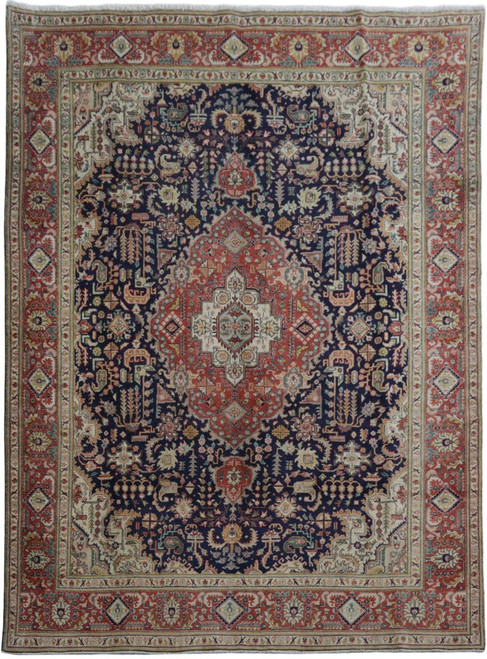
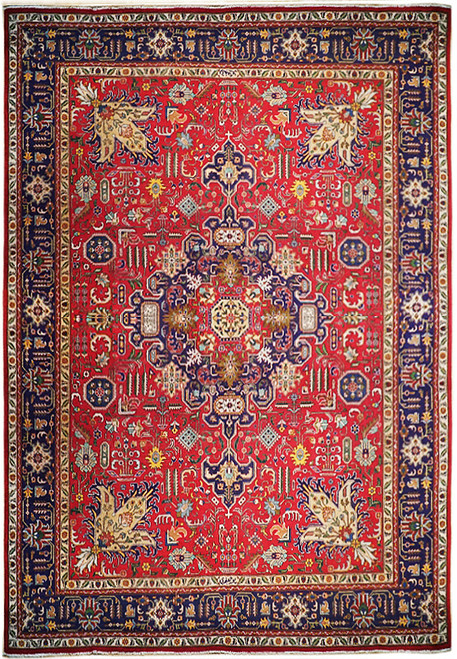
Woven in the 1980s and still carrying a full 3/8" wool pile, this 9'7" x 12'10" Tabriz reads exactly the way a good northwest Persian workshop piece should: a stepped navy medallion anchored dead center, olive green quarter spandrels holding the 4 corners, and a wide indigo border that closes the whole thing off without crowding it. The wool has the slight sheen that comes from hand-spun stock and decades of gentle settling, and the selvedges and fringes are intact with no restoration to disclose. It falls squarely in the most useful of all sizes, which is why buyers searching 10x13 Persian rugs tend to land on pieces like this one. It ships with a certificate of authenticity documenting origin, materials and hand-knotted construction.
Design and Motifs
The center medallion is built in tiers: an ivory cartouche cradling small lobed flowerheads, ringed by a navy field that throws out teal-outlined hooks and serrated leaves, then finished top and bottom with long pendant finials. Around it the red ground is not left open but filled with a loose, airy vinework of palmettes, 8 petal rosettes, tulip forms and curled cloudband leaves, several of them drawn in pale ivory so they read almost as calligraphic flourishes against the red. The olive spandrels repeat the same vocabulary in miniature, each one framed by a fine stepped key-fret line. The main border alternates turquoise fan palmettes with rose and crimson blossoms on a navy ground, flanked by ivory guard stripes carrying a rosette-and-vine chain. It is a drawing with real balance: formal enough to sit under antique furniture, lively enough to hold its own in a modern room.
A Raspberry Red Field Set Against Navy and Olive
The field is a cool raspberry red rather than a brick or rust red, closer to cherry, and it shifts slightly toward crimson where the light strikes across the pile. Against it the medallion and border read as a deep indigo navy, almost black in the shadows of the close-up photographs and clearly blue in the overhead shots. The third color is the one that makes the rug: a soft olive green in the spandrels and scattered through the leafwork, an unusual and very collectible note in Tabriz weaving. Supporting tones include ivory and cream in the guard bands and the larger field flourishes, sea-green and turquoise in the palmettes, rose pink and pale salmon in the blossoms, saffron gold in the small buds, and touches of chocolate brown in the border stems. The overall impression is jewel-toned and warm, and the red carries well under both daylight and lamplight.
Tabriz Weaving in Northwest Persia
Tabriz sits in the far northwest of Persia and has been the country's commercial weaving capital for centuries, with a workshop tradition that measures fineness in Raj, the count of knots per gereh across the width. Tabriz weavers work on a cotton foundation with a Turkish knot and a hook tool, which is why their rugs hold crisp outlines and stay flat and square through decades of use, and why a room-size piece like this one still lies true at almost 13 feet. The 1980s output from the better Tabriz workshops is exactly this: sound wool, disciplined drawing, and classical medallion layouts kept slightly looser and more open than the ultra-fine collector grades. If you want to place this piece in context, our guide on how to date an Oriental rug walks through the wear, dye and back-of-the-rug clues that put a weaving in its decade.
9'7" x 12'10" Persian Tabriz Rug | Navy Medallion on Red Field | Olive Spandrels | 1980s, Excellent
Ask about this rug
This piece is the only one of it, so the things worth knowing about it are particular to it. If you want to talk through the size, the colour in your own light, or the weave, speak to someone here first.