Watch the film
| Size in ft: | Width: 9'7" x Length: 12'3" |
| Size in Inch: | Width: 115" x Length: 147" |
| Size in meters: | Length: 3.73 x Width: 2.92 m |
| Colors: | Navy Blue, Red, Green, Gold, Ivory, Teal |
| Shape: | Rectangular |
| Woven: | 100% Hand-knotted | Handmade |
| Foundation: | Cotton |
| Pile: | |
| Age: | 1980's | Semi-Antique |
| Design: | All Over Paisley | Boteh Repeat | No Medallion |
| Origin: | Persian Khorasan | Made in Persia |
| Condition: | Excellent | Full even pile |
9'7" x 12'3" Persian Khorasan Rug | All Over Paisley Boteh | Navy Blue | 1980s
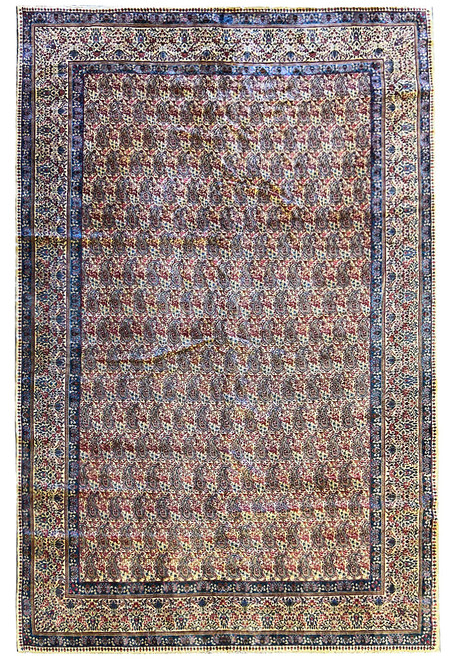
This is a room size Persian Khorasan rug from the Mashad weaving region, hand-knotted in wool on a cotton foundation in the 1980s and never cut down or reduced. The field carries no medallion at all, just rank after rank of paisley cones marching across a deep navy ground, which is the older Khorasan habit of letting a single motif carry the whole surface. At 9'7" x 12'3" it sits squarely in the bracket buyers shop as 9x12 Persian rugs, with enough length to run a full seating group or a 10 seat table without the furniture crowding the border. The pile is full and even across all 4 corners, the selvedges are intact, and the fringes are original. Every rug we sell ships with a certificate of authenticity recording origin, age, materials and knot construction.
Design and Motifs
The drawing is a strict boteh repeat, the teardrop paisley that Persian weavers have used for centuries as a symbol of the cypress bent by wind. Large cones are set in staggered rows, each one outlined in ivory and filled with a second generation of miniature paisleys, 8 petal rosettes and hooked leaves, so the pattern rewards looking at from 2 feet as much as from across the room. Smaller boteh drift between the big ones, and a thin vine in pale blue links the whole field together without ever turning into a formal lattice. This is a textbook example of the sort of all over rugs that read as texture from a distance. The wide main border reverses the scheme, placing upright paisleys and palmette cartouches on a rust red ground scattered with small white rosettes, and 4 narrow guard stripes in ivory and teal frame it on both sides. The corners are properly resolved, with the border pattern turning cleanly rather than being chopped.
A Navy Field Lit From Within
The ground is a saturated indigo navy blue that shifts as you walk around it, going almost black where the pile leans away and opening into a lighter mid blue where it leans toward the light. Against that darkness the paisleys are unusually bright: cream and ivory outlines, turquoise and teal cores, olive and moss green leaf work, mustard and old gold, and small hits of crimson and burgundy at the center of each cone. Touches of aubergine and soft rose appear in the smaller motifs, and the effect is closer to a jewelled shawl than a typical floor rug. The border swings the temperature the other way, a warm brick and rust red that grounds the composition and pulls out the red accents scattered through the field, while the ivory guard stripes keep a clean line of separation. Green and teal appear often enough to make this rug work with cooler paint and upholstery as easily as with warm woods.
Khorasan Weaving in Northeast Persia
Khorasan is the large northeastern province of Persia, and its weaving is sold and catalogued under Mashad, the provincial capital and its most famous rug city. The region is known for long stapled, lustrous wool and for a soft, slightly pliable handle that comes from the local Persian knot technique, so a Khorasan rug drapes and settles rather than standing stiff. Workshop pieces from the area tend to favor curvilinear drawing and a high color count, which is exactly what you see here in the number of separate shades used inside a single paisley. The knotting on this example is tight and regular, with straight rows visible on the reverse and small enough knots to hold the fine ivory outlines without them breaking up. For a piece woven in the 1980s and kept in this condition, the pile depth and the clarity of the dyes are both well above what most rugs of this age still show.
9'7" x 12'3" Persian Khorasan Rug | All Over Paisley Boteh | Navy Blue | 1980s
Ask about this rug
This piece is the only one of it, so the things worth knowing about it are particular to it. If you want to talk through the size, the colour in your own light, or the weave, speak to someone here first.