| Size in ft: | Width: 9'7" x Length: 13'8" |
| Size in Inch: | Width: 115" x Length: 164" |
| Size in meters: | Length: 4.17 x Width: 2.92 m |
| Colors: | Coral, Ivory, Blue, Green |
| Shape: | Rectangular |
| Woven: | 100% Hand-knotted | Handmade |
| Foundation: | Silk warp and weft |
| Pile: | Wool and Silk on Silk | 70 Raj |
| KPSI: | 70 Raj | Approx. 700 |
| Age: | 1980's | Never used |
| Design: | Tabriz | Central medallion | Floral all over field |
| Origin: | Persian Tabriz | Made in Persia |
| Condition: | Perfect | Never used |
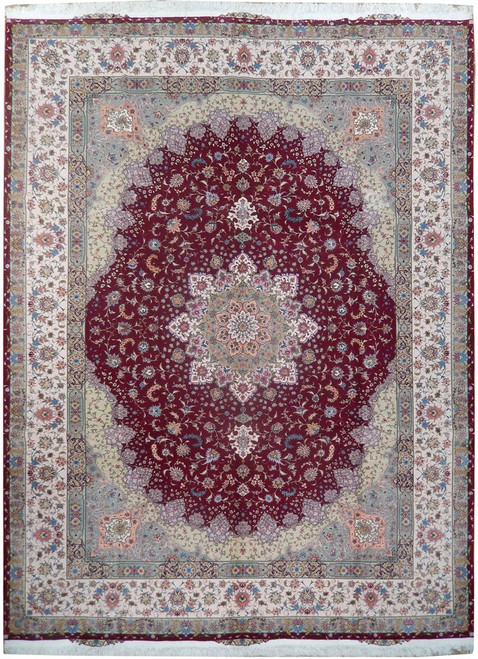
9'7" x 13'8" Persian Tabriz Rug | 70 Raj Wool and Silk on Silk Foundation | 1980s, Never Used
This is a 1980s workshop piece that was rolled and stored rather than lived on, and it shows: the pile stands full, the silk highlights still flash when the light moves across the field, and the fringe has never been walked down. It measures 9'7" x 13'8", woven at 70 Raj with a wool and silk pile knotted onto a silk warp and weft, which is the top specification a Tabriz atelier will attempt at this scale. Pieces of this fineness are usually made in scatter and area sizes because the loom time is punishing, so a room size example in perfect, unused condition is the uncommon part. Every rug we sell ships with a certificate of authenticity that records the origin, the materials and the knot count, and this one sits comfortably alongside the best 10x14 Persian rugs we handle.
Design and Motifs
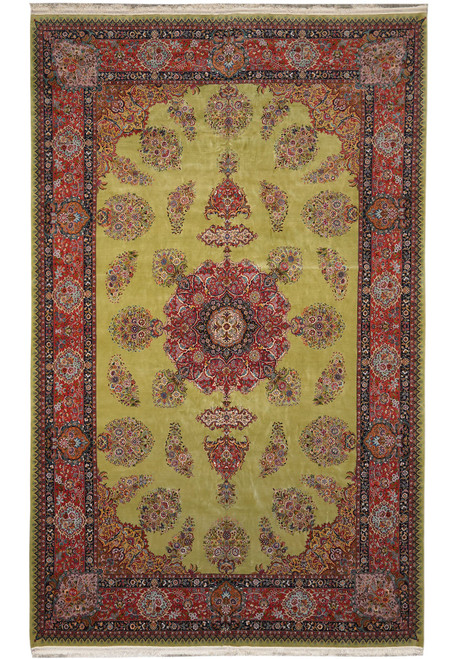
The drawing is classic curvilinear Tabriz, built around a round navy medallion that radiates outward in serrated lobes rather than sitting as a flat disc. At its heart is an ivory cartouche holding a single pink and coral rosette, ringed by fine scrolling vine, then a dense navy band packed with boteh, palmettes and tiny blossoms. Slim pendants drop from the top and bottom of the medallion into the open field, and the four corner spandrels repeat the same vocabulary in ivory so the layout reads as one continuous garden rather than four separate quarters. The field itself is never empty: split leaves, cloud bands, lotus palmettes and small stars run edge to edge on hair-thin vines, with each motif outlined in a darker shade so the shapes hold their edges at 700 knots to the square inch. The main border carries alternating navy and light blue cloud band panels with large rosettes, flanked by ivory guard stripes of lavender wisteria sprays and pink carnations, the detail visible in the close-up border photograph.
A Coral Field Framed in Sky Blue and Navy
The ground is a deep coral that leans toward raspberry in raking light and softens to a dusty rose where the silk knots catch the sun, which is why the field looks like two related colors depending on where you stand in the room. Against it, the medallion and the outer border run a true midnight navy, dark enough to anchor the whole composition, while a broad sky blue band separates the two and keeps the rug from reading heavy. Ivory does the connective work in the spandrels, the guard stripes and the medallion center, and it is a warm cream rather than a stark white. Scattered through the vinework are sage and olive greens in the leaves, soft gold in the palmette outlines, lavender in the wisteria clusters, and pale pink in the carnations and the central rosette. The palette is decorative rather than tribal, and it sits naturally with warm wood floors, cream walls and antique brass.
Tabriz Weaving and the 70 Raj Standard
Tabriz in northwest Persia has been the country's commercial and technical weaving capital for centuries, and it grades its own work by Raj, the number of knots counted across a gereh of roughly 2.75 inches of width. 40 Raj is ordinary commercial goods, 50 Raj is fine, 60 Raj is collector grade at about 400 knots per square inch, and 70 Raj is the ceiling that only the best city workshops even attempt. Reaching it requires a silk foundation, because cotton warps are too thick to pack that many knots into the width, and it requires a weaver willing to spend years at a single loom of this size. The result here is a pile you can read like printed paper: the vine lines stay unbroken, the rosette petals keep their curve, and the silk passages in the flowers and medallion sit slightly lower than the wool, so light reflects off them at a different angle and the pattern appears to move. Turn the rug over and the back is as legible as the front, which is the simplest proof of what went into it.
9'7" x 13'8" Persian Tabriz Rug | 70 Raj Wool and Silk on Silk Foundation | 1980s, Never Used
Ask about this rug
This piece is the only one of it, so the things worth knowing about it are particular to it. If you want to talk through the size, the colour in your own light, or the weave, speak to someone here first.