| Size in ft: | Width: 9'9" x Length: 13' |
| Size in Inch: | Width: 117" x Length: 156" |
| Size in meters: | Length: 3.96 x Width: 2.97 m |
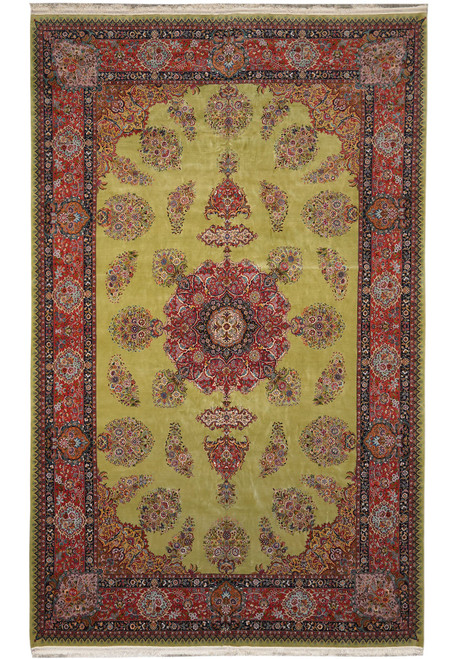
| Colors: | Burgundy, Ivory, Green, Blue |
| Shape: | Rectangular |
| Woven: | 100% Hand-knotted | Handmade |
| Foundation: | Silk warp and weft |
| Pile: | Wool and Silk |
| KPSI: | Approx. 500 |
| Age: | 1980's | Never used |
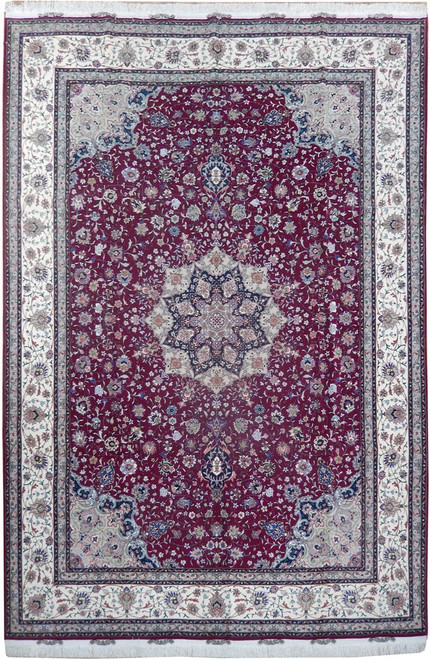
| Design: | Tabriz Floral Medallion | Dome medallion | All over vine and palmette field |
| Origin: | Persian Tabriz | Made in Persia |
| Condition: | Perfect | Never used |
9'9" x 13' Persian Tabriz Rug | Wool and Silk on Silk Foundation | 1980s, Never Used
This is a workshop Tabriz of the kind that does not come out of storage very often: woven in the 1980s, never put on a floor, and still carrying the full original pile from selvage to selvage. The pile is wool with silk, knotted on a silk warp and weft at approximately 500 knots per square inch, which is why the drawing stays this crisp at a scale of 10x13 Persian rugs. Silk foundations let the weaver pull the knot count up and keep the rug light and supple in the hand for its size, and you can see the silk catching light across the medallion and the spandrels as you walk around it. Dating is straightforward on a piece like this, with the wool still bright and the fringe untouched, and our guide to dating an Oriental rug covers what we look at. Every rug we sell ships with a certificate of authenticity.
Design and Motifs
The layout is the classic Tabriz dome medallion, but drawn with far more detail than the commercial version of the same idea. At the center sits a many pointed starburst rosette, ring inside ring: a small white and green flowerhead, then a band of peach petals, then curling arabesque scrollwork, then an outer crown of lavender and ivory palmettes. Above and below it, two pendant cartouches run out onto the field, each finished with a fine ivory cusp. The medallion is enclosed by a scalloped ring of lavender lotus heads that reads almost like a wreath, and beyond that the field fills edge to edge with a dense vine lattice of palmettes, rosettes, buds and split leaves, no two neighbouring flowers in quite the same color. The 4 corners carry soft pistachio spandrels with a small salmon cartouche set inside each one. The main ivory border is drawn with big turning lily and palmette heads on a scrolling stem, framed by narrow guard stripes of blue and rose blossoms and closed with a burgundy outer stripe, visible in the corner photograph.
A Burgundy Field Cooled by Green and Ivory
The field is a deep wine burgundy, dark enough to read as near black in low light and clearly red under lamps, and it does the job of making everything laid over it glow. Against it the palette is deliberately cool and soft: pistachio and celadon green through the medallion center and the corner spandrels, powder blue and a deeper cornflower in the small flowerheads, lavender in the lotus wreath, and salmon to peach in the petals and cartouches. The border ground shifts from ivory to a warm blush, with olive, gold and brown in the leafwork, so the frame is gentle rather than stark white. Silk is used selectively rather than everywhere, picking out petal edges, scroll tips and the medallion rings, so the rug changes tone as you cross the room. It is a burgundy rug that behaves like a light one, and it will sit comfortably with cream walls, walnut floors and green or blue upholstery.
Tabriz Weaving and What 500 Knots Means
Tabriz sits in northwest Persia and has been the country's most organized weaving city for centuries, with named workshops, trained designers and a grading system of its own. Tabriz counts fineness in Raj, the number of knots across a gereh of about 2.75 inches: 40 Raj is ordinary commercial goods, 50 Raj is fine, and 60 Raj is roughly 400 knots per square inch and already collector territory. At approximately 500 knots per square inch this rug sits above that benchmark, which is only achievable on a silk foundation because silk warps are thin and strong enough to carry that many knots without the rug losing shape. That density is what allows the curved line, the true circular medallion ring and the tiny four petal flowers you can see in the close-up rather than the stepped, angular approximations a coarser weave forces. If you want the background on the material, our Persian silk rugs guide explains how silk is used in the foundation and in the pile, and why the two are priced so differently.
9'9" x 13' Persian Tabriz Rug | Wool and Silk on Silk Foundation | 1980s, Never Used
Ask about this rug
This piece is the only one of it, so the things worth knowing about it are particular to it. If you want to talk through the size, the colour in your own light, or the weave, speak to someone here first.