Watch the film
| Size in ft: | Width: 9'8" x Length: 12'10" |
| Size in Inch: | Width: 116" x Length: 154" |
| Size in meters: | Length: 3.91 x Width: 2.95 m |
| Colors: | Antique Red, Navy, Green, Ivory |
| Shape: | Rectangular |
| Woven: | 100% Hand-knotted | Handmade |
| Foundation: | Cotton |
| Pile: | Wool | 3/8" pile |
| Age: | Semi-Antique |
| Design: | Heriz | Sherabian | Floral Medallion |
| Origin: | Persian Heriz | Made in Persia |
| Condition: | Excellent |
9'8" x 12'10" Persian Heriz Rug | Sherabian Floral Medallion | Semi-Antique, Excellent Condition
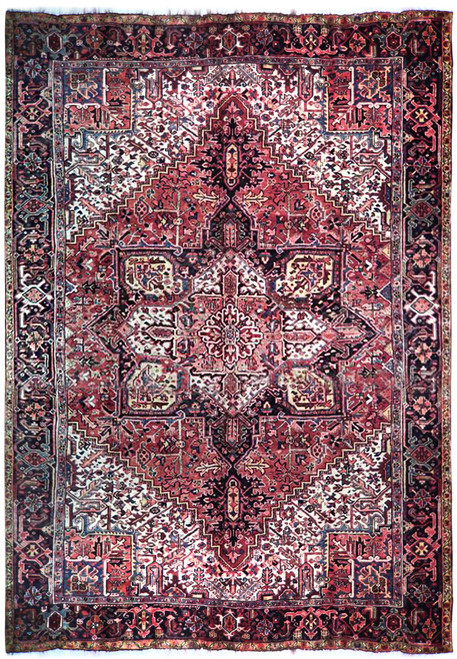
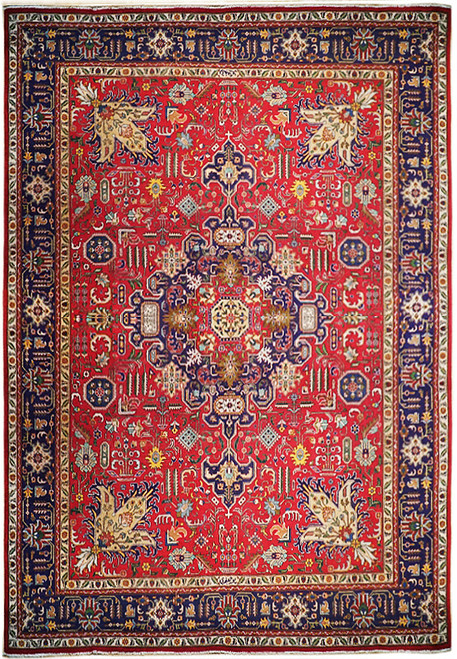
Most Heriz rugs are drawn with a ruler. This one was not. The center of the field carries a large multi-lobed floral medallion built from curved petals and fine tendrils, the kind of drawing associated with the Sherabian weavers who worked at the refined end of the Heriz district. It is hand-knotted in wool on a cotton foundation, with a 3/8" pile that still stands firm and even across the whole 116" x 154" surface, and the condition is excellent with clean, original hand-tied fringes at both ends. At just under 10 feet by 13 feet it fits the same footprint most buyers shop for when they look at 10x13 Persian rugs, covering a full seating group or a long dining table with the border left visible. Every rug we ship leaves with a certificate of authenticity documenting origin, materials and knotting.
Please Note About the Photographs:
These photographs were taken in our warehouse under different lighting, so the red field reads brighter and warmer in some frames and considerably deeper in the close-up shots. That difference is camera and light, not fading, wear or damage. The rug is an even antique red throughout, and it is professionally steamed and pressed before it ships.
Design and Motifs
The field is organized around one large rosette medallion whose petals radiate outward in tiers, each petal outlined in ivory so the whole figure reads clearly from across a room. Above and below it sit matching pendants, and the open ground between them is filled with serrated leaves, curling palmettes, small blossoms and hooked vine work rather than left bare. The 4 corner spandrels are the piece's signature move: broad ivory grounds carrying oversized curved leaf forms and scrolling vines that echo the medallion instead of repeating a stock corner unit. Framing all of it is a wide main border of linked palmettes and round rosettes on a dark ground, held in place by narrow reciprocal guard stripes of tiny flowerheads. Look closely at the close-up photographs and you can see the small irregularities of village drawing, one leaf slightly longer than its mirror, a rosette set a fraction off center, which is exactly what separates a hand-knotted piece from a machine-made copy of the same layout.
A Palette of Antique Red, Navy, Green and Ivory
The dominant color is an antique red that has mellowed into a warm terracotta brick, softer and dustier than the bright madder of a new rug, with gentle tonal movement through the field where the dye lots shift. Navy does the structural work: it outlines the medallion arms, fills the ground of the main border and darkens the leaf forms so the drawing holds its shape. Between them runs a muted green, closer to olive and sage than to a clear bottle green, appearing in the border ground, in the leaves and in the small subsidiary flowers, and it is the color that keeps the rug from reading as purely red and blue. Ivory is used sparingly and deliberately in the corner spandrels, in the medallion outlines and in the guard stripes, which is what gives the piece its light. Accents of rust, apricot, soft rose and charcoal appear in the small blossoms. Together the palette suits warm wood floors, brass and leather, and it sits easily with both traditional and transitional furniture.
Heriz Weaving and the Sherabian Hand
Heriz is a group of villages east of Tabriz in northwest Persia, below Mount Sabalan, where mineral-rich water and mountain grazing produce a famously tough, lustrous wool. That wool is why Heriz rugs have a reputation for outlasting the houses they are bought for. Ordinary village Heriz weaving is boldly angular and usually sits under 200 knots per square inch, so a piece like this one, drawn with curved petals, flowing vines and finely articulated spandrels, represents the more ambitious end of the district, the workshop-influenced Sherabian style that demanded a tighter knot and a more experienced weaver at the loom. The back photograph shows the result: a straight, even, tightly packed weave on a cotton foundation, with clear definition of each motif and no slack or wandering lines. Semi-antique, excellent, and built on wool that still has decades of floor life ahead of it.
9'8" x 12'10" Persian Heriz Rug | Sherabian Floral Medallion | Semi-Antique, Excellent Condition
Ask about this rug
This piece is the only one of it, so the things worth knowing about it are particular to it. If you want to talk through the size, the colour in your own light, or the weave, speak to someone here first.