Watch the film
| Size in ft: | Width: 9'8" x Length: 12'10" |
| Size in Inch: | Width: 116" x Length: 154" |
| Size in meters: | Length: 3.91 x Width: 2.95 m |
| Colors: | Deep Red, Black, Blue, Ivory, Olive |
| Shape: | Rectangular |
| Woven: | 100% Hand-knotted | Handmade |
| Foundation: | Cotton |
| Pile: | |
| Design: | Heriz | Geometric Medallion | Ivory Corner Spandrels |
| Origin: | Persian Heriz | Made in Persia |
| Condition: | Excellent |
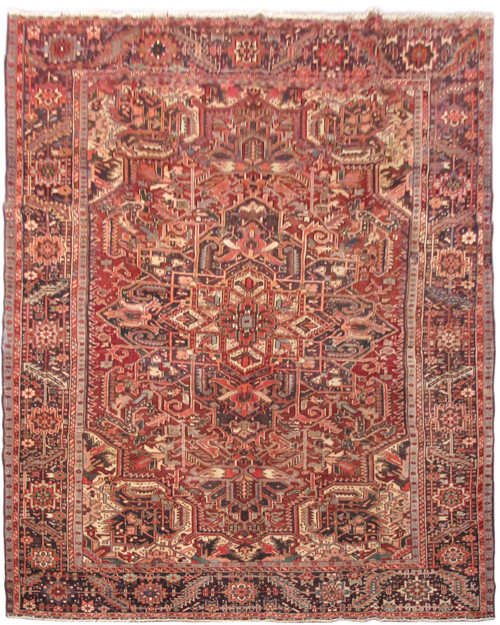
9'8" x 12'10" Persian Heriz Rug | Geometric Medallion | Deep Red with Ivory Spandrels | Excellent Condition
This is a full room size Persian Heriz, hand-knotted in wool on a cotton foundation and measuring 9'8" x 12'10". The pile stands at a firm 3/8", the handle is heavy and flat, and the wool still carries the dry mountain lustre that Heriz weaving is bought for. Every line in the field is drawn with a ruler and a compass of the eye rather than a curve, which is exactly what separates this village work from the city ateliers further south. It sits squarely in the most useful of all dimensions, and buyers shopping 10x13 Persian rugs will recognise how rarely a piece this size turns up in this condition. It ships with a certificate of authenticity confirming origin, material and hand-knotted construction.
Design and Motifs
The centre carries an 8 point ivory star medallion set inside a stepped and serrated frame, with a small blue rosette at the exact middle. Four ivory cartouches, each filled with hooked scrollwork, sit at the medallion corners, and long anchor palmettes reach north and south along the vertical axis. Above and below the medallion two hexagonal pendants in navy and ivory break up the open red ground. The corner spandrels are drawn in ivory with heavy serrated leaves, angular vine hooks and small stepped rosettes, and they cut into the field far enough to leave a clear red reserve around the centre. The main border is an almost black ground carrying a repeat of diamond rosettes and angular turtle palmettes, flanked by narrow reciprocal guard stripes. It is textbook drawing for geometric Persian rugs, with every element built from straight segments and steps rather than flowing curves.
The Color Palette
The field is a deep saturated red that pulls toward burgundy in the pile direction and toward brick where the light hits the tips, the sort of tone that anchors red and burgundy Persian rugs without turning orange. Against it the main border reads almost black, a very dark indigo brown that frames the whole composition and makes the ivory work jump forward. The ivory itself is a warm unbleached cream, used for the star medallion, the four corner cartouches and the spandrels, and it is outlined in the same near black so the shapes stay crisp. Mid blue and slate blue appear in small doses inside the palmettes, the hexagon pendants and the border rosettes, and there are quieter touches of olive khaki and soft grey green in the leaf work and the spandrel infill. A few flecks of dark aubergine and rust sit in the smaller field ornaments. The back photograph shows the same reds, indigos and camel browns running clean through the knot, with no painted or tipped color.
Heriz Weaving in Northwest Persia
Heriz is a cluster of villages east of Tabriz, on the slopes below Mount Sabalan in northwest Persia. The water there is mineral rich, and the sheep grazing those pastures grow a wool that is famously tough and high in lanolin, which is why a Heriz can spend fifty years under a dining table and still hold its pile. Weavers work from memory rather than a cartoon, which is why the medallion here is drawn in straight steps and why the two halves of the field are close but never identical. Village Heriz work usually runs under 200 knots per square inch, and the knot count is not the point: the value sits in the wool, the vegetal dyes and the density of the beat-down, all visible in the back of this piece where the rows sit tight and even. The weight, the flat handle and the unworn 3/8" pile put this one at the strong end of what comes out of that district.
9'8" x 12'10" Persian Heriz Rug | Geometric Medallion | Deep Red with Ivory Spandrels | Excellent Condition
Ask about this rug
This piece is the only one of it, so the things worth knowing about it are particular to it. If you want to talk through the size, the colour in your own light, or the weave, speak to someone here first.