Watch the film
| Size in ft: | Width: 9'8" x Length: 12'7" |
| Size in Inch: | Width: 116" x Length: 151" |
| Size in meters: | Length: 3.84 x Width: 2.95 m |
| Colors: | Burgundy, Blue, Green |
| Shape: | Rectangular |
| Woven: | Hand-Knotted |
| Pile: | Wool |
| Origin: | Persia |
| Design: | Zirkhaki Kashmar |
| Age: | 1980's |
| Condition: | Excellent- Perfect |
9'8" x 12'7" Persian Kashmar Rug | Zirkhaki Vase & Bird Design | 1980s | Excellent Pile
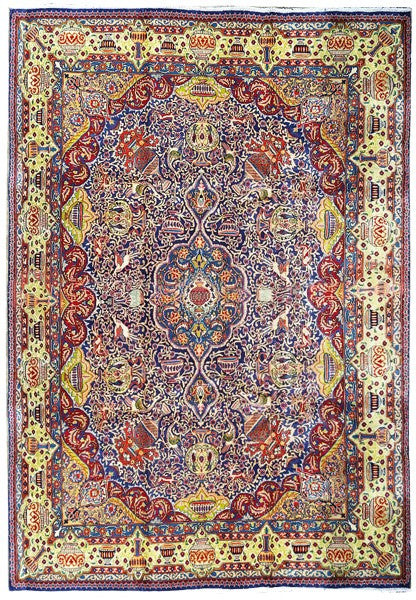
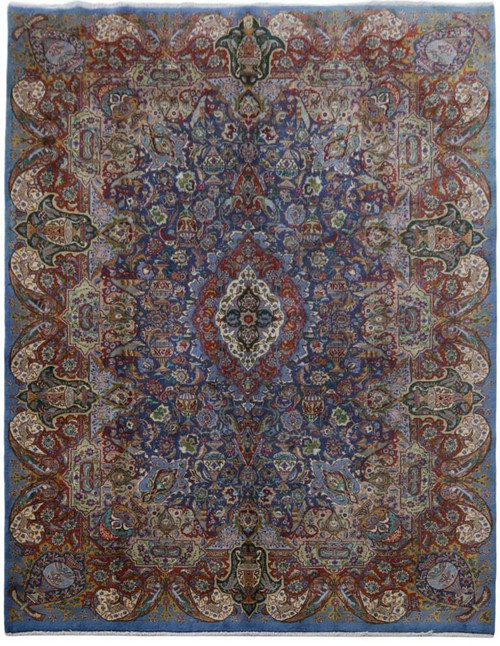
Kashmar weavers in Khorasan built their reputation on crowded, story-telling fields, and this 9'8" x 12'7" piece from the 1980s is a full example of that habit. The burgundy ground is packed with drawn vases, ewers, footed bowls, birds and small inscribed panels, all orbiting a compact ivory and cobalt medallion, and the wool pile is still thick and even with no thin spots or restoration. It ships with a certificate of authenticity. At this footprint it sits in the same class as our 10x13 Persian rugs, covering a full seating group or a 8 chair dining table with pull-back room.
Design and Motifs
The drawing is the Zirkhaki Kashmar formula: an antiquarian field of collected objects rather than a simple flower garden. A small pointed medallion in ivory, cobalt and rust orange sits at center, capped top and bottom by lobed pendants, and around it the weaver has scattered at least 6 different vessel types, from tall bottle-neck vases and handled ewers to shallow footed bowls, each filled or flanked by blossoming stems. Rectangular panels of stylised calligraphy float between them, a device Kashmar borrowed from tile work. The 4 corners carry deep blue spandrels holding pairs of long-legged white birds among pink blossoms, and the navy main border alternates orange lozenge cartouches with arrowhead palmettes, fenced by ivory guard stripes of scrolling vine. Nothing repeats mechanically; small shifts in the vessel drawing show the cartoon was worked by hand.
Burgundy Field, Indigo Border and the Olive Undertone
The field is a true burgundy, a deep madder red that reads cooler and darker than a Kashan red and gives the pale motifs room to sit forward. Against it the border is indigo navy, nearly black where the pile turns, so the rug frames itself hard at the edge. The blues are the real interest here and run through 3 clear registers: inky navy in the outlines, a bright cobalt in the corner spandrels, and a soft sky blue inside the vases and rosettes. Olive green appears as a fine outline color along vines and leaf tips, which is what keeps all that red and blue from going flat, and it carries into the greenish grey of the medallion ground. Ivory does the linework, rust orange lights the cartouches and medallion arms, and small hits of rose pink, aubergine and soft peach show up in the blossoms. Colors are strong and clean with no bleeding and no sun fade.
Kashmar, Khorasan, and How It Was Woven
Kashmar is a town in Khorasan, southwest of Mashad in the northeast corner of Persia, and it weaves within the Khorasan group, sharing cartoons, wool supply and market with Persian Mashad rugs. The region's fleece is long-stapled and high in lanolin, which is why the pile on this rug still has a wet shine after 40 years and why the nap springs back under the hand. Construction is the standard Khorasan workshop build: asymmetric Persian knot on a cotton warp and weft, a medium-fine weave that holds the curved vine and the small lettering panels, and a pile clipped at a moderate height so the drawing stays legible without losing weight. The back shows tidy, regular knot rows and straight selvages, the sign of a piece woven on a proper workshop loom rather than a village frame. If you want the wider background on the tradition, the Persian Mashad and Khorasan weaving guide covers how these looms work.
9'8" x 12'7" Persian Kashmar Rug | Zirkhaki Vase & Bird Design | 1980s | Excellent Pile
Ask about this rug
This piece is the only one of it, so the things worth knowing about it are particular to it. If you want to talk through the size, the colour in your own light, or the weave, speak to someone here first.