Watch the film
| Size in ft: | Width: 9'8" x Length: 13' |
| Size in Inch: | Width: 116" x Length: 156" |
| Size in meters: | Length: 3.96 x Width: 2.95 m |
| Colors: | Red, Navy Blue, Green, Ivory |
| Shape: | Rectangular |
| Woven: | 100% Hand-knotted | Handmade |
| Foundation: | Cotton |
| Pile: | |
| Age: | 1980's | Approx. 40 years old |
| Design: | Tabriz Floral Medallion | All Over Vine Field | Ivory Spandrels |
| Origin: | Persian Tabriz | Made in Persia |
| Condition: | Excellent | Ready to lay |
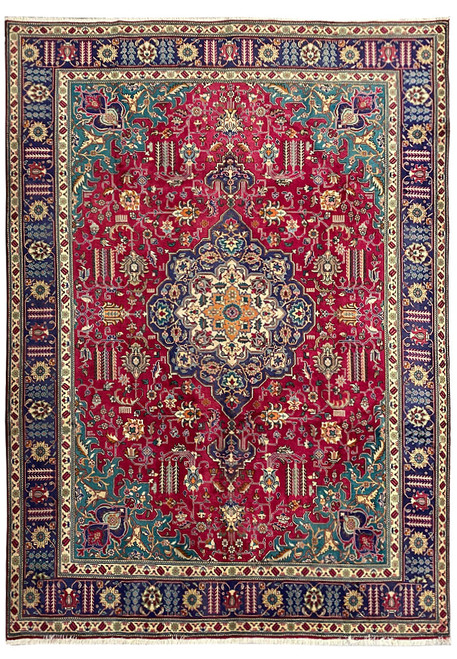
9'8" x 13' Persian Tabriz Rug | Navy Medallion on Raspberry Red Field | 1980s Hand-Knotted Wool
This 9'8" x 13' Persian Tabriz rug was hand-knotted in the 1980's on a cotton foundation with a wool pile, and it has the look that made Tabriz the best known weaving city in Persia: one commanding navy medallion anchored in a raspberry red field that keeps flowering right out to the ivory borders. At 116" by 156" it covers a full seating group or a 10 seat dining table without crowding the walls, and it sits comfortably among our 10x13 Persian rugs. The pile is even, the drawing is crisp from medallion to selvedge, and the condition is excellent with no repairs. Every rug we ship leaves Freeport with a certificate of authenticity recording origin, age, materials and exact measurements.
Please Note About the Photographs:
The first photograph was taken flat under studio lighting and reads brighter and pinker than the rug is in person. The showroom photographs that follow, shot on our floor in daylight, are the truer reading: a deep raspberry red field with ivory borders. Nothing in the pile has faded and nothing has been painted or touched up, and the rug is professionally steamed and pressed before it ships.
Design and Motifs
The center holds a lobed navy medallion built around an 8 petal rosette, ringed by ivory arabesque tracery and 4 small inset cartouches that each carry their own miniature flowering spray. Above and below it, 2 pendant finials in navy break into the field. What separates this piece from an ordinary medallion rug is that the field is not left open: a continuous vine system carries ivory and pale celadon palmettes, serrated saz leaves, carnations and rosettes across every inch of the red ground, with pairs of small birds perched in the vine scroll near the medallion. The 4 corners resolve into stepped ivory spandrels filled with vase and flower motifs in caramel brown and turquoise, drawn with the curved line Tabriz looms are built for. The main ivory border runs a cartouche and palmette rhythm in rose, navy and deep green, held between pale turquoise guard stripes and a fine meander inner band.
A Raspberry Red Field With Navy, Ivory and Teal Green
The field is a raspberry red that leans rose rather than brick, a softer tone than the tomato reds found on many red Persian rugs, and it photographs differently depending on the light: cooler and pinker from above, deeper and more wine toned at floor level. Against it the medallion reads as a dark slate navy with blue green undertones, and the ivory used for the borders and spandrels is a warm cream rather than a bleached white. The secondary palette is where the weaver had fun. Deep forest green and bright teal fill the leaves, pale celadon lightens the palmettes, rose pink picks out the flower heads, and a caramel brown runs through the corner vases and a few vine stems. Soft peach appears at the very heart of the medallion. The effect is rich but not heavy, and the cream borders keep the whole 116" width feeling open.
Tabriz Origin and Weaving Quality
Tabriz sits in the northwest of Persia and has woven commercially for longer than any other Persian city, which is why its workshops measure fineness in Raj, the number of knots counted across a gereh of about 2.75 in of width. The wool here is the tough, slightly lustrous highland fleece the region is known for, spun firm and knotted on a cotton warp, which is why a rug of this age still stands with a level pile and tight, straight edges. The drawing tells you it came off a workshop loom rather than a village one: the medallion is symmetrical, the vine scroll repeats without wandering, and the border cartouches turn each corner cleanly, all of which take a paper cartoon and a master at the loom. A 1980's date puts it in the semi antique bracket, old enough for the dyes to have mellowed and for the wool to have taken on a natural sheen, and if you want to understand how weavers, dealers and collectors read these clues, our guide on how to date an oriental rug walks through the same evidence.
9'8" x 13' Persian Tabriz Rug | Navy Medallion on Raspberry Red Field | 1980s Hand-Knotted Wool
Ask about this rug
This piece is the only one of it, so the things worth knowing about it are particular to it. If you want to talk through the size, the colour in your own light, or the weave, speak to someone here first.