Watch the film
| Size in ft: | Width: 6'7" x Length: 9'9" |
| Size in Inch: | Width: 79" x Length: 117" |
| Size in meters: | Length: 2.97 x Width: 2.01 m |
| Colors: | Red, Blue, Ivory, Green |
| Shape: | Rectangular |
| Woven: | 100% Hand-knotted | Handmade |
| Foundation: | Cotton |
| Pile: | |
| Age: | 1980's |
| Design: | Tabriz | Floral Medallion | All Over Vine Field |
| Origin: | Persian Tabriz | Made in Persia |
| Condition: | Excellent |
6'7" x 9'9" Persian Tabriz Rug | Red Field Floral Medallion | 1980s Hand-Knotted Wool
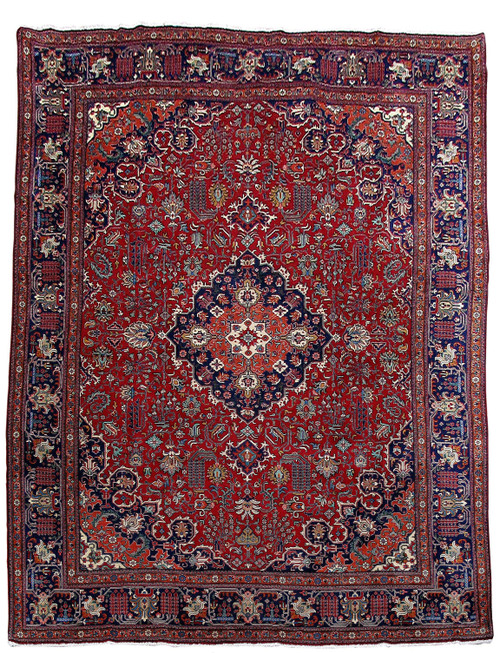
This is a hand-knotted Persian Tabriz from the 1980s, woven in wool on a cotton foundation and kept in excellent condition, with the pile still standing full and even from selvage to selvage. It is a classic town piece: a deep red field carrying an all-over flowering vine, a navy lobed medallion sitting slightly high of center, and ivory spandrels closing off the 4 corners. At 6'7" x 9'9" it sits squarely in the practical 7 x 10 Persian rug range, large enough to anchor a seating group with the front legs of the furniture on the wool. Every rug we sell ships with a certificate of authenticity recording the origin, age, materials and construction of the piece you receive.
Design and Motifs
The drawing is fully curvilinear, which is what separates a town Tabriz from village work. At the heart sits a navy medallion built from interlocking arabesque scrolls that coil back on themselves around a small rosette core, with a pale blue star shape at the very center and slender pendants reaching out toward each end of the field. Around it the red ground is filled edge to edge with a fine vine system: leafy stems, tiny 6 petal blossoms, half palmettes and buds worked so closely that no part of the field is left empty. The ivory spandrels in all 4 corners are drawn as large split leaf cartouches with sky blue palmettes and small ladder-hatched panels inside them, and their scalloped outlines give the field its lobed shape. The main navy border alternates rosettes and leafy sprays with pale medallion cartouches set at intervals, and it is framed on both sides by narrow guard stripes of running vine and by a fine sawtooth line that keeps the whole composition tight.
A Madder Red Field Framed in Indigo and Ivory
The field reads as a warm true red, closer to madder than to brick, and it holds its saturation right through the center of the rug where foot traffic would normally show first. Against it the medallion and the wide border are a deep indigo navy that reads almost black at a distance and opens up into blue under lamplight. The spandrels and the cartouches in the border are a soft undyed ivory with a faint cream cast, and that ivory is what gives the rug its light. Inside the pattern the palette widens: sky blue in the palmettes and the medallion core, sage and olive green through the leafwork, dusty rose and salmon pink in the smaller blossoms, and touches of camel and tan in the border medallions. The outer guard stripe carries a paler ground that steps the eye down from the dark border to the ivory fringe.
Woven in Tabriz, Northwest Persia
Tabriz sits in the northwest of Persia and has been the country's most organized weaving city for centuries, working from drawn cartoons on vertical looms and measuring fineness in Raj, the number of knots counted across a gereh of roughly 2.75 inches. That workshop discipline is visible here in the evenness of the knotting, the straight selvages and the way the vine repeats stay in register across the full 9'9" length. The wool of the region is tough and slightly lustrous, which is why Tabriz pieces of this period wear so well and why a 1980s rug can still show a full pile. If you want to understand how weavers, dealers and collectors date an Oriental rug, the combination of synthetic-free color behavior, cotton warp and the drawing style on this piece places it firmly in that decade.
6'7" x 9'9" Persian Tabriz Rug | Red Field Floral Medallion | 1980s Hand-Knotted Wool
Ask about this rug
This piece is the only one of it, so the things worth knowing about it are particular to it. If you want to talk through the size, the colour in your own light, or the weave, speak to someone here first.