Watch the film
| Size in ft: | Width: 9'9" x Length: 12'8" |
| Size in Inch: | Width: 117" x Length: 152" |
| Size in meters: | Length: 3.86 x Width: 2.97 m |
| Colors: | Blue, Red, Green, Ivory |
| Shape: | Rectangular |
| Woven: | 100% Hand-knotted | Handmade |
| Foundation: | Cotton |
| Pile: | |
| Age: | 1970's | Approx. 50 years old |
| Signature: | Woven cartouche in the lower border | Script not fully legible |
| Design: | Ancient Design | Central Medallion | Vase and Palmette Border |
| Origin: | Persian | Made in Persia |
| Condition: | Perfect | Full even pile |
9'9" x 12'8" Persian Rug | Ancient Medallion Design, Navy & Rose | Signed 1970s
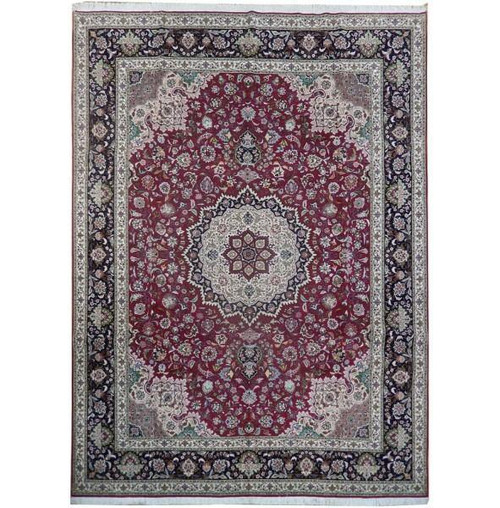
This is one of those room-size pieces that changes the temperature of a space the moment it goes down. The field is deep inky navy, the medallion burns rose and turquoise at the center, and the main border runs a warm coral red loaded with flowering vases. It was woven by hand in Persia in the 1970's, in wool on a cotton foundation, and the weaver put a signature cartouche into the lower border, which is something a village weaver almost never bothers to do. At 9'9" x 12'8" it sits squarely in the classic drawing room proportion, so if you are shopping 10x13 Persian rugs for a living room or a long dining table, this one covers the footprint without looking stretched. Every rug we ship leaves with a certificate of authenticity recording its size, materials, age and origin.
Please Note About the Photographs:
A few faint horizontal shadow lines cross the field in some of the gallery photographs. These are fold marks from pallet storage, not wear, not fading and not damage. They relax out once the rug is laid flat, and every rug is professionally steamed and pressed before it ships.
Design and Motifs
The drawing follows the old court formula and keeps every element where it belongs. At the center sits a small turquoise disc holding an 8 petal rosette, wrapped by a wide rose-red medallion ring that carries 8 lobed cartouches, each one filled with a tiny scripted panel or a footed vase. Above and below the medallion, twin pendant finials reach into the navy ground, and each corner of the field closes with a cream spandrel packed with palmettes, cypress sprays and curling cloudband leaves. The open navy between those anchors is never empty: split arabesque vines, serrated saz leaves, rosettes and small blossoming urns fill it edge to edge. The main border is the show piece, a coral red band alternating large navy vase medallions with paisley boteh and flowering stems, framed by ivory guard stripes of running vine. The lower border carries the woven cartouche. Count the corners and the spandrels and you will see the cartoon was resolved properly at all 4, which is the mark of a drawn design rather than a copied one.
A Palette of Navy, Rose Red and Turquoise
The base is a saturated midnight navy blue, dark enough that it reads almost black in low light and opens into true indigo under a lamp. Against it the weaver ran a whole ladder of reds: the coral tomato red of the main border, a deeper rose red through the medallion ring, and flashes of hot magenta in the palmettes and border blossoms. Turquoise does the lifting, appearing as the medallion disc, as small leaf tips, as cartouche fills and as pale blue-green outlines that keep the dense drawing readable. Ivory and soft sand tones carry the spandrels and the guard stripes, so the corners feel lighter than the center and the eye travels inward. Olive and moss green sit in the vine work, with a few soft browns and a touch of gold in the vases. It is a busy palette handled with control, and the abrash, the gentle tonal drift you can see across the navy ground, confirms that the yarns were dyed in small batches the traditional way.
Persian Weaving, Workshop Quality and Age
This is workshop weaving rather than village weaving. The back photograph shows straight, evenly spaced rows of knots with no lazy lines and no distortion, the kind of discipline you only get on a properly tensioned loom with an experienced weaver following a drawn cartoon. The curved lines in the medallion and the fine detail inside the border cartouches simply cannot be executed at a coarse knot count, so the density here is doing real work. The wool is local Persian fleece, springy and lustrous, cut to a 3/8" pile that has held its body after roughly 50 years of life, and the cotton warp and weft give the rug the flat, stable lie you want under furniture. The 1970's dating is consistent with the dyes, the wool handle and the signature convention; if you want to understand the evidence yourself, our guide on how to date an oriental rug walks through the same clues we used. The signed cartouche in the lower border is the detail collectors will care about most, because it ties the piece to a named hand.
9'9" x 12'8" Persian Rug | Ancient Medallion Design, Navy & Rose | Signed 1970s
Ask about this rug
This piece is the only one of it, so the things worth knowing about it are particular to it. If you want to talk through the size, the colour in your own light, or the weave, speak to someone here first.