Watch the film
| Size in ft: | Width: 9'9" x Length: 13'3" |
| Size in Inch: | Width: 117" x Length: 159" |
| Size in meters: | Length: 4.04 x Width: 2.97 m |
| Colors: | Rust, Blue, Green, Ivory |
| Shape: | Rectangular |
| Woven: | 100% Hand-knotted | Handmade |
| Foundation: | Cotton |
| Pile: | |
| KPSI: | 70 Raj | Approx. 500 |
| Age: | 2000's |
| Signature: | Signed | Woven cartouche in the outer guard band |
| Design: | Tabriz Medallion | Curvilinear floral field |
| Origin: | Persian Tabriz | Made in Persia |
| Condition: | Perfect |
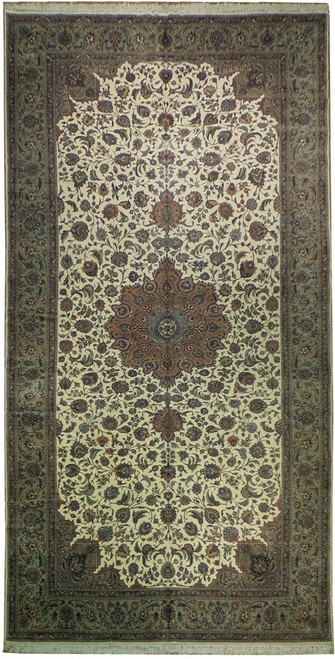
9'9" x 13'3" Persian Tabriz Rug | Signed 70 Raj Medallion | Approx. 500 KPSI
This is workshop weaving at the level where the drawing stops being decoration and starts being draftsmanship. Woven in the 2000s at 70 Raj, with a signature cartouche set into the ivory guard band at one end, the piece carries a fully curvilinear medallion design across a rust field, and the knot count is high enough that every vine tip, bird and rosette holds its outline instead of blurring into the ground. At 9'9" x 13'3" it sits squarely in the most useful room size in the house, and it is one of the finer pieces we stock among 10x13 Persian rugs. The pile is full, the fringe is original and untrimmed, and the rug ships with a certificate of authenticity documenting origin, materials and hand-knotted construction.
Please Note About the Photographs:
The first studio photograph was taken under strong overhead light and reads lighter and pinker than the rug actually is. The floor photographs on the parquet, and the close-up of the medallion, are the truest record of the colour: a deep rust field with a genuine terracotta weight to it. Nothing about the rug has faded or changed, it is simply the lighting in the first frame.
Design and Motifs
The centre is a navy starburst medallion with 16 lobes, each lobe filled with its own paisley and palmette, radiating out from an ivory core. Inside that core sits a pale salmon 8 petal rosette ringed by fine burgundy arabesque, the kind of layered centre that only draws correctly at this knot count. Slender pendants extend above and below the medallion, and 4 corners carry quartered spandrels on a pale rose ground, each filled with scrolling vine and blossom. The rust field between them is not left open: it is covered edge to edge with a symmetrical lattice of curling vines, cloudbands, cypress sprays, split palmettes and small bird figures tucked in among the leaves. The main border runs on light blue, alternating large rosette cartouches with dark navy paisley reserves, and it is fenced by ivory guard stripes drawn with grape clusters, urns and calligraphic scroll. Look at the close-up of the outer bands and you will find the woven cartouche itself, a small panel of script that marks this as a signed workshop commission rather than an anonymous production run.
A Rust Field Framed in Navy and Sky Blue
The field is a warm rust, closer to terracotta and old brick than to true red, and it shifts slightly with the nap so the rug looks softer walking one way and deeper walking the other. Against it the medallion and the paisley reserves are a dense midnight navy, almost black in the folds, which gives the design its structure and its depth. The main border breaks to a clear sky blue, and that single lighter band is what keeps the whole rug from reading heavy: it lifts the edge and lets the rust field sit inside a cool frame. Detail work brings in ivory and cream in the guard stripes and the medallion core, salmon and dusty pink in the rosettes, lavender in the grape clusters, and olive to sea green in the leaves and vine tips. Small touches of gold and soft brown appear in the scrollwork. It is a genuinely multi-coloured palette handled with restraint, warm enough for a room with wood floors and oil-rubbed woodwork, cool enough at the border to sit beside blue and grey upholstery.
Tabriz Weaving and What 70 Raj Means
Tabriz, in the northwest of Persia, has been the country's most commercially serious weaving city for centuries, and it is the place where the workshop system, the master designer and the Raj grading standard all come together. Raj counts the knots across one gereh, about 2.75 inches, of the rug's width. 40 Raj is ordinary commercial goods, 50 Raj is fine, 60 Raj is collector grade, and 70 Raj is the ceiling that only the best ateliers attempt, because a warp that tightly spaced demands top-grade wool, an expert loom setup and weavers who can hold the count across more than 13 feet of length without drifting. That fineness is exactly why this design works: curved vines, bird outlines and a 16 lobe medallion all need a small knot to stay legible. The cotton foundation keeps the rug flat and dimensionally stable, the tightly packed wool pile takes traffic well, and a signed 70 Raj Tabriz of this size is the sort of piece that stays in a family rather than getting replaced.
9'9" x 13'3" Persian Tabriz Rug | Signed 70 Raj Medallion | Approx. 500 KPSI
Ask about this rug
This piece is the only one of it, so the things worth knowing about it are particular to it. If you want to talk through the size, the colour in your own light, or the weave, speak to someone here first.