Herati Rugs
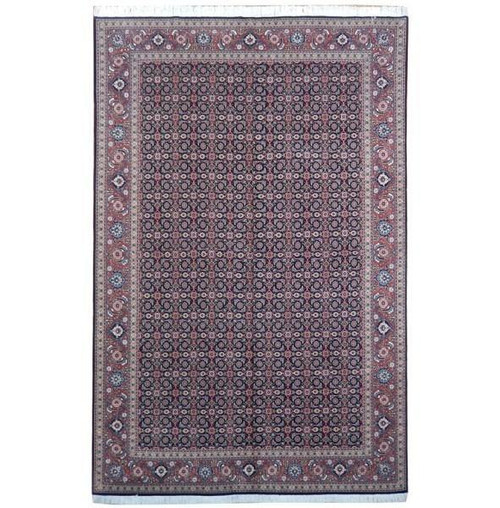
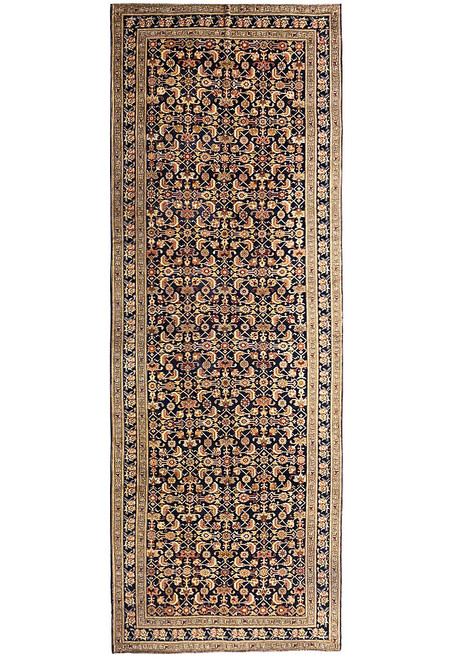
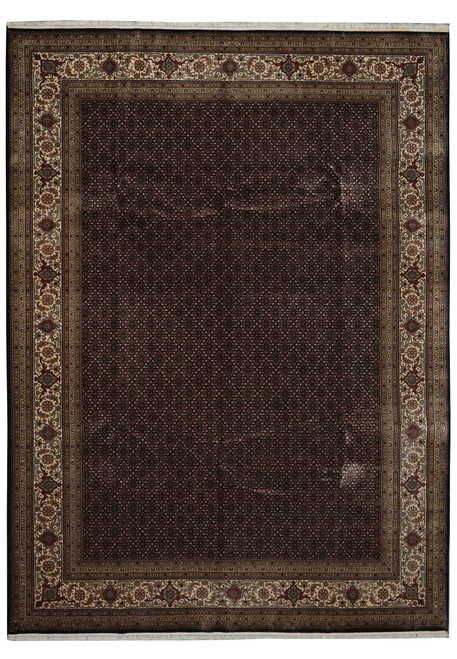
Herati is a pattern, not a town you can buy a rug from. It is a small rosette set inside a diamond, flanked by four curved leaves that face inward, repeated across the whole field. The trade also calls it the fish, or mahi. It is woven in Kurdistan, Khorasan, Azerbaijan and India, and the same drawing turns up in rugs that have nothing else in common.
What the pattern is made of
Four elements, always the same four. A rosette sits at the centre of a diamond lozenge. From the four corners of that lozenge, four long curved leaves arch outward, their points turned back toward the rosette. The lozenges interlock into a lattice, so the field has no centre and no edge and can be extended in any direction until the rug runs out. Around it, more often than not, sits the border the trade calls the turtle, a row of broad palmettes that reads as a shell from a distance. Anyone browsing rug designs will meet this combination more than any other in Persian weaving.
Why anyone says fish
Somebody a long time ago looked at four curved lanceolate leaves circling a flower and saw fish circling a pond. Persian calls a rug drawn this way mahi-dar, with fish, and the English trade shortened it to the fish pattern. There are no fish in it. The leaves are leaves, and the name has outlived every attempt to correct it.
The name comes from Herat
The pattern is named for Herat in western Afghanistan and is traditionally associated with Safavid-period weaving there, which is a convention of attribution rather than a documented birthplace. What is not in doubt is how far it spread. By the nineteenth century it was standard from Kurdistan to Khorasan, and it has since been drawn in India, Pakistan and China. A rug being Herati says nothing at all about where it was made.
One pattern, twelve different hands
This is the useful part, because the drawing changes completely from place to place. Tabriz draws it small, round and dense, usually under a floating medallion, and calls it Mahi. Bijar draws it large and heavy, the leaves like ironwork laid over the ground. Senneh draws it minutely on a thin flat pile, the finest version of the repeat anywhere. Hamadan village looms draw it blunt and cheerful on a single weft. Moud and other Khorasan weaving sets it in fine wool on an ivory ground. Indian workshops reproduce all of the above. Put six Herati rugs side by side and the pattern is the only thing they share.
Colour, and what the ground does
The two standard grounds are indigo navy and madder red, with ivory the usual third choice and the one that makes the lattice most legible. On navy the repeat reads as texture until you stand over it, which is either restraint or a waste of fine drawing depending on the room and the light it gets.
What an all-over field does underfoot
No open ground means no place for a walked path to show. Incident is spread evenly across the whole field, so the line people actually take through a room disappears into the pattern, and so does a good deal of ordinary domestic mess. Among traditional layouts this is the most forgiving one there is, and it is the reason Herati fields ended up in hallways, dining rooms and everywhere else that gets used rather than admired.
When not to choose it
A Herati field needs fineness to work. The pattern lives on the curve of those four leaves, and at a coarse knot count the leaves collapse into blobs and the lattice turns to porridge. A coarse geometric rug is honest, a coarse Herati is a failed attempt at something else. It is also a pattern that never stops talking. If the floor is meant to be the quiet surface in a room that is already busy, the answer is a plain or nearly plain field, a Gabbeh or a large simple geometric piece such as a Kazak, not the most densely worked repeat in Persian weaving.