Watch the film
| Size in ft: | Width: 10'3" x Length: 14'3" |
| Size in Inch: | Width: 123" x Length: 171" |
| Size in meters: | Length: 4.34 x Width: 3.12 m |
| Colors: | Reddish-Brown, Muted Brown, Deep Red, Soft Brown, Light Blue, Ivory, Navy Blue, Olive Green |
| Shape: | Rectangular |
| Woven: | 100% Hand-knotted | Handmade |
| Foundation: | 100% Cotton |
| Pile: | |
| Age: | 1970's | Approx. 50 years old |
| Design: | Heriz | Geometric medallion with ivory spandrels |
| Origin: | Persian Heriz | Made in Persia |
| Condition: | Excellent | Full even pile |
10'3" x 14'3" Persian Heriz Rug | Ivory Spandrels & Light Blue Medallion | 1970s
This is a full-size village Heriz from the 1970s, hand-knotted in the mountain villages northwest of Tabriz on a cotton foundation with a heavy hand-spun wool pile. At 10'3" x 14'3" it belongs with the true 10x14 Persian rugs, a room-defining format that carries a large sofa group or a 10 chair table without the furniture crowding the border. The pile is deep and even across the full field, the selvedges are intact and the ivory cotton fringe is original, which is why it is graded excellent. Every rug we sell ships with a certificate of authenticity recording origin, age, materials and measurements.
Please Note About the Photographs:
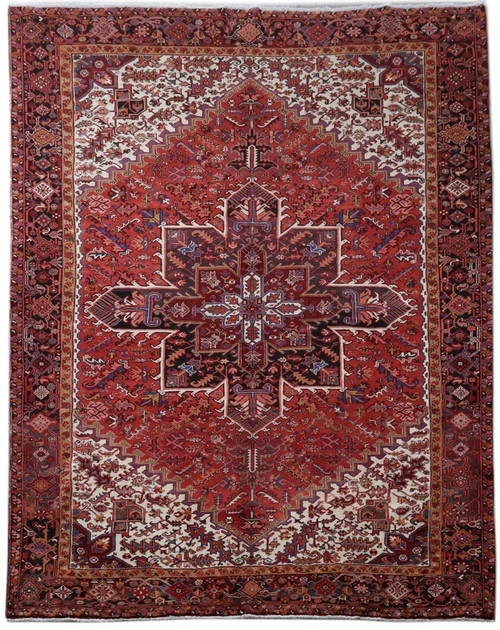
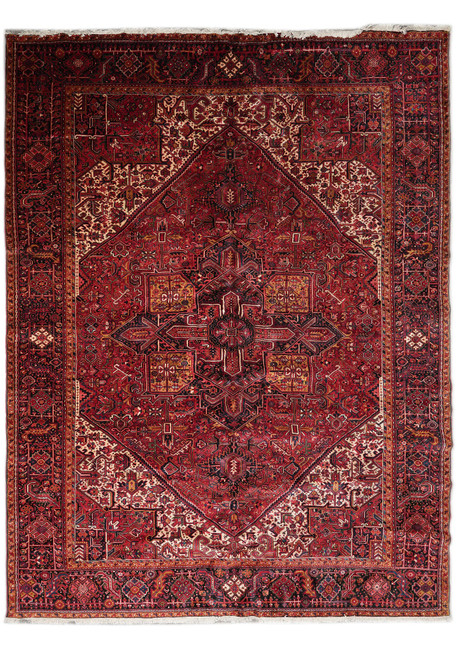
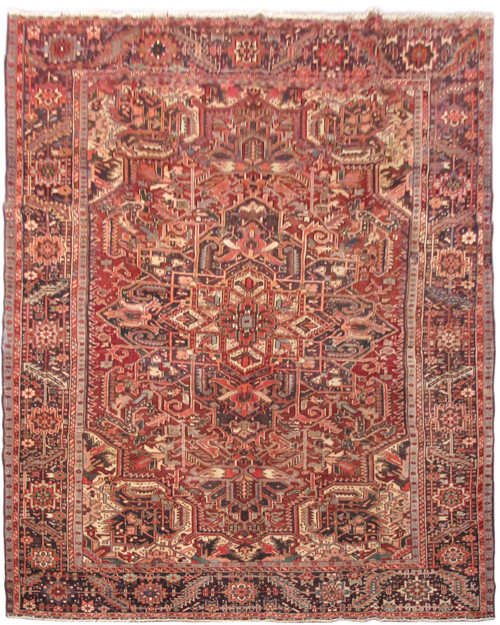
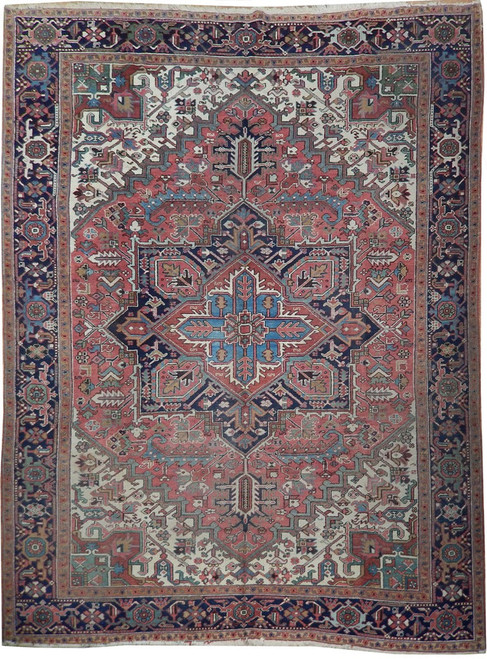
The overhead shots were taken under warmer indoor light and read deeper and browner, while the angled and close-up photos were taken in daylight and show the brighter terracotta red, the ivory corners and the light blue of the medallion. This is a difference in lighting between cameras, not fading, wear or damage. The detail images are the truest guide to the color in person.
Design and Motifs
The drawing is classic Heriz: everything is built from straight lines, stepped edges and sharp angles rather than curved vine work. At the center sits a large stepped medallion in light blue and salmon, filled with small leaf sprays and finished with a single ivory 8 petal rosette at the very heart. Anchor pendants run off the medallion top and bottom, and the 4 corners are filled with big ivory spandrels drawn in the same angular vocabulary, packed with hooked vines, serrated leaves and small cruciform devices. The deep red field between them is never left empty, with angular palmettes, blossom heads and little animal-like hooks scattered edge to edge. The main border carries a navy ground with alternating rosette cartouches and diamond stars, framed by narrow gold and red guard stripes. Buyers who like this hard-edged village drawing should look at the wider selection of geometric Persian rugs.
A Deep Red Field With Light Blue and Ivory Relief
The field is a deep red that shifts toward reddish-brown and soft terracotta depending on the light and the direction of the pile, exactly the abrash you want to see in hand-spun, vegetable-dyed village wool. Against it, the light blue of the medallion and the pale sky blue fills inside the spandrels do the cooling work, keeping a rug this size from reading heavy. Ivory and cream carry the 4 corners and the small tendrils inside the field, muted brown and olive green shade the leafwork and the outer ground of the inner guard band, and a warm gold stripe separates the border from the field. The main border is dark navy, close to black in low light, which frames the whole piece and gives the red field a hard edge. Soft brown and a dusty rose appear through the border cartouches. The overall palette is warm and lived-in rather than bright, and it sits comfortably on oak, walnut and stone floors.
Heriz Weaving and Why These Rugs Survive
Heriz is a district of villages east of Tabriz, on the slopes below Mount Sabalan in northwest Persia. The water there is rich in minerals and the local sheep grow a famously tough, high-lanolin fleece, which is the real reason a Heriz outlives most other rugs on the floor: the wool resists crushing and the dirt brushes out of it. Weavers work from memory and from a village cartoon rather than a court drawing, so the knot count stays moderate, generally under 200 knots per square inch, and the design is simplified into bold angular shapes that read well from across a room. This example shows that tradition at its healthiest, with a thick pile, a heavy handle and strong original ends. The 1970s date puts it in the semi-antique bracket, and if you want to understand how weavers, wear and materials place a piece in time, our guide on how to date an Oriental rug walks through the same signals we used here.
10'3" x 14'3" Persian Heriz Rug | Ivory Spandrels & Light Blue Medallion | 1970s
Ask about this rug
This piece is the only one of it, so the things worth knowing about it are particular to it. If you want to talk through the size, the colour in your own light, or the weave, speak to someone here first.