Watch the film
| Size in ft: | Width: 11'2" x Length: 14'7" |
| Size in Inch: | Width: 134" x Length: 175" |
| Size in meters: | Length: 4.44 x Width: 3.40 m |
| Colors: | Brick Red, Blue, Ivory, Black, Brown, Olive |
| Shape: | Rectangular |
| Woven: | 100% Hand-knotted | Handmade |
| Foundation: | Cotton |
| Pile: | |
| Age: | 1970's |
| Design: | Heriz | Stepped Geometric Medallion | Ivory Corner Spandrels |
| Origin: | Persian Heriz | Made in Persia |
| Condition: | Excellent | Full even pile |
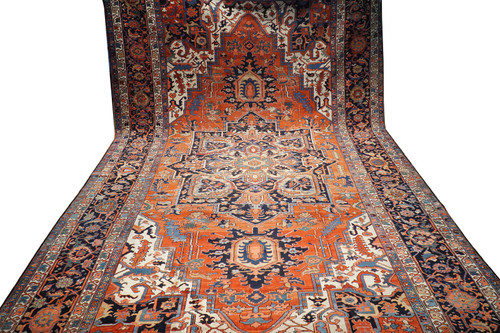
11'2" x 14'7" Persian Heriz Rug | Stepped Medallion, Ivory Spandrels | 1970s, Excellent Condition
This 11'2" x 14'7" Heriz was knotted in the 1970s in the village district east of Tabriz, and it is the sort of piece a large room gets arranged around rather than decorated with. A brick red field holds one stepped medallion at center, ivory spandrels open out into all 4 corners, and a wide black-navy main border carries the whole thing to the edge. The pile is the tough local Heriz wool on a cotton foundation, and after roughly 50 years of life it is still full, even and glossy, with clean selvages and original ends. Anyone comparing oversize Persian rugs at this scale will notice how few of them survive with their pile intact. Every rug we sell ships with a certificate of authenticity.
Design and Motifs
The drawing is pure village Heriz: straight lines, angled turns and stepped outlines rather than curved vine work. The medallion is a hooked, cross-armed star flanked by 2 anchor pendants top and bottom, with 4 gold cartouches set into its arms and a small dark rosette at the exact center. Around it the field is packed with serrated leaves, hooked brackets, small rosettes and angular blossoms, none of them repeating quite exactly, which is the signature of a rug drawn from memory rather than a cartoon. The ivory spandrels reverse that logic, putting red and navy motifs on a pale ground for immediate contrast. The main border runs a rhythm of 8 petal rosettes and lobed palmettes on near-black navy, edged by gold and ivory guard stripes. It reads as a textbook example of geometric Persian rug design.
A Field of Brick Red Against Navy and Ivory
The field is a deep brick red that shifts in the light, drifting toward tomato and soft rose in some passes and toward a darker burgundy in others, the natural abrash of hand-dyed wool worked in small lots. Against it the ivory spandrels read almost cream, warmed slightly where the wool has aged. The main border is a black-leaning navy that anchors the outer edge, with a lighter cornflower blue used sparingly inside rosettes and leaf tips. Olive and camel gold appear in the medallion cartouches, the outer guard stripe and scattered blossoms, while brown and true black outline the larger motifs and keep the geometry crisp. Salmon pink flickers through the border flowers. Anyone building a room around red and burgundy Persian rugs will find this palette warm rather than loud.
Heriz Weaving in Northwest Persia
Heriz is a cluster of villages east of Tabriz on the slopes below Mount Sabalan. The water there runs through mineral-rich rock, and the local sheep grow a fleece that is famously hard-wearing, which is why Heriz rugs have a reputation for outlasting the houses they are bought for. Weavers work on a stout cotton foundation with a heavier knot than the city workshops, so village Heriz weaving usually lands under 200 knots per square inch by design, trading fineness for structure and long life. The angular drawing here, the stepped medallion and the confident 4 corner spandrels all point to a well-run village loom working in the classic 1970s manner, and the wear pattern, dye behavior and finishing are consistent with that period. If you want to understand how weavers, dealers and collectors date an Oriental rug, this piece is a useful study.
11'2" x 14'7" Persian Heriz Rug | Stepped Medallion, Ivory Spandrels | 1970s, Excellent Condition
Ask about this rug
This piece is the only one of it, so the things worth knowing about it are particular to it. If you want to talk through the size, the colour in your own light, or the weave, speak to someone here first.