Watch the film
| Size in ft: | Width: 10'7" x Length: 11'6" |
| Size in Inch: | Width: 127" x Length: 138" |
| Size in meters: | Length: 3.51 x Width: 3.23 m |
| Colors: | Light Brown, Terracotta, Blue |
| Shape: | Rectangular |
| Woven: | Hand-Knotted |
| Pile: | Wool |
| Origin: | Turkey |
| Design: | Antique Sparta |
| Age: | 1950's |
| Condition: | Excellent |
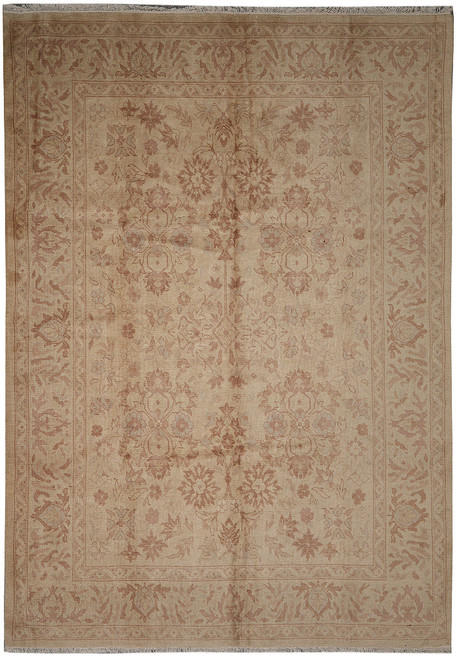
10'7" x 11'6" Turkish Sparta Rug | All-Over Cypress & Floral Design | 1950s Estate Piece
Sparta rugs from the 1950s in this condition do not come out of estates often, and almost never in a near-square 10'7" x 11'6" format. The field is a warm light brown that the weavers built from lightly heathered wool, and across it runs an all-over drawing of slender cypress trees, flowering branches and rosette sprays in slate blue, terracotta and deep oxblood. The pile is full, the ends and selvages are original, and the wool still carries the soft sheen that western Turkish flocks are known for. Every rug we ship leaves Freeport with a certificate of authenticity recording its origin, materials, age and exact measurements, so what is written here follows the piece to your floor. If you have been comparing a Turkish weave against other traditions, our guide to what makes an Oriental rug distinct is a useful place to start.
Please Note About the Photographs:
A few of the close-up photographs show faint horizontal lines running across the pile. Those are fold marks from years of flat storage, not wear, not fade and not damage. They relax once the rug is opened out on the floor, and every rug is professionally steamed and pressed before it ships.
Design and Motifs
There is no medallion here. The weaver chose an all-over design that repeats in vertical columns: tall narrow cypress forms filled with latch-hook and knotwork, upright flowering trees hung with 8 petal rosettes, and arched weeping-willow fans that spread sideways between them. Small hooked crosses, tiny bird-like leaf sprigs and paired blossom cups fill the ground between the larger figures, so the field stays busy without ever looking crowded. The main border is a wide slate blue band carrying a meandering vine of clustered berry rosettes and angular palmettes, framed on both sides by terracotta guard stripes and an outer reciprocal zigzag in oxblood. Corners are resolved by hand rather than mechanically repeated, and the little drawing variations from one tree to the next are the clearest sign you are looking at a hand-knotted village piece and not a printed copy. The near-square proportion means the pattern reads the same from every seat in the room.
A Soft Palette of Light Brown, Terracotta and Blue
The ground is light brown with a copper cast, closer to camel and dried apricot than to red, and it shifts gently under changing light because the wool was dyed in small lots. Over that sit two families of color: terracotta and salmon in the flowering trees, the arched fans and the guard stripes, and a cool range of blues running from soft dove blue-grey through to a dark teal used for the outlines and the tiny leaf flecks. Deep oxblood brown draws the stems, the trunks and the outer zigzag, which gives the whole surface its definition. The main border reads as a muted grey-blue against the warmer field, an unusual contrast that keeps this rug from feeling like the usual red-and-navy formula. Ivory appears only in small highlights inside the border blossoms. The overall effect is warm, dusty and low-contrast, which is exactly why these estate pieces work so well with walnut, brass, linen and painted plaster walls.
Sparta: Weaving Quality in Western Turkey
Sparta, the town of Isparta in southwestern Turkey, became a serious carpet-weaving center in the late 19th century and kept working through the middle of the 20th, weaving large room-size pieces for European and American houses in a softer, more open drawing style than its neighbors. The wool from that region is long-stapled and takes dye with a quiet glow rather than a hard shine, and the weave is a firm, even single-weft construction on a cotton foundation that holds a big square format flat without buckling. This example dates to the 1950s, and the way the pile has burnished, the softening of the dyes and the honey tone of the original fringe all support that reading; our guide on how to date an Oriental rug walks through the same clues. Seventy years on, the pile is still full from edge to edge, which says as much about the weaver as it does about the family that kept it.
10'7" x 11'6" Turkish Sparta Rug | All-Over Cypress & Floral Design | 1950s Estate Piece
Ask about this rug
This piece is the only one of it, so the things worth knowing about it are particular to it. If you want to talk through the size, the colour in your own light, or the weave, speak to someone here first.