| Size in ft: | Width: 10'8" x Length: 13'10" |
| Size in Inch: | Width: 128" x Length: 166" |
| Size in meters: | Length: 4.22 x Width: 3.25 m |
| Colors: | Rust Coral, Beige, Blue |
| Shape: | Rectangular |
| Woven: | 100% Hand-knotted | Handmade |
| Foundation: | Cotton |
| Pile: | |
| Age: | 1930's | Antique |
| Design: | Antique Mahal | Open Field | Small Diamond Medallion |
| Origin: | Persian Mahal | Made in Persia |
| Condition: | Very Good | Low pile in some areas |
10'8" x 13'10" Persian Mahal Rug | Open Rust Coral Field with Small Diamond Medallion | 1930s Antique
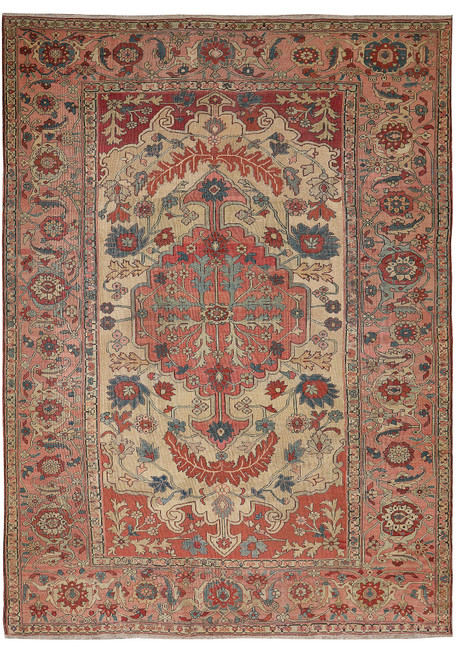
Antique Mahals that were left almost entirely open are the ones decorators fight over, and this 1930s piece is exactly that rug: a vast rust coral field carrying nothing but a single small diamond medallion, wrapped in a camel gold border full of rosettes and palmettes. It measures 10'8" x 13'10", hand-knotted in wool on a cotton foundation, with roughly 90 years of honest use behind it. The pile has worn low in places and the field has settled into the soft, uneven tonality that only real age and natural dyes produce. Among 10x14 antique Persian rugs this one stands out for how quiet it is, and every rug we sell ships with a certificate of authenticity documenting origin, materials and age.
Please Note About the Photographs:
This is a genuine antique in very good but not perfect condition. The paler streaks and patches you see across the field are low pile and abrash, the natural colour variation of hand-dyed wool, not damage or staining. The rug lies flat, is fully intact edge to edge, and is professionally cleaned, steamed and pressed before it leaves our warehouse. Photographed under warehouse lighting, the field reads anywhere from terracotta to salmon depending on the angle.
Design and Motifs
The drawing is village work of the most confident kind. A single small diamond medallion sits at the centre, no more than 18 inches across, outlined in ivory with a jagged latch-hook fringe and filled with a dark indigo ground carrying miniature red, green and blue flowerheads. Around it, nothing: the field is left completely open, with only a serrated ivory sawtooth line marking where it meets the border and stepped corner spandrels closing off the 4 corners. That restraint is what gives the rug its scale. The main border runs on a camel gold ground with alternating rosettes and palmettes, some set in coral cartouches, others in soft rose and sky blue, joined by angular vinework and small serrated leaves. Narrow guard stripes on either side carry a repeating cross-flower on pale blue, and a dark brown outer band with a small vine finishes the edge. Every element is drawn in straight, deliberate lines rather than the curved court style, which is exactly what you want from a Mahal.
A Field of Rust Coral, Terracotta and Abrash
Colour is the whole argument for this rug. The field is a warm rust coral that shifts horizontally in wide bands, deepening to brick and copper toward the lower end and lightening to a sun-washed salmon and apricot through the centre, the classic abrash of madder dyed wool taken from different dye lots. Against that, the border reads camel gold to wheat beige, a genuinely light frame that lifts the whole piece rather than boxing it in. The floral work inside the border brings in indigo, a bright sky blue, muted teal green, coral red, ivory and a faded rose that has aged beautifully. The medallion adds the only true dark note, a near black indigo ground with pinpoints of crimson and green. In a room with white walls and oak floors the field reads terracotta and warm; under lamplight in the evening it goes deeper and redder.
Mahal Weaving in the Sultanabad District
Mahal rugs come from the cluster of villages around Mahallat and Sultanabad in the Arak region of central Persia, the district that supplied the Western export trade from the late 19th century onward. These were never fine-knotted city pieces, and they were never meant to be. Their reputation rests on wool quality, natural dyes and bold large-scale drawing, woven on the heavy cotton foundations that let them be made room size and larger without distortion. The wool from this region is long-stapled and lanolin-rich, which is why the pile on a 90 year old Mahal like this one still has lustre where it has worn low rather than going dry and brittle. The weave here is even, the selvages original and the ends secure, all consistent with 1930s production; if you want to understand the clues that place a piece in a decade, our guide on how to date an antique Oriental rug walks through them. At 10'8" x 13'10" this covers a full dining or living room with margin to spare.
10'8" x 13'10" Persian Mahal Rug | Open Rust Coral Field with Small Diamond Medallion | 1930s Antique
Ask about this rug
This piece is the only one of it, so the things worth knowing about it are particular to it. If you want to talk through the size, the colour in your own light, or the weave, speak to someone here first.