Watch the film
| Size in ft: | Width: 10' x Length: 13'1" |
| Size in Inch: | Width: 120" x Length: 157" |
| Size in meters: | Length: 3.99 x Width: 3.05 m |
| Colors: | Olive Green, Red, Blue |
| Shape: | Rectangular |
| Woven: | 100% Hand-knotted | Handmade |
| Foundation: | Cotton |
| Pile: | 3/8" Wool |
| Design: | Floral Medallion | All-Over Vine and Palmette |
| Origin: | Persian Tabriz | Made in Persia |
| Condition: | Excellent |
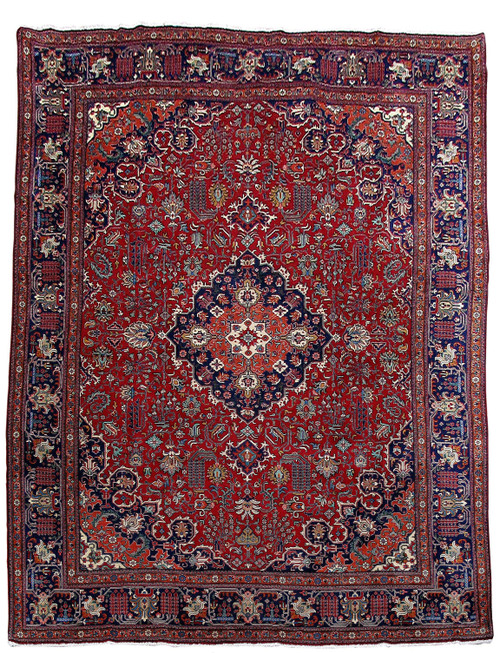
10' x 13'1" Persian Tabriz Rug | Olive Green Field, Navy Star Medallion | Excellent Condition
An olive green ground is the rarest thing about this rug. Tabriz weavers built their reputation on red and ivory, so a field dyed to this soft sage olive was a deliberate choice, and it changes the whole temperament of the piece: quieter, warmer, easier to live with than the usual crimson. At 10' x 13'1" it is a true room size, one of the most useful proportions in 10x13 Persian rugs, hand-knotted in fine wool on a cotton foundation with a 3/8" pile that still stands full and even across the field. The condition is excellent, the sides and ends are original, and the back photograph shows a tight, regular knot with the drawing reading as crisply from the reverse as it does from the face. Every rug we sell ships with a certificate of authenticity.
Design and Motifs
The center holds a deep navy star medallion, its 16 points stepping outward over a terracotta inner rosette that itself frames a small ivory 8 petal flower. Slender navy pendants drop above and below it, each one a lobed cartouche filled with tiny blossoms. Around that core the field runs as a continuous all-over composition rather than an empty ground: paired curled leaves, palmettes opening like fans, single rose heads, buds on thin stems and long serrated saz leaves that sweep in mirrored pairs toward the corners. The drawing is curvilinear throughout, with no straight lines anywhere in the field, which is the mark of a cartoon drawn by a city designer rather than a village weaver working from memory. The main border carries alternating palmettes and rosettes on a red ground, linked by a scrolling vine, and is framed on both edges by narrow guard stripes of small flowerheads on navy and ivory. The corners resolve cleanly, a detail worth checking on any Tabriz, because a well resolved corner is proof the cartoon was followed properly to the end.
A Rare Olive Green Field Against Red and Navy
The field is a muted olive green with a grey-gold cast, closer to dried sage or moss than to a saturated green, and it shifts noticeably with the nap: walk one way and it warms toward khaki, walk the other and it cools toward soft celadon. Against it the ornament is drawn in a full range of tones. The medallion and the smaller cartouches are a deep indigo navy, nearly black in the shadows. The main border is a clear tomato red, the brightest note in the rug and the element that gives it its frame. Inside the florals you will find terracotta and apricot, dusty rose, pale salmon pink, cream and ivory, several distinct greens from teal to a dark bottle tone, and a warm chocolate brown that outlines many of the leaves. Small touches of red repeat through the field as single rose heads, tying the border color back into the center. The whole palette is soft rather than loud, which is why this rug sits comfortably with both antique wood furniture and contemporary upholstery.
Tabriz Weaving in Northwest Persia
Tabriz sits in the northwest of Persia, high on the Azerbaijan plateau, and has been the country's most organized weaving city for centuries. Tabriz masters measure fineness by Raj, the number of knots counted across a gereh of about 2.75 inches, and a house working at this level produces the tight, upright pile and precise outlining you can see in the close-up photographs. The city is also where the workshop system was perfected: a designer draws the cartoon, a dyer manages the wool, and the weavers work to the plan knot by knot, which is why Tabriz florals hold their curves and their symmetry across a piece this large. The wool here is dense and slightly lustrous, the cotton foundation keeps the rug flat and square, and the 3/8" pile has enough body to take traffic for decades without thinning. Explore more Persian Tabriz rugs to see how varied the city's output can be, then come back to this one for the color.
10' x 13'1" Persian Tabriz Rug | Olive Green Field, Navy Star Medallion | Excellent Condition
Ask about this rug
This piece is the only one of it, so the things worth knowing about it are particular to it. If you want to talk through the size, the colour in your own light, or the weave, speak to someone here first.