Watch the film
| Size in ft: | Width: 10' x Length: 13' |
| Size in Inch: | Width: 120" x Length: 156" |
| Size in meters: | Length: 3.96 x Width: 3.05 m |
| Colors: | Deep Red, Navy Blue, Sky Blue, Ivory, Gold, Camel |
| Shape: | Rectangular |
| Woven: | 100% Hand-knotted | Handmade |
| Foundation: | Cotton Foundation |
| Pile: | |
| Age: | 1980s |
| Design: | Traditional | Central Medallion | All-over Floral Field |
| Origin: | |
| Condition: | Excellent | Full even pile |
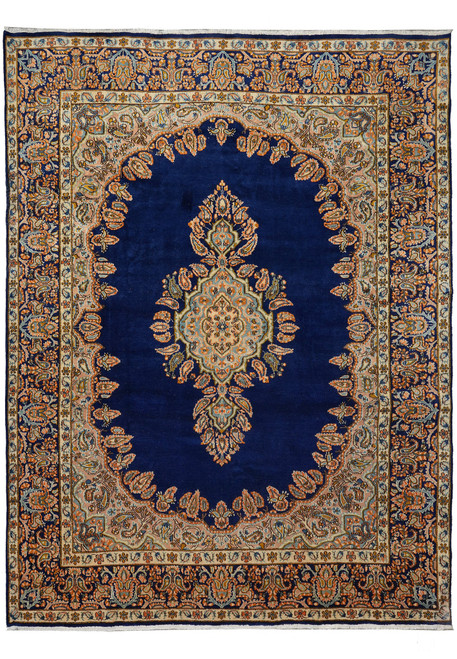
10' x 13' Persian Rug | Deep Red Field with Navy Medallion | 1980s Wool, Excellent Condition
Laid out flat, this 10' x 13' Persian rug reads as one continuous garden. A deep red ground carries hundreds of small flowering stems, a dark indigo medallion anchors the exact center, and four matching cornerpieces close the field off against a navy main border. It was hand-knotted in wool on a cotton foundation in the 1980s and has been kept in excellent condition, with the 3/8" pile still full and even from selvage to selvage and both ends finished in clean ivory fringe. Room-filling 10x13 Persian rugs in this classic medallion format are the format most buyers want under a full seating group or a long dining table, and this one ships with a certificate of authenticity documenting its handmade Persian origin.
Design and Motifs
The medallion is a lobed oval outlined in a thin yellow-gold line, filled with a wreath of camel and rose palmettes turning around a pale sky blue rosette at the dead center, with slim pendants rising and dropping from its top and bottom points. Around it the red field is drawn all over: palmettes, serrated saz leaves, curling paisleys, small eight petal rosettes and tulip heads strung along a fine vine scroll, packed closely enough that the ground behaves like a lattice rather than open space. The 4 cornerpieces repeat the navy of the medallion and carry the same vocabulary at larger scale, so the eye reads a single composition rather than separate parts. The main border is navy as well, with a procession of big palmettes and flowerheads linked by a gold vine, and it is flanked on both sides by light blue guard stripes of meandering blossoms plus a narrow reciprocal line that keeps the whole frame crisp.
A Deep Red Ground Framed in Indigo and Sky Blue
The field red is deep and slightly wine-toned, not a bright pillar-box red, and it shifts as the light moves across the wool because the pile has that soft sheen good lambswool keeps. Against it the navy is nearly black in the shadows and resolves into true indigo in the close-up photographs, which is what gives the medallion and cornerpieces their weight. Everything in between is the interest: dusty rose, sage and olive green, camel, soft brown, gold-yellow on the vinework, ivory highlights on individual leaves, and a pale sky blue that appears in the rosette at the medallion core and again in the guard stripes and in scattered flowerheads across the field. That sky blue is the color that keeps the palette from going heavy, and it is the reason a red and navy rug of this size still feels lively in a bright room.
Persian Workshop Weaving and Quality
This is city-workshop weaving, not village work. Curved line drawing of this kind, where a vine can sweep through a quarter turn without breaking into steps, only comes off the loom cleanly at a high knot count on a taut cotton foundation, and the folded corner shows exactly that: rows sitting straight and tight, the pattern reading almost as sharply from the back as from the face. The wool is soft-handed and has taken the natural-toned dyes evenly, with no abrash breaks across a 13 foot length, which tells you the yarn was dyed in one large lot for the whole commission. Woven in the 1980s and never put into heavy service, it sits in the sweet spot collectors look for, old enough to have settled and mellowed but with decades of pile left; if you want to understand how weavers, dealers and appraisers date an Oriental rug, the structure and dye behavior on this piece are a textbook example.
10' x 13' Persian Rug | Deep Red Field with Navy Medallion | 1980s Wool, Excellent Condition
Ask about this rug
This piece is the only one of it, so the things worth knowing about it are particular to it. If you want to talk through the size, the colour in your own light, or the weave, speak to someone here first.