


Watch the film
| Size in ft: | Width: 10' x Length: 14'5" |
| Size in Inch: | Width: 120" x Length: 173" |
| Size in meters: | Length: 4.39 x Width: 3.05 m |
| Colors: | Multi, Navy, Teal Blue, Ivory, Sage Green, Peach, Gold |
| Shape: | Rectangular |
| Woven: | 100% Hand-knotted | Handmade |
| Foundation: | 100% Cotton |
| Pile: | |
| Signature: | Woven cartouche in the center medallion and border guard |
| Design: | Traditional | Diamond Lattice Panel Field | Center Medallion |
| Origin: | Made in Pakistan |
| Condition: | Excellent | Full even pile |
10' x 14'5" Pakistani Oriental Rug | Diamond Lattice Panel Design | Signed Medallion Cartouche
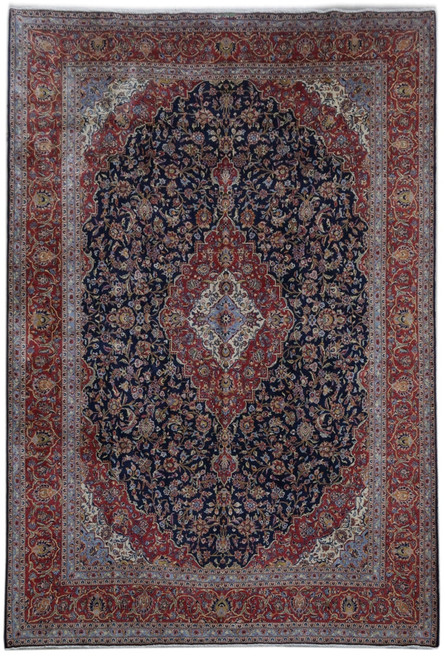
This is a full room-size piece at 10' x 14'5", hand-knotted knot by knot on a cotton foundation with a fine wool pile clipped low enough that the drawing stays crisp from across the room. The field is laid out as a diamond lattice of compartments, each one holding its own flowering plant, and the whole composition gathers into a teal and navy medallion with a small woven cartouche set at the very center. It is exactly the kind of tightly drawn traditional Oriental rug that reads formal without reading heavy, and among 10x14 Oriental rugs the panel layout is unusually well balanced for the length. Condition is excellent, with full even pile and clean flat-woven ends, and it ships with a certificate of authenticity.
Please Note About the Photographs:
The flat studio photograph reads darker and cooler than the rug is in person. The showroom floor images, shot in daylight on parquet, are the accurate reference for the soft sage green, teal blue and peach tones. The medallion closeup shows the true depth of the blue.
Design and Motifs
The field is divided by fine slanting lines into rows of diamond compartments, and no two neighbors repeat the same filling: some carry a single flowering shrub, some a slender tree with drooping branches, others a dense scatter of blossoms and curling leaves. Alternating panels sit on near-black grounds and their neighbors on ivory and sage, which gives the lattice a checkerboard rhythm before you ever notice the individual flowers. At the center sits a lobed teal medallion ringed in scrolling vine, and inside it a small ivory oval holds the woven cartouche and a sprigged tree. The 4 corners answer the medallion with dark spandrels of matching vinework. The main border is a deep navy band of palmettes and leafy scrolls, flanked by a taupe strip of paired leaf forms and by narrow guard stripes of small rosettes, with the second woven inscription tucked discreetly into one guard along the end.
A Multi-Color Palette Built on Navy, Teal and Ivory
The anchor color is a very deep navy, close to black in the border and in the alternating field panels, and it is what makes everything laid over it glow. Against that ground the weaver worked a clear teal blue through the medallion and its surrounding vines, a warm ivory in the panel grounds and the inner oval, and a muted celadon sage that carries most of the foliage. Softer accents appear throughout: dusty peach and salmon in the diagonal lattice lines and in the larger blossoms, a khaki gold in the border leafwork, a pale taupe in the secondary border band, and small touches of olive and dove grey in the leaf tips. The overall read is multi-color but restrained, cool rather than hot, which is why it settles easily into rooms with grey, greige, blue or soft green walls instead of demanding a red-based scheme. The cotton fringe and the flat ivory ends frame all of it cleanly.
Hand-Knotted in Pakistan
Pakistan's workshop weavers have spent generations building a reputation for fine, disciplined knotting of classical medallion and panel designs, and this piece is a good example of that tradition at the upper end. The ruler photograph shows the knot line running tight and regular across the border, with the curved vine and the small rosettes resolving cleanly rather than stepping, which only happens at a genuinely fine knot count. The wool is well spun and tightly packed on a cotton foundation, the selvedges are firm, and the low clip means the pattern will keep its definition under real furniture and real traffic. Anyone shopping room-size hand-knotted Oriental rugs should handle the back of a piece like this one, where the density and the evenness of the rows tell you more than any photograph of the front.
10' x 14'5" Pakistani Oriental Rug | Diamond Lattice Panel Design | Signed Medallion Cartouche
Ask about this rug
This piece is the only one of it, so the things worth knowing about it are particular to it. If you want to talk through the size, the colour in your own light, or the weave, speak to someone here first.
Related rugs
-

-

-
-

12 x 14'5 Oriental Ziglar Rug
$6,600.00 -
