Watch the film
| Size in ft: | Width: 11'3" x Length: 16' |
| Size in Inch: | Width: 135" x Length: 192" |
| Size in meters: | Length: 4.88 x Width: 3.43 m |
| Colors: | Beige, Ivory, Cobalt Blue, Navy, Salmon, Rose, Olive Green, Charcoal |
| Shape: | Rectangular |
| Woven: | 100% Hand-knotted | Handmade |
| Foundation: | Cotton |
| Pile: | |
| Age: | 1980s | Approx. 40 years old |
| Design: | Heriz | Geometric medallion | Blue corner spandrels |
| Origin: | Persian Heriz | Made in Persia |
| Condition: | Excellent | Full even pile |
11'3" x 16' Persian Heriz Rug | Ivory Field, Cobalt Corner Spandrels | 1980s Oversize
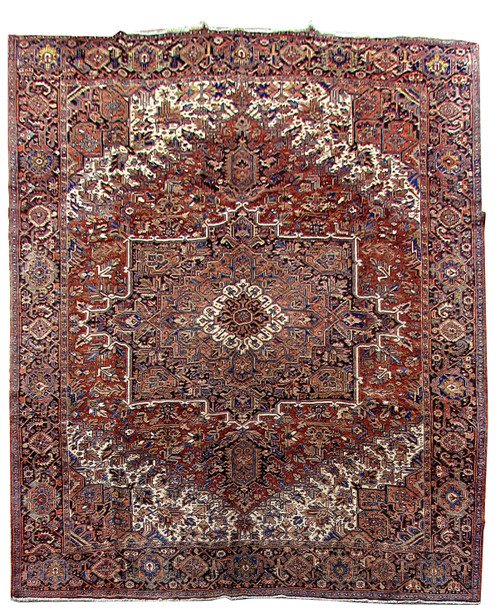
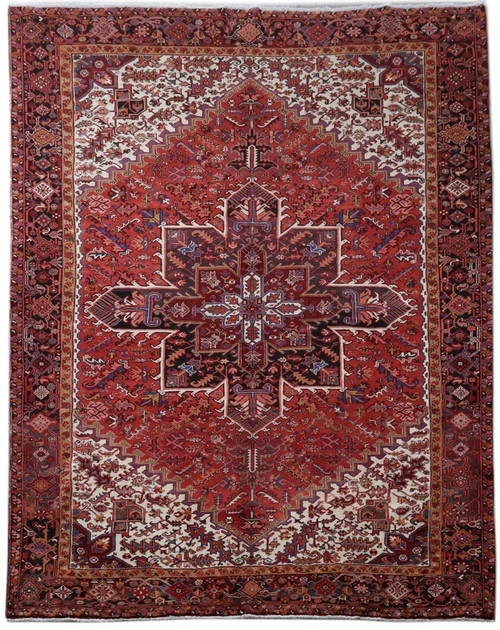
This is an unusually refined Heriz, and the first thing a dealer notices is the field. Instead of the familiar brick red ground, the weaver laid the whole 11'3" x 16' center in ivory and warm beige and reserved deep cobalt blue for the four corner spandrels, which turns the normal Heriz contrast inside out. The drawing is finer than village Heriz work usually runs, the wool is glossy and full across the entire pile, and the rug has kept its shape and its selvedges after roughly 40 years. At this scale it belongs in a great room, a long formal dining room or a double-height entry, and it sits comfortably alongside the best oversize Persian rugs we import. Every rug we sell ships with a certificate of authenticity confirming the origin, the materials and the hand-knotted construction.
Please Note About the Photographs:
The first overhead photograph was shot under warm studio light and reads more golden than the rug actually is. The on-floor and close-up images are the truer record: the field is a soft ivory and beige, the corners a clear cobalt blue, and the medallion a muted sage green. Colors on screen always shift with lighting, so judge the palette from the detail shots.
Design and Motifs
A large diamond-shaped medallion fills the center of the field, built up in layers: a sage green core with a burgundy and ivory star at its heart, a salmon surround lobed with curled ivory scrollwork, and four charcoal anchor medallions extending north and south along the long axis. Serrated leaves, hooked palmettes and small stylized blossoms run in strict mirror symmetry through the ivory ground, drawn with more curve and more small detail than the blunt, straight-line convention of ordinary village weaving, which places this squarely among the better geometric Persian rugs of its period. The cobalt spandrels carry their own coral and olive palmette sprays with ivory leaf tips. Framing it all is a wide beige main border of linked rosettes and cartouches, flanked by a blue floral minor stripe and an outer navy guard band of small red and cream blossoms.
A Pastel Palette Built on Ivory and Cobalt
The ground moves between ivory and a soft wheat beige depending on how the light catches the pile, and against it the four cobalt blue corners read almost electric in the close-up photographs. Between those two poles sits a genuinely pastel range: dusty salmon and rose through the medallion frame and the main border, olive and moss green in the leaf work, teal accents in the pendant cartouches, and a deep charcoal that is nearly black in the anchor medallions and the fine outline drawing. Small touches of brick red, cream and true green appear in the border blossoms. The dyes have aged into one another the way good wool dyes do, with gentle abrash visible across the blue field, so nothing in the palette looks flat or printed.
Heriz Weaving in Northwest Persia
Heriz is a cluster of weaving villages east of Tabriz, on the slopes below Mount Sabalan, where the mineral-rich water is credited with producing wool of exceptional toughness and shine. That wool is why Heriz rugs are the workhorses of the Persian trade: they take generations of traffic and keep their pile. Most village Heriz weaving runs under 200 knots per square inch, so a piece drawn as finely as this one, on a firm cotton foundation with tightly packed wool pile and a full 16 foot length, represents the upper end of what the district produced. The 1980s date shows in the wool quality and in the soft-toned dye range typical of that decade, and the construction details, from the flat-woven ends to the hand-tied fringe, line up with the standard markers used to date an Oriental rug.
11'3" x 16' Persian Heriz Rug | Ivory Field, Cobalt Corner Spandrels | 1980s Oversize
Ask about this rug
This piece is the only one of it, so the things worth knowing about it are particular to it. If you want to talk through the size, the colour in your own light, or the weave, speak to someone here first.