Watch the film
| Size in ft: | Width: 12'9" x Length: 21' |
| Size in Inch: | Width: 153" x Length: 252" |
| Size in meters: | Length: 6.40 x Width: 3.89 m |
| Colors: | Mahogany Red, Blue, Olive |
| Shape: | Rectangular |
| Woven: | 100% Hand-knotted | Handmade |
| Foundation: | Cotton |
| Pile: | |
| Age: | 1930's | Antique |
| Design: | Sarouk | All-over floral sprays and vases |
| Origin: | Persian Kashan | Made in Persia |
| Condition: | Excellent |
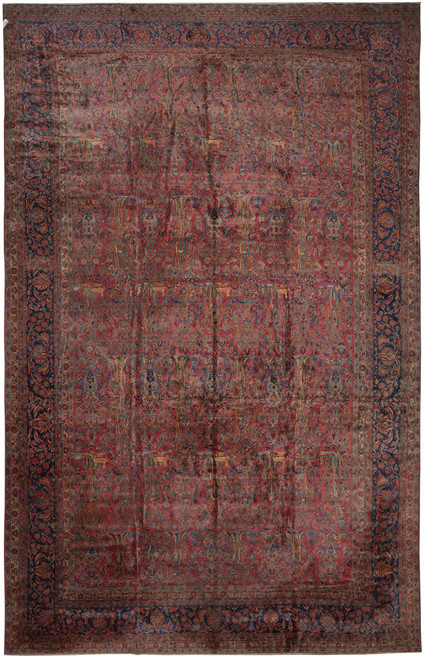
12'9" x 21' Persian Kashan Rug | Antique All-Over Sarouk Design | 1930s Manchester Wool
This is a true 1930s piece, nearly a century old, and it has kept the one thing that matters most in antique Persian Kashan rugs: an even, unbroken mahogany red across 12'9" x 21' of field, with no abrash streaks, no patch repairs and no thin spots. The pile is Manchester wool, the soft long-staple merino that Kashan workshops imported and spun for their best production in this period, and you can feel it in the way the surface takes light from a low angle. At 268 square feet it belongs with the oversize Persian rugs built for great rooms, long formal dining rooms and hotel lobbies, and it ships free anywhere in the 50 states with a certificate of authenticity documenting origin, age, materials and hand-knotted construction.
Design and Motifs
There is no medallion here. The field is drawn in the classic Sarouk manner, a repeating lattice of detached flowering sprays set in staggered rows so the eye keeps moving instead of settling on one center. Look closely and the vocabulary is rich: footed vases holding fans of blossom, large serrated palmettes, curling acanthus leaves, small rosettes, slender cypress and willow forms, and tiny birds perched among the stems. A tall boteh cartouche repeats down the center line of the field. The main border is a deep indigo ground carrying an alternating march of upright flowering plants and broad palmettes, held between narrow reciprocal guard stripes of vine and rosette. Both the field repeat and the border rhythm are cleanly resolved at all 4 corners, which is a drawing test that separates workshop weaving from village copies.
The Mahogany Red, Indigo and Olive Palette
The ground reads as a warm mahogany red with a raspberry cast in direct light, a shade that has mellowed with age rather than faded, and it stays consistent from one end of the 21' length to the other. Against it, the floral work is drawn mostly in midnight indigo and a softer sky blue, so the sprays sit visually forward of the field. Olive and sage green fill the leaves and give the whole surface a slightly antique, muted cast instead of a hard contrast. Saffron gold and apricot pick out the vase bodies, the small birds and the seed heads, and ivory appears only in the thin guard stripes and the outer selvage line, which is where it does the most work framing the composition. The dark indigo border anchors the red and makes the rug read grounded rather than floating in a large room.
Kashan Weaving and Manchester Wool
Kashan sits in central Persia north of Isfahan and carries a weaving tradition that goes back to the Safavid court workshops, which is why its rugs are the ones people picture when they picture a Persian rug. When you watch Shark Tank there is a Persian Kashan on the floor. The city built its modern reputation in the early 20th century on finely spun Manchester wool, a symmetrical knot worked at close gauge on a cotton foundation, and drawing that keeps curved lines truly curved across a piece this wide. The back photo shows the weave: tight, regular rows with the design legible from behind, which is the honest way to read an antique. For anyone trying to place a rug like this in time, the wool type, the palette and the border drawing all point to the interwar decades, and our guide on how to date an Oriental rug walks through the same clues we used on this one.
12'9" x 21' Persian Kashan Rug | Antique All-Over Sarouk Design | 1930s Manchester Wool
Ask about this rug
This piece is the only one of it, so the things worth knowing about it are particular to it. If you want to talk through the size, the colour in your own light, or the weave, speak to someone here first.