Watch the film
| Size in ft: | Width: 13' x Length: 20'2" |
| Size in Inch: | Width: 156" x Length: 242" |
| Size in meters: | Length: 6.15 x Width: 3.96 m |
| Colors: | Light Natural |
| Shape: | Rectangular |
| Woven: | Hand-Knotted |
| Pile: | Fine Wool |
| Origin: | Pakistan |
| Design: | Oushak |
| Age: | New |
| Condition: | Perfect |
13' x 20'2" Oushak Rug | Light Natural Ivory Field with Taupe & Gold Borders | Hand-Knotted Fine Wool
At 13' x 20'2" this is a room-defining piece, hand-knotted in fine wool on a cotton foundation and drawn in the Oushak manner: a pale field, wide open spacing, and an all-over pattern that never crowds itself. The wool has the slightly uneven, hand-spun character that makes a light ground interesting rather than flat, and the pile takes light differently as you walk around it, shifting from warm cream to cool greige. Pieces at this scale are made to order and rarely sit in stock, and few oversize hand-knotted rugs come in a palette this quiet. It is brand new, never used, in perfect condition, and ships with a certificate of authenticity.
Design and Motifs
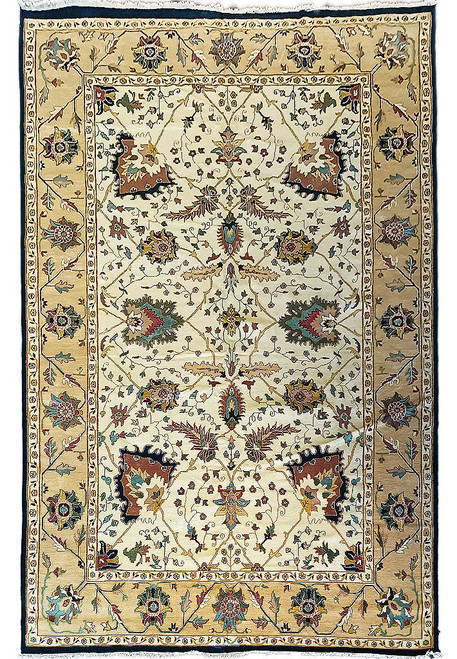
The field is an all-over Oushak design built from long curving vines that travel corner to corner, hung with broad angular palmettes, split leaves, stepped crosses and small square rosettes. Two large motifs anchor the centre line: a slate blue octagonal rosette with a cross-form heart, and a horned palmette in grey with an ivory outline that reads almost like a tribal emblem. Around them the drawing loosens deliberately, with single blossoms, forked leaves and small cruciform sprigs floating in the open ground. The border system runs three deep, a wide taupe main band carrying rosettes, hooked crosses, birds and pendant cartouches, framed inside and out by soft gold guard stripes filled with a running reciprocal vine. Corners resolve cleanly rather than being cut short, which is the mark of a well-managed cartoon at this width.
A Light Natural Palette of Ivory, Taupe and Soft Rust
The ground is light natural, an ivory that leans greige where the wool abrashes, so the surface never looks bleached or uniform. The main border sits a shade or two darker in warm taupe grey, and the guard stripes and many of the field blossoms are a soft camel gold that gives the whole rug its warmth. Accents are used sparingly and to real effect: muted rust and terracotta on the vine stems and a handful of small squares, slate blue grey on the two large motifs and several leaves, pale sage green tucked into blossom centres, and chalk ivory on the border birds and cartouches. Nothing is saturated, and there is no black anywhere in the rug, which is why it settles into pale oak, limestone, linen and plaster rooms without competing with them.
Oushak Design, Woven in Pakistan
The Oushak vocabulary comes from western Anatolia, where large-format weavings with pale grounds and generous drawing were made for palaces and grand halls. This piece was hand-knotted in Pakistan, which is where a great deal of the world's best contemporary hand-knotted work in this style is done today, on wide upright looms with the experienced teams and hand-spun wool that a 13' x 20'2" commission requires. The weave is even across the full width, the selvedges are hand-finished, and the pile is clipped medium-low so the drawing stays crisp. If you are weighing this against a formal court design, our guide to what separates a Persian rug from a broader Oriental rug is worth a read before you decide.
13' x 20'2" Oushak Rug | Light Natural Ivory Field with Taupe & Gold Borders | Hand-Knotted Fine Wool
Ask about this rug
This piece is the only one of it, so the things worth knowing about it are particular to it. If you want to talk through the size, the colour in your own light, or the weave, speak to someone here first.