| Size in ft: | Width: 16'2" x Length: 26'8" |
| Size in Inch: | Width: 194" x Length: 320" |
| Size in meters: | Length: 8.13 x Width: 4.93 m |
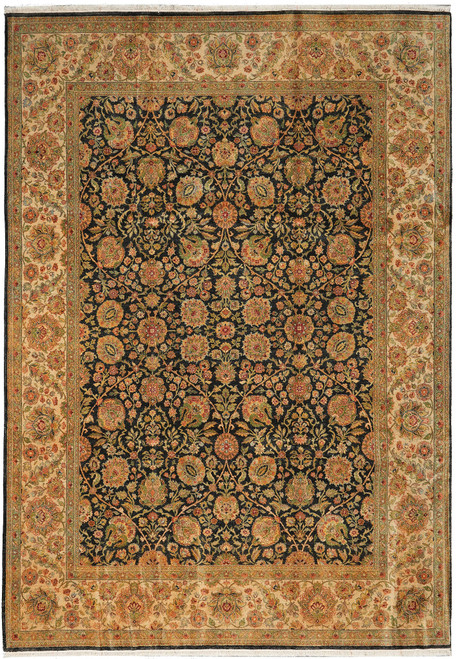
| Colors: | The Primary Colors Of This Rug Are A Range Of Dark To Medium Tan Brown With Mustard Hues, Which Provide The Backdrop For The Detailed Patterns. The Border Features A Deep Black That Frames The Rug, Accentuating The Intricate Designs In The Central Area. |
| Shape: | Rectangular |
| Woven: | Hand-Knotted |
| Origin: | India |
| Design: | Jaipour |
| Condition: | Excellent- Rug Is One Of The Largest Handmade Rugs In The World. You Will Not Find A Rug Of This Size And Quality Anywhere. |
16'2" x 26'8" Jaipur Oriental Rug | Tan Brown & Mustard All Over Floral | Black Border | Palace Size
Very few looms in the world are built wide enough to weave a rug 16'2" x 26'8", which is roughly 431 square feet of hand-knotted wool in one continuous piece. This Jaipur design fills that scale the way a palace piece should, with an all over floral field in tan brown and mustard gold that carries the eye the full length of the rug and a deep black border heavy enough to hold the whole composition together. Photographs 1 and 14 show how evenly the drawing repeats across a span this long, which is the hardest thing to achieve on a loom of this width. It arrives in excellent condition with a full pile, tightly bound sides and original hand-tied fringe, and ships with a certificate of authenticity confirming it as a genuine hand-knotted rug. Buyers shopping oversize hand-knotted rugs know how rarely anything past 20 feet long comes up at all, and rarer still in this quality of wool.
Please Note About the Photographs:
This field shifts noticeably with the light. Under studio lighting it photographs as a golden olive, while in warm indoor light the tan brown and mustard tones come forward, as in images 1, 9 and 10. Every photograph here is of this exact rug, and the close-up shots were taken on our warehouse floor, so anything visible in the background is the room, not the rug.
Design and Motifs
There is no central medallion here. Instead the weavers used a classic all over floral design, a continuous lattice of thin vine scroll that links lotus palmettes, split leaves, serrated rosettes and small budded sprays in a mirrored repeat running the length of the field. Look closely at images 15 and 16 and you can pick out the signature touches: palmettes filled with tiny gold lattice squares on an ivory ground, pinecone forms shaded from rose into brown, and slender feathery leaves outlined in a single dark line. The main border reverses the scheme entirely, setting large open palmettes and eight petal rosettes on solid black, with a sage and gold vine guard stripe on each side and a stepped reciprocal minor band at the outer edge, visible in the corner detail of image 13. It is drawing in the Mughal floral tradition that Jaipur workshops have carried forward, and on a rug this long the repeat never drifts out of register.
Tan Brown, Mustard Gold and a Deep Black Frame
The field is built from a range of dark to medium tan brown warmed through with mustard, and because the wool was dyed in batches there is a gentle abrash across the ground that keeps 431 square feet of one color from ever looking flat. Against that backdrop the weavers placed rose pink, apricot and saffron orange blossoms, soft sage green leaves, cream and ivory highlights, and fine brown outlines that give the flowers their edge. The border is a true deep black, near ink, and it is what makes the field glow: every gold and rose motif in the main band reads brighter for sitting on that dark ground, as the low angle shot in image 8 shows. The guard stripes bring in a muted celadon and olive that bridges the black back to the field, and the ivory cotton fringe finishes both ends cleanly. It is a warm, low contrast palette that works in wood panelled rooms and under gold or brass lighting.
Jaipur Weaving and the Making of a Palace Size Rug
Jaipur, in Rajasthan, is one of the great weaving centers of northern India, and India is where most of the world's best contemporary hand-knotted work is now made. We say that with no hedging: the wool sorting, the vegetal and low impact dyeing, and the drawing standards in the top Jaipur workshops are as good as anything being woven today, which is exactly why a fine Oriental rug from India belongs in the same conversation as far more famous names. A piece 16'2" wide on the loom needs a purpose built frame and a row of weavers working shoulder to shoulder for years, all reading the same cartoon and all keeping the same beat, since any inconsistency in knotting tension would show as a wave across a span this wide. The back, shown in images 17, 18 and 20, is tight and regular with clearly defined rows on a cotton foundation, and the pile is dense, springy hill wool that will take generations of use in a great room, ballroom or oversize formal dining space.
16'2" x 26'8" Jaipur Oriental Rug | Tan Brown & Mustard All Over Floral | Black Border | Palace Size
Ask about this rug
This piece is the only one of it, so the things worth knowing about it are particular to it. If you want to talk through the size, the colour in your own light, or the weave, speak to someone here first.