Watch the film
| Size in ft: | Width: 4'8" x Length: 8' |
| Size in Inch: | Width: 56" x Length: 96" |
| Size in meters: | Length: 2.44 x Width: 1.42 m |
| Colors: | Blue, Brown, Sage Green, Straw Gold, Ivory, Rust |
| Shape: | Rectangular |
| Woven: | 100% Hand-knotted | Handmade |
| Foundation: | Cotton |
| Pile: | Flat Weave Wool and Silk |
| Age: | 1930's | Antique tapestry panel |
| Design: | Scenery | Pastoral Verdure | Acanthus and Rosette Border |
| Origin: | French | Made in France |
| Condition: | Excellent | Lined and prepared for wall display |
4'8" x 8' French Antique Tapestry Rug | Pastoral Verdure Scene | Flat Woven Wool & Silk
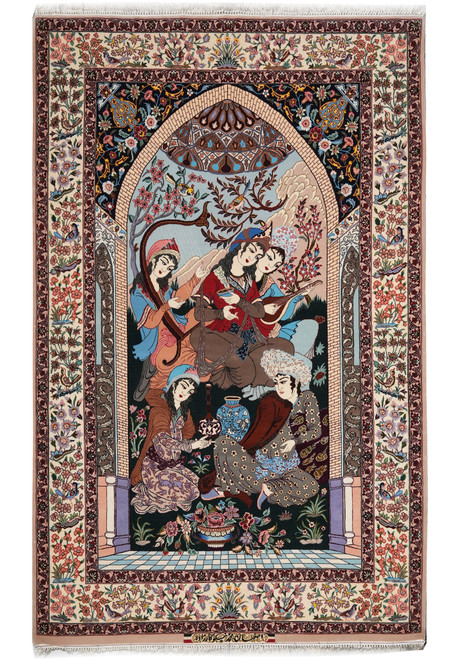
This 4'8" x 8' French tapestry is a woven picture rather than a pile rug. A young shepherd in a pale tunic leans on his staff beneath an oak, his flock settled on the bank behind him, and the whole scene is held inside a deep acanthus border. It dates to the 1930's, is worked in flat weave wool with silk used for the lit highlights, and finishes at 56" x 96" with a lavender-brown binding tape and a full fabric lining across the back. The drawing is intact, the colors have softened rather than faded out, and the panel reads equally well on a wall or laid down in a quiet room. It ships with a certificate of authenticity.
Please Note About the Photographs:
The reverse photograph shows a stitched hanging sleeve, a hook and loop strip and our inventory tag against the beige lining. That hardware is wall-mount preparation, not damage or repair. Because this is a flat woven tapestry with no knotted pile, it is happiest hung, framed or used in a low-traffic spot rather than under a dining chair. The vertical breaks you can see in the close-up images are the slit joins of true tapestry weaving, an intentional feature of the technique.
Design and Motifs
The central panel is a verdure landscape, the pastoral subject French weavers returned to for centuries. A shepherd stands at the left in a buckled shoe and knee breeches, one hand on a long crook, the other reaching toward the trunk of a spreading oak whose clustered leaves fill the upper third of the field. Three sheep rest to the right against a band of water drawn with pale reeds and short horizontal strokes, and the foreground breaks into thistles, ferns and low brush in rust and dark brown. A narrow black-brown guard stripe frames the picture like a painted edge. Outside it runs a wide border of scrolling acanthus leaves, small blue and ivory blossoms and a rosette set into each of the 4 corners, with tall leaf bouquets rising along both long sides. Read the detail images and you can follow how the weaver shaded a single leaf across 4 or 5 tones.
A Palette of Indigo Blue, Sage and Golden Brown
Blue carries the picture. It moves from a deep indigo in the shaded canopy and the stream, through a smoky teal in the middle distance, into a pale chalk blue where the sky opens behind the tree. Against that sit the greens: sage, olive and a grey-green that the weaver used for the sheep fleece and the shepherd's tunic. The oak leaves are picked out in straw gold and butter yellow, the brightest notes in the whole panel, and small ivory flower heads flicker along the border. Warm rust and burnt orange appear in the foreground brush, at the top corners and in thin lines beside the inner guard, balancing all that cool blue. Outlines and the inner frame are a brown so dark it reads nearly black. Silk was reserved for the highlights, so when raking light crosses the surface, as in the rolled edge photograph, the gold foliage and the fleece lift and glow while the wool grounds stay matte. The binding tape is a muted lavender-brown that flatters the faded blues.
French Verdure Weaving and the Quality of This Panel
France built its tapestry reputation in the Creuse, around Aubusson and neighboring Felletin, where workshops wove verdure landscapes for chateau walls from the 17th century onward and kept the tradition alive well into the 20th. The technique has nothing to do with pile weaving: the weft is packed down over a hidden warp so the entire surface is image, color changes are joined with slits and hatched transitions, and the weaver works from a painted cartoon. That is why a European tapestry sits outside the families discussed in our guide to Persian rugs versus Oriental rugs, and why it is judged on weft count and drawing rather than knot count. Here the weft is fine enough to model a face, a shoe buckle and individual leaves at small scale, which on a panel only 56" wide is genuinely difficult work. The softened blues, the hand-applied lining and the wear pattern in the lower field all support the stated 1930's date, and our guide to dating an antique woven textile explains the signs collectors look for.
4'8" x 8' French Antique Tapestry Rug | Pastoral Verdure Scene | Flat Woven Wool & Silk
Ask about this rug
This piece is the only one of it, so the things worth knowing about it are particular to it. If you want to talk through the size, the colour in your own light, or the weave, speak to someone here first.