Watch the film
| Size in ft: | Width: 4' x Length: 6'2" |
| Size in Inch: | Width: 48" x Length: 74" |
| Size in meters: | Length: 1.88 x Width: 1.22 m |
| Colors: | Coral, Gold, Green |
| Shape: | Rectangular |
| Woven: | Hand-Knotted |
| Pile: | Wool |
| Origin: | Turkey |
| Design: | Prayer |
| Age: | 1960's |
| Condition: | Very Good |
4' x 6'2" Turkish Kayseri Prayer Rug | Coral Mihrab with Gold & Green Borders | 1960s Vintage
This 4' x 6'2" Kayseri prayer rug was hand-knotted in wool in central Turkey in the 1960's, and it is a classic statement of the form: one single arched niche, one open coral field, and everything else given over to the borders. The drawing is directional rather than symmetrical, built to be read from one end, which is exactly why pieces like this are so often hung rather than walked on. The wool has taken on the quiet sheen that only decades of use and light produce, and the weave is tight and flat enough to sit under a door or a low chair without trouble. It is a genuine old-world hand-knotted Oriental rug, not a machine-made reproduction, and it ships with a certificate of authenticity recording its origin, materials, age and measurements.
Please Note About the Photographs:
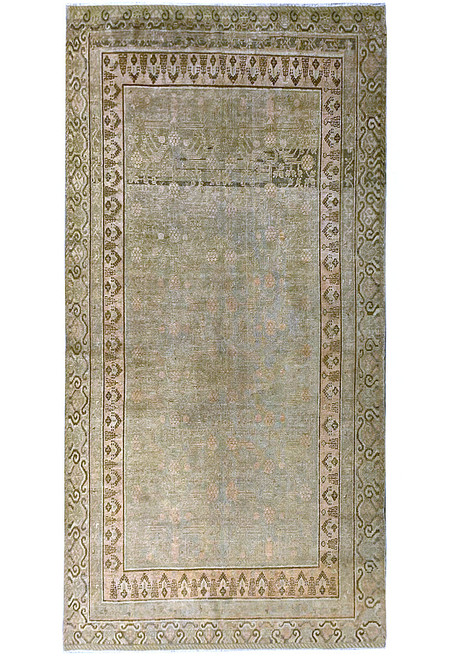
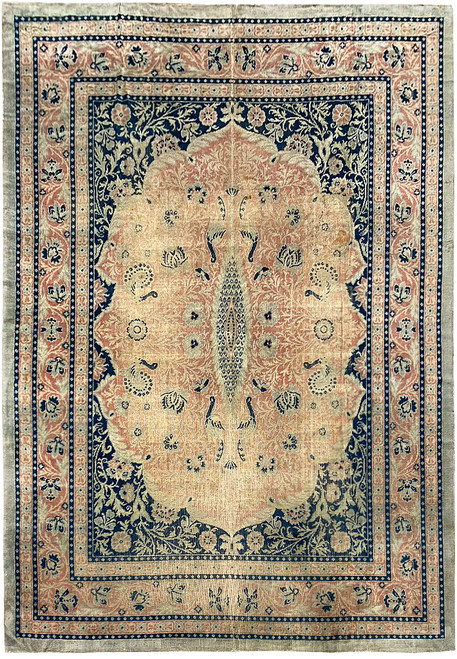
The first image in this gallery was shot under lighting that pushes the coral, gold and green far brighter than the rug reads in the room. The remaining photographs, taken on a wood floor in daylight, are the truer record: a softer warm coral field with muted sage and gold. Judge the color from those, and ask us for more photos if you want a closer look before you buy.
Design and Motifs
The field is a true mihrab, a pointed prayer niche with shouldered sides rising to a slim finial at the top. From the apex hangs a single lamp pendant, drawn in pale green and gold and suspended on a thin cord, the oldest and most recognizable device in the prayer rug vocabulary. Two slender flowering stems stand like columns inside the niche, each rising from a small footed base, and a small blossom sits centered at the bottom edge of the field. The spandrels on either side of the arch carry a red coral-branch vine scrolling into tiny leaves and buds, and a narrow panel above the arch is filled with small blossoms and upright sprigs. The main border is the real showpiece: large gold and ivory palmettes alternating with footed vases, outlined in clear red and linked by thin flowering stems, with four corners resolved cleanly rather than cut off. Three slim guard stripes of repeating blossoms frame the whole composition, and the outermost edge finishes in a running sprig border.
Coral, Gold and Soft Green
The open niche is a warm coral, somewhere between salmon and soft terracotta, and it moves: horizontal bands of lighter and deeper tone run across the field where the weaver changed dye lots, the natural abrash that tells you the yarn was dyed in small batches. Around it the spandrels and panel read as a pale celadon green with a faint blue cast, and that green deepens into a yellow-leaning chartreuse through the main border, where mustard gold and ivory palmettes sit against it. Clear red, the same note as the field but sharper, does all the outlining and gives the pattern its structure. Small accents of turquoise blue and buttery yellow appear in the lamp, the flower heads and the guard stripes. The overall effect is warm and sun-washed rather than loud, a coral and green pairing that sits easily with oak floors, cream walls, brass and natural linen.
Kayseri and the Anatolian Prayer Rug Tradition
Kayseri sits in central Anatolia, at the foot of Mount Erciyes, and has been a workshop weaving center for generations, known for careful drawing, fine wool yarn and a long specialty in prayer formats. Kayseri weavers work the symmetrical Turkish knot on a cotton foundation, which keeps the back flat and the lines crisp; the reverse of this piece, shown next to a ruler in the last photograph, is tight and even across both the field and the border, with no slack or lumpy areas. A 1960's date puts it squarely in the period when Kayseri workshops were still weaving for domestic prayer use rather than purely for export, and the honest abrash and hand-finished selvedges back that up, as does the wear pattern described in our guide to how to date an Oriental rug. At 4' x 6'2" it falls among the most usable 4x6 Oriental rugs, big enough to anchor a bedside or an entry and small enough to stretch on a frame and hang as the pictorial panel it was drawn to be.
4' x 6'2" Turkish Kayseri Prayer Rug | Coral Mihrab with Gold & Green Borders | 1960s Vintage
Ask about this rug
This piece is the only one of it, so the things worth knowing about it are particular to it. If you want to talk through the size, the colour in your own light, or the weave, speak to someone here first.