One of one
5' x 7'6" Persian Isfahan Rug | Wool and Silk on Silk Foundation | Signed Ivory Floral Medallion
- SKU
- 4199x
- ORIGIN
- Isfahan Rugs
- SIZES
- 5x8
- SHAPES
- Rectangular
5' x 7'6" Persian Isfahan Rug | Wool and Silk on Silk Foundation | Signed Ivory Floral Medallion
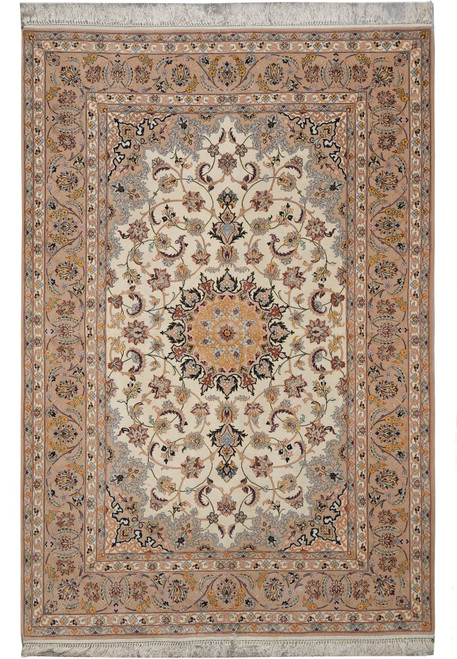
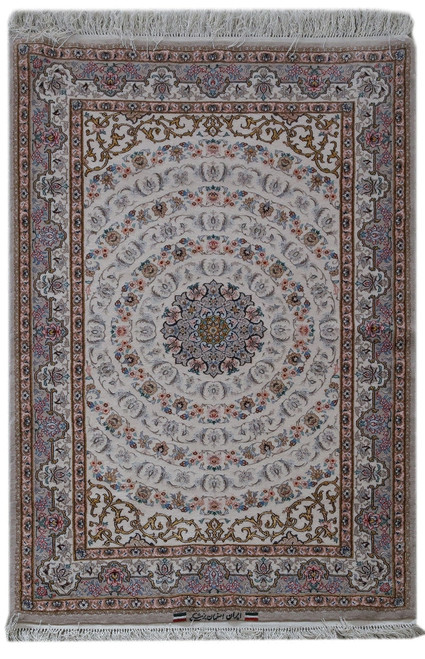
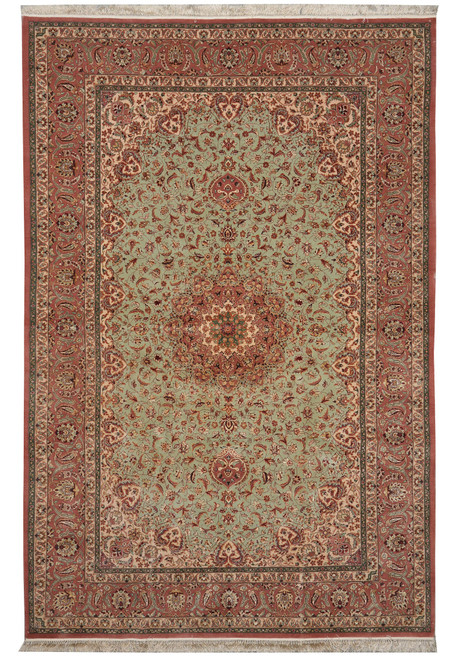
This 5' x 7'6" Isfahan was knotted in wool and silk on a silk foundation in the 2000s, and it arrives in perfect condition with full pile and intact fringe at both ends. It is the format Isfahan built its reputation on: a pale ivory field, one layered medallion at the center, and drawing precise enough that every silk outline stays a separate line instead of blurring into its neighbor. The end border carries a woven cartouche in Persian script naming the weaving city, which puts this piece with town workshop production rather than village weaving. If you are comparing Persian Isfahan rugs across workshops, the drawing and the foundation are where the money shows, and both are strong here. At this footprint it covers the ground a 5x7 Persian rug is usually bought for, in front of a sofa, beside a bed, or under a small round table. It ships from our Freeport warehouse with a certificate of authenticity recording origin, materials and construction.
Design and Motifs
A single round medallion sits dead center, built in concentric rings: a small rose and peach rosette core, a ring of light blue petals outlined in navy, then a wider skirt of blue and gray palmettes that dissolves into the field. Navy pendant finials run off the medallion at top and bottom, and matching navy diamond cartouches sit to left and right, so the composition reads on both axes. The ivory ground around it is not empty for a moment: scrolling islimi vines in wine red and gray carry Shah Abbas palmettes, feathered saz leaves, small rosette clusters and split leaf tendrils, all mirrored across both center lines. The 4 corners resolve with quartered floral spandrels in navy and blue, which frames the field and gives the medallion room to breathe. The main border runs a tan ground with a large scrolling vine and rosette repeat, flanked by ivory guard stripes carrying pink and cream flowerheads, then thin gray blue ribbon stripes at the outer and inner edges. Corner resolution in the border is clean, with the vine turning properly instead of being cut off, which is a fair test of whether the design was drawn by someone who knew what he was doing.
Ivory Field, Rose Pink and Persian Blue
Ivory is the main color, warm rather than white, and in the close-up photographs you can see it shift between cream and a soft oatmeal depending on how the light catches the wool. The secondary tracery across the field is worked in pale gray and silvery cream silk, which reads almost as a shadow pattern, visible from one angle and nearly gone from another. Against that quiet ground the colorists placed the accents carefully: light powder blue in the medallion petals and the smaller flowerheads, deep navy for the outlines, the pendants and the corner spandrels, rose pink and crushed raspberry in the rosettes, and small hits of rust and apricot that keep the palette from going cold. Sage and teal green appear only in the leaves, a few knots at a time. The border moves to a soft tan and mushroom ground, which is what makes the ivory field look brighter than it actually is, and the guard stripes pick up the same pink and cream as the field flowers. Overall it is a light, formal palette that sits comfortably with warm oak floors, tan upholstery and leather, as the room photograph shows.
Isfahan Weaving and Workshop Quality
Isfahan sits in central Persia and has been a court weaving city since the Safavid workshops of the 16th century. Its reputation rests entirely on drawing: the curved line, the flowing vine, the exact repeat of a motif on the opposite side of the field. That kind of drawing is only possible at a high knot count on a stable foundation, which is why the best Isfahan looms are strung with silk rather than cotton. You can see the result on the back of this rug, where the knot rows are tight and even and the foundation is thin enough to make the piece feel more like fine cloth than floor covering. The pile is wool with silk worked through the outlines and the finer flowerheads, the same approach used in the best Persian silk rugs, where silk is used for contrast and light rather than for the whole surface. The woven cartouche in the end border reads, in Persian script, "Iran Isfahan" followed by a weaver's name, which is the mark of a workshop piece and part of why signed Isfahan rugs hold their value in the collector market.
5' x 7'6" Persian Isfahan Rug | Wool and Silk on Silk Foundation | Signed Ivory Floral Medallion
Ask about this rug
This piece is the only one of it, so the things worth knowing about it are particular to it. If you want to talk through the size, the colour in your own light, or the weave, speak to someone here first.