| Size in ft: | Width: 5'2" x Length: 7'4" |
| Size in Inch: | Width: 62" x Length: 88" |
| Size in meters: | Length: 2.24 x Width: 1.57 m |
| Colors: | Ivory, Taupe, Blue, Green, Gold, Peach |
| Shape: | Rectangular |
| Woven: | 100% Hand-knotted | Handmade |
| Foundation: | Silk |
| Pile: | Wool and Silk |
| Age: | 2000's | Never used |
| Design: | Isfahan Floral Medallion | Arabesque Vine Field |
| Origin: | Persian Isfahan | Made in Persia |
| Condition: | Perfect | Never used |
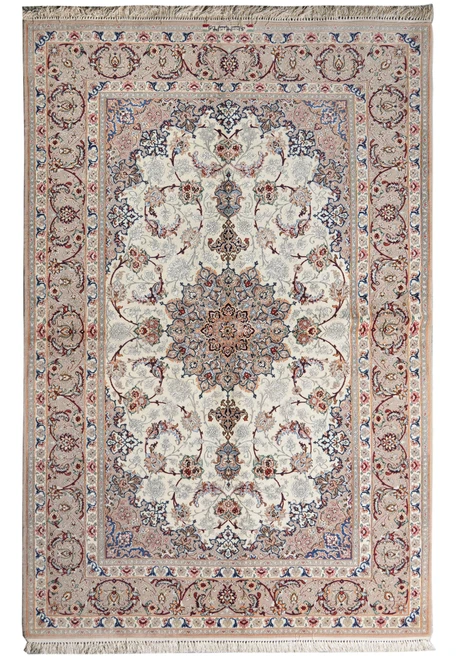
5'2" x 7'4" Persian Isfahan Rug | Ivory Floral Medallion | Wool and Silk on Silk, Never Used
This is a workshop piece from the 2000's that has never been on a floor, and it shows in the pile: the ivory ground is still bright, the silk highlights still catch light along the vine work, and the ends and selvages are untouched. Wool and silk are knotted on a silk foundation, which is why the drawing stays this crisp at 5'2" x 7'4" and why the rug hangs with the suppleness of a much finer textile than its weight suggests. The photographs show the actual rug, including the back, the fringe and the inventory tag. Every rug we ship carries our certificate of authenticity recording origin, materials and measurements. If you want the background on how the city earned its reputation, our complete guide to Isfahan rugs covers the history, the drawing conventions and what separates a real workshop piece from a copy.
Design and Motifs
The layout is the classic Isfahan formula, drawn tightly rather than loosely. A round gold and peach medallion sits dead center, filled with a fine yellow arabesque and an 8 petal rosette at its heart, then ringed by black-navy split palmettes that give the medallion a sharp silhouette against the ivory field. From there the field opens into a symmetrical system of scrolling vines carrying lotus palmettes, five-lobed rosettes and small cypress-like leaf sprays, with matching quarter medallions anchoring the 4 corners. The main border is a taupe band of alternating palmettes and flowering vine, framed by narrow ivory guard stripes and a fine burgundy outline that reads as a pencil line around the whole rug. The close-up images show how many separate colors go into a single flower head, which is the tell of a drawn cartoon executed by an experienced weaver rather than a simplified commercial copy.
A Palette of Ivory, Taupe, Gold and Soft Blue
The field is a warm ivory, closer to unbleached cream than white, and it carries the whole design without ever going flat. Against it the palette is deliberately soft: taupe in the wide border and in the medallion surround, saffron and mustard gold through the arabesque, powder blue in the rosette centers, muted rose and terracotta in the larger blooms, and small notes of sage green and deep burgundy that appear only when you look closely. Black-navy is used sparingly as outline and drama around the medallion and corner brackets. The silk passages sit in the highlights of the flowers and stems, so the rug changes noticeably depending on which direction you walk past it. In practical terms this is a light, neutral rug that will sit comfortably with oak, walnut, cream upholstery and warm metals, which is much of why buyers searching 5 x 7 Persian rugs keep coming back to ivory Isfahans.
Isfahan: Drawing, Silk Warps and Weaving Quality
Isfahan sits in central Persia and has been a court weaving center since the Safavid workshops of the 16th century. Its reputation rests on drawing rather than size or color: the curved line, the continuous vine, the ability to carry a circular medallion without a single wobble. That standard only works on a high knot count and a foundation that will hold it, which is why the best Isfahan looms use silk warps as this one does. A silk foundation lets the weaver pack knots more densely, keeps the rug thin and flexible, and stops the design from drifting as the piece grows on the loom. Turn the rug over, as in the folded corner photograph, and you can see the grain of the back: even, tight and legible, with the pattern readable from the reverse. Combined with the never used condition, that is a rug bought at the front of its life rather than the back.
5'2" x 7'4" Persian Isfahan Rug | Ivory Floral Medallion | Wool and Silk on Silk, Never Used
Ask about this rug
This piece is the only one of it, so the things worth knowing about it are particular to it. If you want to talk through the size, the colour in your own light, or the weave, speak to someone here first.