Watch the film
| Size in ft: | Width: 6'10" x Length: 9'5" |
| Size in Inch: | Width: 82" x Length: 113" |
| Size in meters: | Length: 2.87 x Width: 2.08 m |
| Colors: | Rose Red, Navy Black, Ivory, Sky Blue, Sage Green, Gold |
| Shape: | Rectangular |
| Woven: | 100% Hand-knotted | Handmade |
| Foundation: | Cotton |
| Pile: | 3/8" Wool |
| Design: | Heriz | All Over Pattern |
| Origin: | Persian Heriz | Made in Persia |
| Condition: | Good | Even age patina throughout |
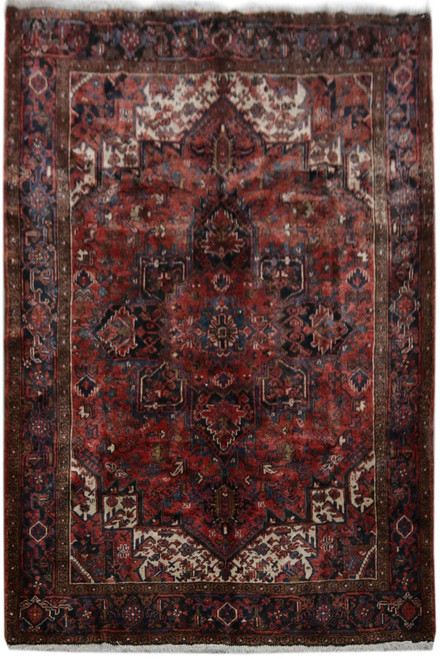
6'10" x 9'5" Antique Persian Heriz Rug | All Over Geometric Design | Rose Red & Navy Wool
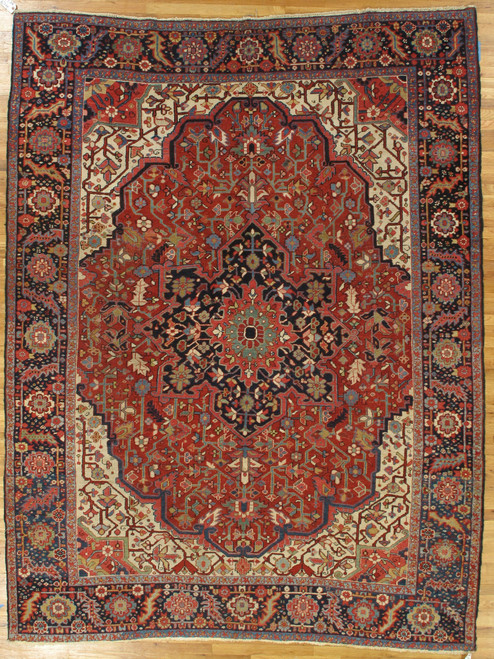
This is a village Heriz of the older type, woven in wool on a cotton foundation and measuring 6'10" x 9'5". Instead of the single central medallion most buyers picture, the weaver filled the field with a repeating, edge-to-edge composition of large angular palmettes and serrated leaves, which is exactly the sort of all over pattern rug that furnishes a room without fighting the furniture. Decades of use have taken the pile down to an even 3/8", and that shortened nap is part of the appeal: the drawing reads crisply, the wool has a low soft sheen, and the reds have mellowed from fire brick to a warm rose. The rug is a practical 7x10 footprint, it lies flat, and it ships with a certificate of authenticity confirming it as a hand-knotted Persian Heriz.
Design and Motifs
The field is built from stacked hexagonal cartouches outlined in ivory and navy, each anchored by a hooked, comb-like leaf that steps out toward the corners. Around them sit broad serrated palmettes, small 8 petal rosettes, tulip heads and paired blossoms, all drawn with the straight lines and stepped diagonals that define geometric Persian rugs from this district. There is no formal medallion and no true spandrel; the pattern simply continues past the border as if cut from a longer bolt of design, which is what collectors mean when they call a Heriz an all over. The main border carries alternating rosette medallions and angular vine work on a near-black ground, framed on both sides by a pale gold guard stripe of scrolling leaves. Small asymmetries between the top and bottom halves, visible where a leaf turns a different color mid-motif, confirm this was drawn from memory at the loom rather than copied square by square from a cartoon.
A Softened Rose Red Against Deep Navy
The ground color is the story here. What began as a madder red now reads as a soft rose terracotta, warmer and dustier than a new rug, with gentle abrash banding across the width where dye lots changed. Against it the main border sits almost black, a dense indigo navy that pulls the eye outward and makes the field look lighter than it is. Ivory does the structural work, outlining the cartouches and the guard stripes so the pattern stays legible from across the room. The accent palette is quietly varied: sky blue in the small rosette centers, a pale sage and olive green in the leaf tips, gold in the guard borders, and touches of salmon and rust in the flower heads. On a wood floor the effect is warm and faded rather than loud, which is why rugs in this coloring sit so easily with both antique furniture and plain modern upholstery.
Heriz Weaving and the Wool Behind It
Heriz is a group of villages east of Tabriz in northwest Persia, spread below Mount Sabalan, where the mineral-rich water is credited with producing wool that is unusually tough and takes dye deeply. Weavers there work on a heavy cotton foundation with a coarser knot than the city workshops, typically under 200 knots per square inch, and they translate curvilinear court designs into straight lines and angles because that is what the loom and the grid allow. The result is a rug that survives generations of traffic, which is precisely why so many American homes still have one that was bought before the war. Handling this piece, the wool still feels springy at the root and the selvages and fringes are intact, both good indicators of a well-kept older weave. If you want to understand the patina, the abrash and the border wear you are seeing, our guide on how to date an Oriental rug walks through the same signs, and you can compare this one against our other 7x10 Persian rugs.
6'10" x 9'5" Antique Persian Heriz Rug | All Over Geometric Design | Rose Red & Navy Wool
Ask about this rug
This piece is the only one of it, so the things worth knowing about it are particular to it. If you want to talk through the size, the colour in your own light, or the weave, speak to someone here first.