Watch the film
| Size in ft: | Width: 9'5" x Length: 12' |
| Size in Inch: | Width: 113" x Length: 144" |
| Size in meters: | Length: 3.66 x Width: 2.87 m |
| Colors: | Red |
| Shape: | Rectangular |
| Woven: | Hand-Knotted |
| Origin: | Persia |
| Design: | Heriz |
| Condition: | Excellent |
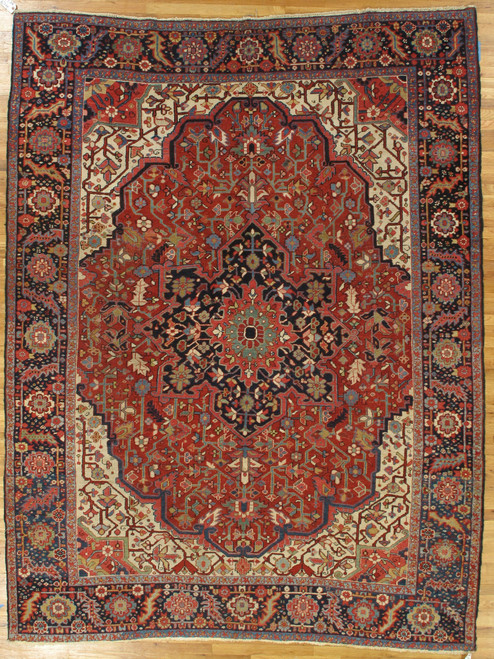
9'5" x 12' Persian Heriz Rug | Geometric Star Medallion | Antique Rust Red Field
This is an antique village weaving from the Heriz district of northwest Persia, hand-knotted in wool on a cotton foundation and measuring 9'5" x 12'. The field has gone the way good old Heriz rugs go, a rust red that has softened unevenly into rose and terracotta, with a deep navy star medallion anchoring the center and wide light blue spandrels opening the 4 corners. The pile is low and settled from decades of honest use, which is exactly what gives a rug like this its transparency and its color. It is a true room size piece that sits naturally among 9x12 Persian rugs for a living room or a dining table, and it ships with a certificate of authenticity confirming the origin, the materials and the hand-knotted construction.
Please Note About the Photographs:
The photographs show this rug exactly as it is today. The lighter passages across the red field and the low pile are age and wear from decades on a floor, not fade from sun damage and not a flaw in the weave. This is the patina collectors look for in a genuine antique, and the rug is professionally cleaned, steamed and pressed before it leaves us.
Design and Motifs
The drawing is classic Heriz and belongs squarely with the best geometric Persian rugs: everything is built from straight lines, angles and stepped outlines rather than curved vine work. At the center sits an 8 point navy star medallion filled with rose cartouches, small paneled boxes and a camel gold cross axis, with a tiny rosette in a blue and rose roundel at the very middle. Long pendant palmettes in blue and rose extend north and south, and serrated saw tooth leaves radiate out of the medallion into the field. The corner spandrels carry oversize palmettes, curling leaves and rosettes on light blue. The main border runs navy with alternating rosettes and angular vinework, framed by a camel guard stripe of small flower heads on each side, and the whole layout stays perfectly balanced end to end across 12 feet.
A Rust Red Field Against Navy and Sky Blue
Red is the dominant color, but it is not one flat red. The field moves from brick and rust through terracotta to a dusty rose where the pile has worn lowest, and that natural abrash is the signature of wool dyed in small village batches. Against it the medallion and the main border read a very dark indigo navy that in daylight shows blue rather than black. The spandrels and the leaf work bring in a soft sky blue that cools the whole rug and keeps the red from ever feeling heavy. Camel gold appears in the guard stripes, the medallion cross and scattered leaves, ivory picks out the outlines and a few small blossoms, and there are quiet notes of rose pink and muted olive green through the corners. It is a warm red rug that still reads blue from across a room, which is why this palette works over both wood floors and dark stone.
Heriz Weaving in Northwest Persia
Heriz is a group of villages east of Tabriz, lying below Mount Sabalan, and its reputation rests on two things: mineral rich water that sets the dyes, and local wool so tough that Heriz rugs survive generations of foot traffic that would finish a finer weave. Weavers there work from memory and from village drawings rather than a cartoon, which is why the medallion is drawn in straight angular steps and no two Heriz rugs are ever quite identical. The knot count on village work of this type is modest by design, since a heavier knot and a stout cotton foundation are what make the rug last, and the back photo here shows that even, honest weave clearly. For anyone curious about reading age from wear, dyes and construction, our guide on how to date an oriental rug covers the same signals visible in this piece.
9'5" x 12' Persian Heriz Rug | Geometric Star Medallion | Antique Rust Red Field
Ask about this rug
This piece is the only one of it, so the things worth knowing about it are particular to it. If you want to talk through the size, the colour in your own light, or the weave, speak to someone here first.