Watch the film
| Size in ft: | Width: 9'5" x Length: 18' |
| Size in Inch: | Width: 113" x Length: 216" |
| Size in meters: | Length: 5.49 x Width: 2.87 m |
| Colors: | Ivory, Brick Red, Navy Blue, Teal, Gold, Brown, Rose |
| Shape: | Rectangular |
| Woven: | 100% Hand-knotted | Handmade |
| Foundation: | Cotton |
| Pile: | |
| Design: | Heriz | Stepped geometric medallion | Ivory field |
| Origin: | Persian Heriz | Made in Persia |
| Condition: | Perfect | Full even pile |
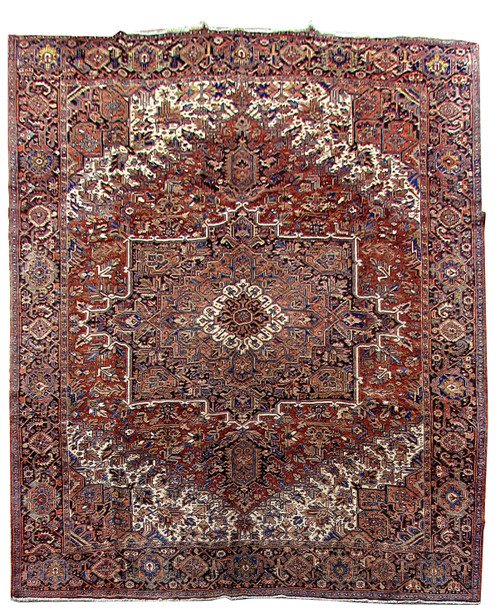
9'5" x 18' Persian Heriz Rug | Ivory Field Geometric Medallion | Oversize Gallery Length
A 9'5" x 18' Heriz is a room-defining piece, and the proportion is the first thing a dealer notices: 18 feet of length against a 9'5" width reads as a gallery rug rather than a standard rectangle, which makes it one of the harder shapes to source among oversize Persian rugs. The weavers handled the extra length well, stretching a single stepped medallion and its pendants down the middle of an open ivory field instead of repeating a small motif to fill space. The pile is a full 3/8" of sturdy Heriz wool on a cotton foundation, the ends and sides are sound, and the drawing stays symmetrical from one end to the other. Every rug we sell ships with a certificate of authenticity confirming it is 100% hand-knotted in Persia.
Design and Motifs
The center holds a large stepped medallion built in layers: a teal core with a small rose and ivory rosette at its heart, a brick red frame notched with arrowhead points, and an outer brown surround carrying 4 teal cartouches. Anchor pendants run north and south from it, each ending in a small shield with a rose and gold blossom. The ivory field around the medallion is packed with angular vinework, hooked leaves, cypress-like sprigs and little blocky palmettes in rose, teal, gold and brown, drawn in the straight-line vocabulary that defines a geometric Persian rug from this district. The 4 corner spandrels are brick red and heavily filled with serrated leaves and rosettes, and they meet the field along a jagged stepped line rather than a curve. The main border on a navy ground alternates ivory rosette cartouches with rose palmettes and upright vase forms, held between minor bands of gold and rose flowerheads.
Colors in This Heriz
Ivory is the governing color, a warm undyed cream that carries the whole field and keeps 18 feet of rug from feeling heavy, which is exactly why open-ground pieces sit at the top of the demand list among ivory Persian rugs. Against it the spandrels read brick red with a soft terracotta cast, deeper in the close-up shots and lighter where the light hits the pile straight on. The medallion brings in the two colors that make this rug memorable: a clear peacock teal and a dark chocolate brown, unusual choices for a district that usually leans on red and navy alone. Rose pink appears through the vines and border palmettes, mustard gold outlines many of the leaves, and the navy border grounds the whole composition with ivory rosettes floating on it. Small touches of olive green and pale sky blue turn up in the field figures. The dye lots are natural and slightly variable, so subtle horizontal tone shifts are part of the character of a village weave.
Heriz Weaving and Origin
Heriz rugs come from a cluster of villages east of Tabriz in northwest Persia, sitting below Mount Sabalan. The wool from those flocks is famously tough and the local water is rich in minerals, which is the accepted explanation for why Heriz pile wears like iron and why the dyes settle into that particular warm, slightly chalky palette. Weavers there work from memory and from a drawn quarter plan rather than a full cartoon, which is why the lines are angular, the corners step instead of curve, and no two Heriz rugs of the same design are ever identical. Knot counts in village work generally sit below 200 knots per square inch, and the strength of the weave shows in the handle: dense, heavy, flat-lying, with the 3/8" pile standing upright across the full 18 foot length. A piece this long would have needed an unusually tall loom and a team working the width together, which is why oversize Heriz rugs in a single clean ivory ground remain scarce on the market.
9'5" x 18' Persian Heriz Rug | Ivory Field Geometric Medallion | Oversize Gallery Length
Ask about this rug
This piece is the only one of it, so the things worth knowing about it are particular to it. If you want to talk through the size, the colour in your own light, or the weave, speak to someone here first.