Watch the film
| Size in ft: | Width: 6'11" x Length: 10'2" |
| Size in Inch: | Width: 83" x Length: 122" |
| Size in meters: | Length: 3.10 x Width: 2.11 m |
| Colors: | Red, Blue, Ivory |
| Shape: | Rectangular |
| Woven: | Hand-Knotted |
| Pile: | 3/8" Wool |
| Origin: | Persia |
| Design: | Tabriz |
| Condition: | Excellent |
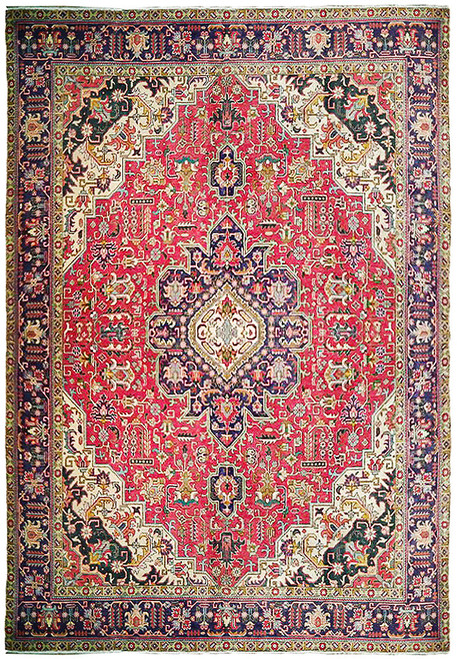
6'11" x 10'2" Persian Tabriz Rug | Rose Red Field with Ivory Medallion | Semi Antique Wool Pile
This is a semi antique Tabriz in the classic northwest Persian formula: a rose red field, a stepped ivory and charcoal medallion, and a deep indigo border that frames the whole thing like a picture. At 6'11" x 10'2" it sits right in the most useful of all 7 x 10 Persian rugs, large enough to carry a seating group but still easy to place. The pile is 3/8" wool on a cotton foundation, even from end to end, with the light, honest patina that only comes from age rather than from washing. Every rug we sell ships with a certificate of authenticity confirming it is hand-knotted in Persia.
Design and Motifs
The center holds a broad diamond medallion drawn in 2 layers: an ivory core filled with a pink and blue rosette and a ring of curling leaves, set inside a charcoal black frame outlined in pale sky blue. Small lobed cartouches break out of the medallion at the sides, and slender pendants run north and south into the field, each finishing in a little floral crown. Around the medallion the red field is not left open. It is planted with flowering stems, palmettes, rosebuds and small boteh, some in ivory, some in pink and peach, with sage green leaves and brown vine work threading between them. A thin ivory vine sweeps up into the corners to mark the spandrels, which reverse the scheme and sit in indigo blue. The main border repeats large ivory and rose palmettes alternating with 8 petal rosettes on an indigo ground, and the guard stripes on either side carry a running vine with heart shaped leaves in rose red and green. Nothing in the drawing is mechanical; the corners resolve by hand and each repeat is slightly its own.
A Rose Red Field Against Indigo Blue
The field reads as a soft rose red, closer to old brick and faded raspberry than to a hot modern red, and it moves in gentle bands of abrash where the dye lots shifted during weaving. That movement is what keeps a field this size alive under daylight. Against it the border is a strong indigo blue with a slight green cast in the corners, the deepest note on the rug apart from the charcoal black at the heart of the medallion. Ivory does the drawing work throughout, outlining the medallion, the spandrel vines and the larger border flowers so that the pattern stays legible from across a room. Between those anchors sit the quieter tones: soft pink and peach in the blossoms, sage and pine green in the leaves, a warm walnut brown in the stems, and flickers of pale sky blue in the smaller rosettes. Seen from the back, the same palette shows clean and saturated knot by knot, which is the surest sign the colors are true and not surface treated.
Woven in Tabriz, Northwest Persia
Tabriz sits in the far northwest of Persia and has been the country's most organized weaving city for centuries, working from drawn cartoons rather than memory, which is why the medallion here is so symmetrical and the border corners turn so cleanly. Tabriz weavers count fineness in Raj, knots per gereh across the width, and a room size piece like this one is woven at a good commercial to fine grade, dense enough to hold crisp outlines but built with the thick, hard wearing wool the region is known for. The foundation is cotton, taut and flat, and the ends are finished with plain ivory fringe. Semi antique examples in this palette are the backbone of the market for Persian Tabriz rugs, because they have already proved themselves on the floor for decades and still have most of their pile left to give.
6'11" x 10'2" Persian Tabriz Rug | Rose Red Field with Ivory Medallion | Semi Antique Wool Pile
Ask about this rug
This piece is the only one of it, so the things worth knowing about it are particular to it. If you want to talk through the size, the colour in your own light, or the weave, speak to someone here first.