Watch the film
| Size in ft: | Width: 6'3" x Length: 9'9" |
| Size in Inch: | Width: 75" x Length: 117" |
| Size in meters: | Length: 2.97 x Width: 1.91 m |
| Colors: | Red, Blue |
| Shape: | Rectangular |
| Woven: | Hand-Knotted |
| Pile: | Wool |
| Origin: | Persia |
| Design: | Tabrez |
| Age: | 1950's |
| Condition: | Perfect |
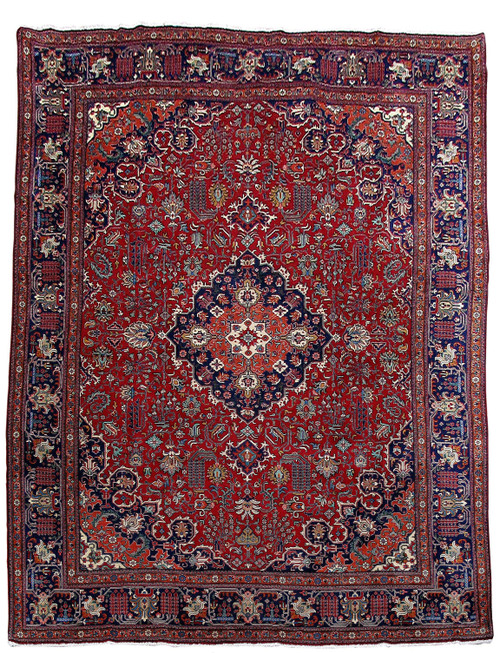
6'3" x 9'9" Persian Tabriz Rug | Red Field, Stepped Geometric Medallion | 1950s, Perfect Condition
A 1950s Tabriz that has been kept, not used up. The pile stands full and even from end to end, the navy outer guard stripes are intact, and the ivory ends still read crisply, which is unusual for a wool rug of this age. It is hand-knotted in wool on a cotton foundation, and at 6'3" x 9'9" it sits squarely in the practical range covered by our 6 x 9 Persian rugs, big enough to carry a seating group with the front legs on, small enough to move without a crew. Every rug we sell ships with a certificate of authenticity recording origin, materials and measurements.
Design and Motifs
The center holds a stepped, saw-toothed medallion: an ivory core carrying an 8 petal rosette, set inside a navy ground, with hooked pendants running off the top and bottom on the long axis. Four ivory corner spandrels answer it, each drawn with serrated leaves, curling vines and small palmettes, so the field reads as a framed panel rather than an open ground. Between medallion and corners the red field is packed with palmettes, rosettes, angular vine work and small geometric bouquets, a drawing style that puts this piece firmly among classic geometric medallion rugs. The wide navy main border alternates cross-form geometric rosettes with stylized tulip and palmette figures, and it is fenced by narrow reciprocal guard stripes that keep the whole layout square.
The Red and Navy Palette
The field is a deep crimson red with a faint cherry lift where the light catches the pile, the kind of red that photographs dark in an overhead shot and brightens considerably in the room. Against it the navy blue of the medallion ground and the main border reads almost black at a distance and resolves into true indigo up close. Ivory does the structural work: the medallion core, the 4 corner spandrels and the fine outer guard stripe, all of which pull the eye through the design. The secondary palette is where the age shows in the best way, with sage and olive green leaves, soft rust and peach in the palmettes, small notes of gold and a warm brown outlining the geometry. Gentle abrash across the red field confirms hand-dyed wool rather than a uniform modern dye lot.
Tabriz Weaving and Quality
Tabriz sits in the northwest corner of Persia and has been the country's most commercially disciplined weaving center for well over a century, working to the Raj system and to a workshop cartoon rather than from memory. That discipline is visible here in the symmetry of the medallion, the straightness of the border repeats and the tight registration of the corner spandrels. The back shows an even, well-packed weave with clean rows and no crowding, wool pile on a cotton foundation, which is exactly the construction that lets a 1950s Tabriz still look like this after 70 years of careful ownership. If you want to understand how weave, dye and wear signals place a piece in a decade, our guide on how to date an Oriental rug walks through the same evidence we used on this one.
6'3" x 9'9" Persian Tabriz Rug | Red Field, Stepped Geometric Medallion | 1950s, Perfect Condition
Ask about this rug
This piece is the only one of it, so the things worth knowing about it are particular to it. If you want to talk through the size, the colour in your own light, or the weave, speak to someone here first.