Watch the film
| Size in ft: | Width: 6'4" x Length: 9'2" |
| Size in Inch: | Width: 76" x Length: 110" |
| Size in meters: | Length: 2.79 x Width: 1.93 m |
| Colors: | Beige, Sage Green, Brown |
| Shape: | Rectangular |
| Woven: | 100% Hand-knotted | Handmade |
| Foundation: | Cotton |
| Pile: | Wool | Low Even Pile |
| Age: | 1930's | Antique |
| Design: | Oushak Chotan | Khotan Style | 3 Medallions |
| Origin: | Turkish Oushak | Made in Turkey |
| Condition: | Excellent | Even low thin pile |
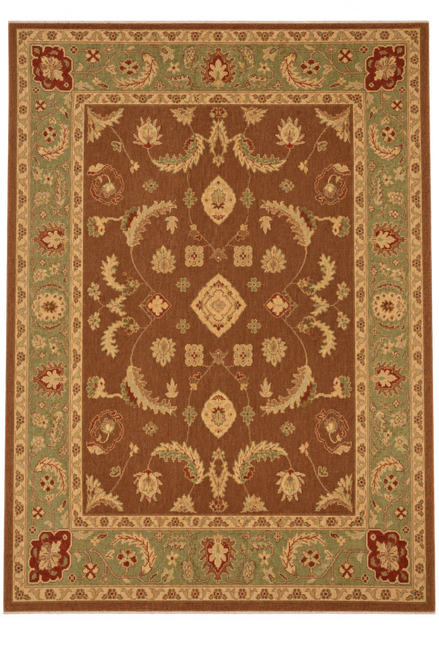
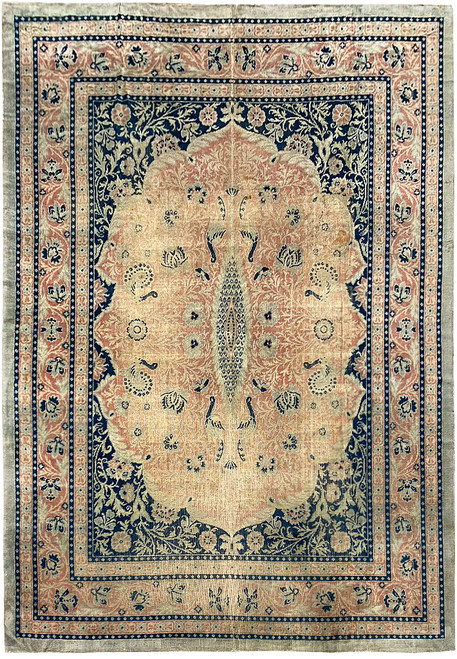
6'4" x 9'2" Turkish Oushak Rug | Antique 1930s Chotan Khotan Design | 3 Medallions, Low Even Pile
Woven in the 1930s, this 6'4" x 9'2" Turkish Oushak carries the Chotan drawing, the Khotan medallion layout that Anatolian workshops borrowed from the old Silk Road weavings and made their own. Three rounded medallions float down a bare sand field, framed by a cloudband and key fret border, with nothing crowding the space between them. Nine decades of use have worn the wool pile low and perfectly even, which is exactly what collectors want in a piece this age: the drawing sits close to the foundation and reads like a graphic print. It is a genuine hand-knotted Oriental rug, not a reproduction, and it ships with our certificate of authenticity. At this scale it sits in the most useful format we sell, the 6 x 9 rug footprint.
Please Note About the Photographs:
The soft horizontal bands across the field are abrash, the natural tonal shift that happens when a weaver moves from one hand-dyed wool batch to the next, and the faint crease lines are fold marks from flat storage on the pallet. Neither is wear, fade or damage. The fold marks relax once the rug is laid flat, and every rug leaves us professionally steamed and pressed before shipping.
Design and Motifs
The field carries 3 large rounded medallions set one above the other on the long axis. The top and bottom medallions are outlined in a thin brown line and filled with 8 small hooked brackets arranged around a single central rosette, while the middle medallion is quartered by a cross and holds 4 stepped, bird-like hooked figures, one per quarter. The 4 corners of the field are marked with angular bracket ornaments built from squares, diagonals and stepped hooks, each paired with a small 8 point star rosette. The main border runs a repeating cloudband and dot motif, and the outer guard band is a linked key fret that turns cleanly at every corner. This is drawing at its most confident and most economical: straight lines, hooks and negative space, with no floral filler anywhere. If you gravitate toward geometric rugs rather than curved vinework, this is the tradition that invented the vocabulary.
A Neutral Palette of Beige, Sage Green and Brown
The ground is a warm sand beige that shifts through oatmeal, pale camel and a dusty pink cast depending on the light and the angle of the pile. Through the center of the rug a wide band of soft olive sage green washes across the field and through the middle medallion, a natural abrash that gives the whole piece its depth. The outlines, cloudbands, fret border and corner brackets are worked in a deep coffee brown that has softened to a smoky chocolate with age, and the medallion interiors lift to a lighter ivory beige so the motifs read clearly from across the room. The close-up of the weave shows tiny flecks of faded rose and old gold buried in the wool, the remains of vegetable dyes that have mellowed for 90 years. Nothing in this rug is loud, which is precisely why it works over wide plank floors, against limewashed walls or under mid-century and rustic furniture.
Oushak Weaving in Western Turkey
Oushak, the town of Usak in western Anatolia, has been a weaving center since the 15th century and remains the name most associated with Turkish room-size rugs. Its wool is long-staple and lanolin-rich, which is why an Oushak can lose most of its pile height and still feel supple rather than brittle underfoot. Weavers there use the symmetrical Turkish knot on a cotton foundation, a knot that grips harder than the asymmetrical alternative and gives village work its reputation for surviving generations of traffic. In the early 20th century Oushak workshops began weaving Khotan and Samarkand layouts like this Chotan design for export, translating an East Turkestan idea into Anatolian wool and Anatolian color. The low even pile, the oxidized brown outlines standing slightly proud of the field and the heavy hand-plied selvedge are all consistent with the stated 1930s date, and our guide on how to date an Oriental rug walks through the same markers.
6'4" x 9'2" Turkish Oushak Rug | Antique 1930s Chotan Khotan Design | 3 Medallions, Low Even Pile
Ask about this rug
This piece is the only one of it, so the things worth knowing about it are particular to it. If you want to talk through the size, the colour in your own light, or the weave, speak to someone here first.