Watch the film
| Size in ft: | Width: 6'8" x Length: 9'7" |
| Size in Inch: | Width: 80" x Length: 115" |
| Size in meters: | Length: 2.92 x Width: 2.03 m |
| Colors: | Ivory, Brown, Blue, Green |
| Shape: | Rectangular |
| Woven: | 100% Hand-knotted | Handmade |
| Foundation: | Cotton |
| Pile: | |
| KPSI: | Approx. 500 |
| Age: | 2000s | Never used |
| Design: | Hunting Tabriz | Shekargah | Round medallion |
| Origin: | Persian Tabriz | Made in Persia |
| Condition: | Perfect | Never used |
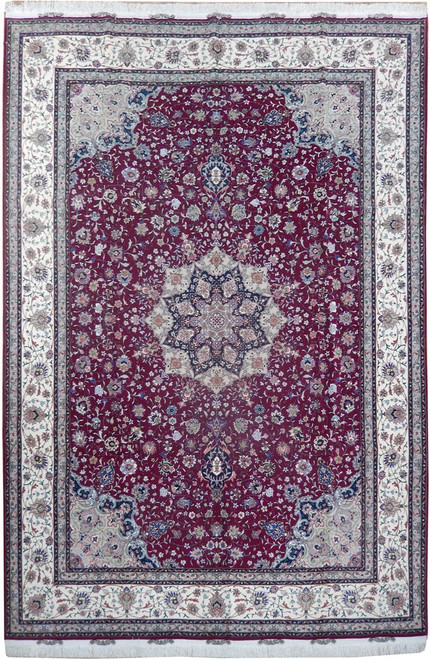
6'8" x 9'7" Persian Tabriz Rug | Hunting Scene Pictorial | 500 KPSI, Never Used
A hunting rug is the hardest thing a Tabriz workshop can attempt, because every horse, hound and hunter has to be drawn correctly at a scale of fractions of an inch, and this 6'8" x 9'7" piece carries the scene across the whole field without a single awkward figure. It is hand-knotted in fine wool on a cotton foundation at approximately 500 knots per square inch, woven in the 2000s and never laid in a home, so the pile still stands full and the ivory ground is clean edge to edge. At this scale it settles naturally into the popular 7x10 Persian rugs range, large enough to anchor a seating group yet still readable as a single picture from a doorway. Every rug we ship leaves with a certificate of authenticity documenting origin, materials and knot count.
Design and Motifs
The composition is a shekargah, the classic Persian hunting ground, organized around a round medallion whose inner disc holds an 8 petal rosette and whose outer bands are filled with tiny running hares, stags and hounds circling the center. Out in the open field, mounted archers in turbans twist in the saddle, spearmen ride down leopards and boars, and greyhounds chase gazelles between scrolling vines, palmettes and split leaves. Winged cranes and long tailed birds fill the gaps, and the drawing is mirrored across both the long and short axes so the scene reads the same from either end of the room. The border system is equally busy: a wide navy ground carries alternating lozenge cartouches of hunting vignettes and octagonal panels holding woven portraits of men and women in Qajar style dress, framed by narrow rosette and vine guard stripes. At close range, as in the corner and border photographs, single animals measure barely an inch across yet still show eyes, collars and saddle cloths.
A Warm Ivory Field With Navy and Soft Green Depth
The field is a warm ivory, closer to fresh cream than to white, and it does most of the work here by giving all those small figures room to breathe. Against it the weavers used a restrained palette of caramel and chestnut brown for the horses and cartouche grounds, soft sage and blue green for riders' coats and leaf forms, rust and terracotta for flower heads and saddle blankets, and touches of pale blue that keep the animals from reading as one mass of brown. The main border reverses the scheme entirely, dropping to a deep navy that is almost black in the photographs, with lilac grey cartouche panels and rose pink rosettes in the guard stripes lifting it. That dark frame is what makes the ivory center glow. The lustre of the wool shifts with the light, so the same rosette can look golden from one side of the room and biscuit from the other, and the overall tone stays friendly with warm neutrals, walnut furniture and aged brass.
Tabriz Weaving and What 500 Knots Per Square Inch Means
Tabriz sits in northwest Persia and has been the country's design capital for centuries, the city where court cartoons were drawn and where the curved line was mastered. Tabriz workshops measure fineness in Raj, knots per gereh across the width, where 40 Raj is commercial work and 60 Raj is the point at which a rug is considered collector grade. At approximately 500 knots per square inch this piece sits above 60 Raj, in the band where a master workshop can render a human face, a horse's bridle and a hound's collar legibly rather than as approximate shapes. The back of the rug, visible in the folded corner photograph, shows the pattern as crisply as the front, which is the honest test of knot density. Woven on a cotton foundation with a tightly packed wool pile, it is built to be used, and buyers comparing Persian Tabriz rugs will find pictorial hunting designs at this fineness are a small fraction of what the city produces.
6'8" x 9'7" Persian Tabriz Rug | Hunting Scene Pictorial | 500 KPSI, Never Used
Ask about this rug
This piece is the only one of it, so the things worth knowing about it are particular to it. If you want to talk through the size, the colour in your own light, or the weave, speak to someone here first.