Watch the film
| Size in ft: | Width: 7'7" x Length: 10'5" |
| Size in Inch: | Width: 91" x Length: 125" |
| Size in meters: | Length: 3.18 x Width: 2.31 m |
| Colors: | Taup. Brown, Charcoa, Gray |
| Shape: | Rectangular |
| Woven: | Hand-Knotted |
| Pile: | Wool |
| Origin: | Persia |
| Design: | Heriz |
| Age: | 1970's |
| Condition: | Low Pile |
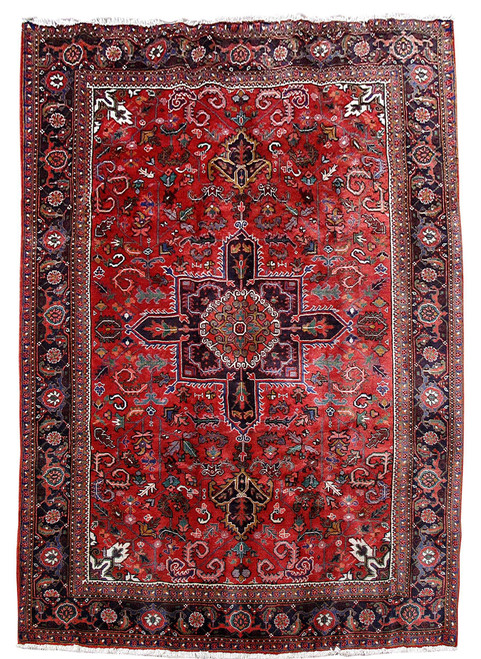
7'7" x 10'5" Persian Heriz Rug | Faded Taupe & Charcoal Geometric Medallion | 1970s Low Pile
This is a Heriz from the 1970s that has spent 50 years mellowing into exactly the colour range decorators keep asking for: taupe, mushroom, walnut brown and charcoal, with almost no red left anywhere in the field. It was hand-knotted in wool on a cotton foundation in the villages east of Tabriz, and the pile now sits low and even, which is what gives the drawing its flat, graphic, almost printed quality. At 7'7" x 10'5" it covers a standard seating group the way 8x10 Persian rugs are meant to, with all four furniture legs on the wool. Every rug we sell ships with a certificate of authenticity confirming it is genuinely hand-knotted and genuinely Persian.
Please Note About the Photographs:
The washed, faded look and the low pile you see in the close-up photos are original to this 1970s weave and are the reason this piece is collected. The wear is even across the whole field rather than concentrated in one spot, the knots are clear and tight on the back, and the rug is professionally cleaned, steamed and pressed before it leaves us.
Design and Motifs
The centre holds a large stepped medallion built from concentric outlines, finished top and bottom with anchor-shaped pendants and flanked by hooked serrated leaves that radiate outward in straight, angular runs. Four corner spandrels repeat the same stepped logic in darker brown, framing an open field that is filled edge to edge with small palmettes, rosettes and blocky vine fragments rather than curved scrollwork. The main border alternates broad ivory panels of stylised flowerheads with narrower dark cartouches, held between fine reciprocal guard stripes. It is a copybook example of the angular village drawing collectors look for in geometric Persian rugs, where every line is resolved in steps instead of curves.
A Faded Palette of Taupe, Brown and Charcoal
The field reads as warm taupe drifting toward sand and oatmeal, with the medallion and spandrels drawn in mushroom and walnut brown. Outlines are near-black charcoal, sharp enough to hold the whole composition together from across a room, and cool gray shading appears through the leaves and border panels where the original indigo has softened over five decades. Ivory carries the border flowerheads and the fringe. Look closely at the pile photographs and you can still find faint peach and apricot flecks tucked between the knots, the last trace of the warmer dyes this rug started life with. The result is a genuinely neutral rug that still has depth, and it sits comfortably with both brown and earth tone rugs and cooler gray interiors.
Woven in the Heriz Villages of Northwest Persia
Heriz is a cluster of villages east of Tabriz, sitting below Mount Sabalan, where the mineral-rich water is credited with producing wool that is unusually tough and slightly glossy. Weavers there work from memory on a coarse, sturdy structure rather than a fine cartoon, which is why Heriz drawing is straight-lined and stepped and why these rugs survive decades of traffic that would flatten a finer weave. Village knotting of this kind generally runs under 200 knots per square inch, and that heavier build is a feature, not a shortcut: the back of this piece shows a dense, regular knot with a firm cotton foundation and intact selvages. Half a century of use has taken the pile down without taking the rug apart.
7'7" x 10'5" Persian Heriz Rug | Faded Taupe & Charcoal Geometric Medallion | 1970s Low Pile
Ask about this rug
This piece is the only one of it, so the things worth knowing about it are particular to it. If you want to talk through the size, the colour in your own light, or the weave, speak to someone here first.