Watch the film
| Size in ft: | Width: 9'5" x Length: 12'7" |
| Size in Inch: | Width: 113" x Length: 151" |
| Size in meters: | Length: 3.84 x Width: 2.87 m |
| Colors: | Taup, Gray |
| Shape: | Rectangular |
| Woven: | Hand-Knotted |
| Pile: | Wool |
| Origin: | Persia |
| Design: | Antique |
| Age: | 1950's |
| Condition: | Very Good, Low Pile, Evenly Worn, Stable |
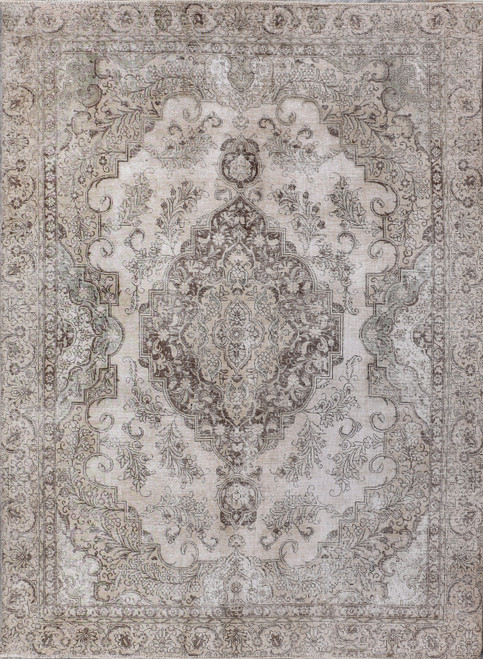
9'5" x 12'7" Persian Vintage Rug | Faded Taupe and Gray Medallion | 1950s Low Pile
Seventy-odd years of use have taken this Persian rug somewhere a new rug cannot go. The wool was knotted by hand in the 1950s on a cotton foundation, and time has pulled the palette down to soft taupe, warm sand and a quiet gray-green, so the drawing now reads like a pencil sketch rather than a bold statement. The pile is low and worn evenly from end to end, the sides and ends are intact, and the rug lies flat and stable. At 9'5" x 12'7" it covers a full seating group and sits naturally alongside other 10x13 Persian rugs, though the muted coloring makes it far easier to live with than most rugs this size. Every rug we ship carries a certificate of authenticity.
Please Note About the Photographs:
This is a genuine vintage piece and the photographs show it honestly. The pale, washed-out surface and the low pile are age and even wear across the whole rug, not damage, not a manufacturing flaw and not a digital filter. There are no holes and no repairs, the foundation is sound, and the rug lies flat. Every rug is professionally cleaned, steamed and pressed before it leaves us.
Design and Motifs
The layout is the classic antique formula: a lobed central medallion with a small pendant at each end, four matching corner spandrels, and a field of curved vine work filling everything in between. The medallion itself is understated, a rounded cartouche holding a single small rosette and ringed by clusters of tiny flower heads on thin stems, with the scalloped outline still crisp in the close-up. Out in the field, palmettes, serrated leaves and eight petal rosettes scroll outward on vines that never quite repeat, and the spandrels carry the heaviest concentration of drawing, which is where the darkest gray-green outlines survive. The main border runs a turtle palmette and vine rhythm between narrow guard stripes, and the outer guard has softened to almost the same tone as the plain outer field. What makes this rug work in a contemporary room is that the pattern is complete and correctly drawn, but the contrast has dropped so far that it functions as texture rather than as a busy floor design.
A Palette of Taupe, Sand and Soft Gray
The field reads as a warm taupe, closer to wet sand in strong light and closer to greige in shade, and it shifts gently across the rug because the original dye lots have aged at slightly different rates. Over that ground the drawing is carried in two related grays: a pale silver-gray in the vines and flower heads, and a deeper gray-green that pools in the spandrels and along the main border, where you can still see the color the whole rug once was. The corners and the border are the darkest areas, giving the piece just enough definition at the edges to frame the seating. Small touches of ivory light up the rosettes and the guard stripes, and the outer plain border has faded almost to a bone white. There is no red, no strong navy and nothing that will fight an existing scheme, which is why this coloring works so easily with white oak floors, linen upholstery, black metal and plaster walls.
Woven in Persia in the 1950s
This is a mid-century Persian town weaving, hand-knotted in wool on a cotton warp and weft with the symmetrical discipline you expect from a workshop rather than a nomadic loom: straight sides, square corners and a medallion that sits properly centered on a rug of this length. The back photograph shows tight, even rows of knots with no slack, no crowding and no obvious abrash in the weave structure, which is why the rug has held its shape through decades of traffic and why the low pile is uniform instead of patchy. Age like this cannot be manufactured; if you want to understand what to look for, our guide on how to date an Oriental rug walks through the wear, dye and construction clues that place a piece like this in the 1950s. A rug that has already survived seventy years in this condition has proven what it is made of.
9'5" x 12'7" Persian Vintage Rug | Faded Taupe and Gray Medallion | 1950s Low Pile
Ask about this rug
This piece is the only one of it, so the things worth knowing about it are particular to it. If you want to talk through the size, the colour in your own light, or the weave, speak to someone here first.