| Size in ft: | Width: 8'2" x Length: 10'3" |
| Size in Inch: | Width: 98" x Length: 123" |
| Size in meters: | Length: 3.12 x Width: 2.49 m |
| Colors: | Beige, Brown, Salmon, Green |
| Shape: | Rectangular |
| Woven: | 100% Hand-knotted | Handmade |
| Foundation: | Cotton |
| Pile: | |
| Age: | 1970's | Semi-antique |
| Design: | Heriz | 8 point star medallion | Angular floral field |
| Origin: | Persian Heriz | Made in Persia |
| Condition: | Excellent | Full even pile |
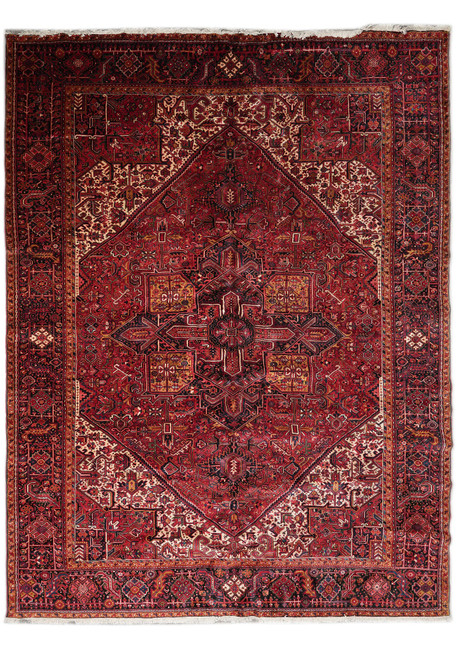
8'2" x 10'3" Persian Heriz Rug | Beige Field & Brown Star Medallion | 1970s Excellent Condition
This is a Heriz woven in the 1970s at a noticeably tighter gauge than most village work of the period, and you can feel it the moment you turn a corner back: short, hard-packed wool pile over a cotton foundation, with the knot rows sitting close and straight across the back. It measures 8'2" x 10'3", the classic 8x10 Persian rug footprint that anchors a sofa group or a 6 seat table without crowding the walls. What separates it from the usual rust and navy Heriz is the palette: a warm camel beige field instead of madder red, with brown, salmon and soft green doing the work. The pile is full and even across all 4 corners, the selvages are intact and the ivory cotton fringe is clean. Every rug we ship carries a certificate of authenticity confirming the origin, materials and hand-knotted construction.
Design and Motifs
The center is an 8 point star medallion in deep brown, stepped and serrated in the way only geometric Persian rugs from the northwest are drawn, with a salmon rosette core and 4 pale green cartouches holding small crimson blossoms at the compass points. Around it a large diamond reserve fills the field, its camel ground covered in angular vine work, serrated leaves, palmettes and tiny hooked blossoms, each one built from straight lines rather than curves because the village loom works in steps, not sweeps. The salmon spandrels carry scrolling vine and arabesque, and each of the 4 corners is set with an olive green panel bearing its own small floral cluster, an unusual touch that gives the corners real interest instead of dead space. The wide brown main border runs a turtle palmette and rosette sequence linked by leafy vine, framed inside and out by narrow guard stripes of ivory and sage carrying a running flower head chain.
A Warm Earth Tone Palette
The field is a golden camel beige that shifts toward honey where the light catches the pile and toward wheat when you walk the other way, the natural abrash of hand-spun wool rather than any printed evenness. Against it the medallion reads as a dark chocolate brown with a russet undertone, and the salmon of the medallion core and the spandrels is a muted terracotta pink, dusty rather than bright, the shade madder takes when it is cut with time. The green appears twice and does two different jobs: a soft sage in the guard stripes and cartouche grounds, and a deeper olive in the 4 corner panels. Scattered through the field vines are small accents of brick red, ivory and gray green, and the whole scheme stays inside a warm neutral range that sits easily with oak floors, leather, walnut and cream upholstery.
Heriz Weaving and Quality
Heriz is a cluster of weaving villages east of Tabriz on the slopes below Mount Sabalan, and its reputation comes from the wool and the water as much as from the drawing. The mineral rich mountain water and the tough, high lanolin fleece of the local sheep produce a fiber that resists crushing and takes dye with a soft glow, which is why Heriz rugs are the ones people put in the busiest rooms of the house and still hand down. Weavers there work from memory on an angular vocabulary of stars, serrated leaves and stepped medallions, no cartoon required. Most village Heriz weaving is coarse by workshop standards, so a piece like this one, knotted noticeably finer and denser than the norm with crisp definition in the small cartouche flowers, is worth noting. The 1970s date puts it in semi-antique territory, and if you want to understand how weavers, dealers and collectors read age from wool, dye and back structure, our guide on how to date an oriental rug walks through the same checks we ran on this piece.
8'2" x 10'3" Persian Heriz Rug | Beige Field & Brown Star Medallion | 1970s Excellent Condition
Ask about this rug
This piece is the only one of it, so the things worth knowing about it are particular to it. If you want to talk through the size, the colour in your own light, or the weave, speak to someone here first.