Watch the film
| Size in ft: | Width: 8'3" x Length: 12' |
| Size in Inch: | Width: 99" x Length: 144" |
| Size in meters: | Length: 3.66 x Width: 2.51 m |
| Colors: | Brick Red, Black Blue, Olive |
| Shape: | Rectangular |
| Woven: | 100% Hand-knotted | Handmade |
| Foundation: | Cotton |
| Pile: | |
| Age: | 1980's | Semi-antique |
| Design: | Heriz Sherabian | Geometric Star Medallion |
| Origin: | Persian Heriz | Made in Persia |
| Condition: | Excellent | Full even pile |
8'3" x 12' Persian Heriz Rug | Sherabian Geometric Medallion | 1980s Hand-Knotted Wool
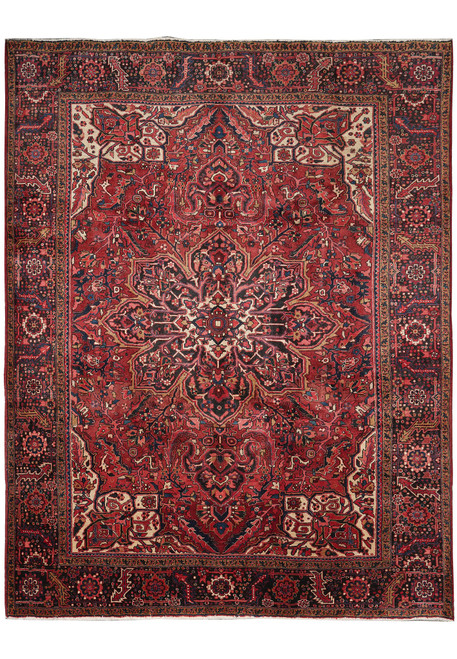
This is a village-woven Persian Heriz of the Sherabian type, knotted by hand in the 1980s on a cotton foundation with a full, glossy wool pile. It reads as one confident statement: a brick red field, a big ivory and ink blue star medallion at the center, and a black blue border packed with rosettes and palmettes. The wool has the heavy, slightly waxy handle that northwest Persian flocks are known for, and after four decades the pile is still even from end to end with no thin areas, no repairs and tightly bound selvedges. At 8'3" x 12' it covers a standard living or dining floor with furniture fully on the rug. Every piece we sell ships with a certificate of authenticity documenting origin, materials and construction.
Please Note About the Photographs:
The full overhead photo was shot under bright studio light and reads lighter and pinker than the rug does in person. The close-up and angled photos are the truer record of the deep brick red. The soft tonal shifts across the field are abrash, the natural variation between hand-dyed yarn batches that every genuine village rug shows, and not fading or wear.
Design and Motifs
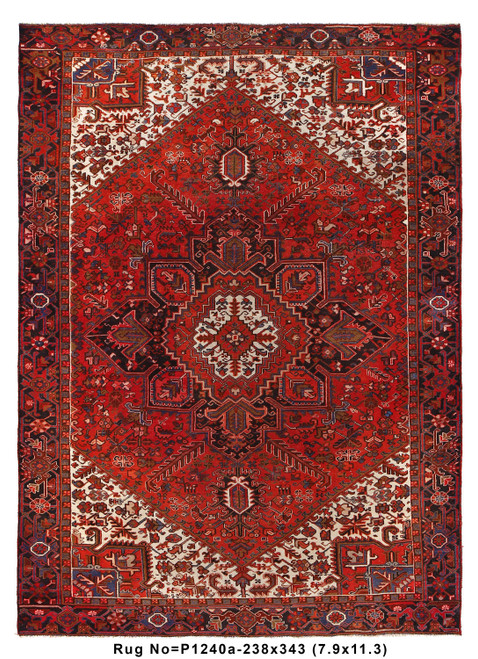
The center holds an 8 petal rosette set inside a stepped ivory star, ringed by an indigo octagon and then by a broad black blue cartouche with hooked arms reaching toward the 4 corners. Above and below the medallion, long serrated pendants end in camel and ivory palmettes, the drawing softened just enough that this reads as a semi-floral rather than a purely angular piece. The 4 corner spandrels are ivory, each filled with small red and blue panel flowers that make the field look like it has been framed twice. Serrated leaves, curling vine tips and tiny boxed blossoms scatter across the open red ground, drawn freehand from memory so no two repeats match exactly. The main border runs on a near-black ground with alternating blue and red rosettes linked by olive vinework, and it is held by reciprocal zigzag guard stripes. Buyers who prefer this kind of angular village drawing to curvilinear city work will find more of it among our geometric Persian rugs.
A Brick Red Field Against Black Blue and Olive
The field is a deep brick red that shifts between a cooler madder tone and a warmer terracotta depending on the light and on which direction the pile lies. Against it, the border ground is a black blue so dark it reads as near black at a distance and resolves into indigo only up close. The third voice is olive, used in the vine tracery of the border and in the outer guard stripe, where it warms toward camel and keeps the red and blue from going flat. Ivory does the structural work: it outlines the star medallion, fills the 4 corner spandrels, picks out the border rosettes and appears as tiny hooks and dots across the field, which is what gives the rug its crisp legibility from across a room. Secondary notes include a soft rose pink in the border flowers, a light sky blue inside the rosettes and small touches of chocolate brown in the leaves. The palette is warm enough for wood floors and traditional upholstery, and the amount of ink blue in the border lets it sit comfortably with navy and charcoal furnishings as well. It is a natural fit among large Persian area rugs chosen to anchor a whole room rather than float under a coffee table.
Heriz Weaving and the Sherabian Villages
Heriz is not a single town but a group of weaving villages east of Tabriz, on the slopes below Mount Sabalan in northwest Persia. The water there is mineral rich, and the sheep pastured on those hills grow a wool so tough and high in lanolin that Heriz rugs became the benchmark for durability, which is exactly why generations of American families put them in their busiest rooms. Sherabian is one of the named village weaves within that district, and pieces carrying its drawing tend to show a slightly finer, more floral hand than the heaviest Heriz work while keeping the same straight-line construction. Weavers work from memory and a village cartoon rather than a full workshop drawing, so the medallion sits a hair off perfect symmetry and the corner spandrels differ subtly from one another, which is the signature of genuine village work. The knot count here is in the normal village range, well under the city standard, but that is the point: a thick foundation, a heavy wool pile and a stout, tightly overcast selvedge are what let a Heriz survive 40 years of traffic and still show the full pile visible in these photos.
8'3" x 12' Persian Heriz Rug | Sherabian Geometric Medallion | 1980s Hand-Knotted Wool
Ask about this rug
This piece is the only one of it, so the things worth knowing about it are particular to it. If you want to talk through the size, the colour in your own light, or the weave, speak to someone here first.