Watch the film
| Size in ft: | Width: 8'8" x Length: 12'9" |
| Size in Inch: | Width: 104" x Length: 153" |
| Size in meters: | Length: 3.89 x Width: 2.64 m |
| Colors: | Khaki, Camel, Ivory, Taupe, Soft Brown, Muted Rose |
| Shape: | Rectangular |
| Woven: | 100% Hand-knotted | Handmade |
| Foundation: | 100% Cotton |
| Pile: | |
| Design: | Ushak | Central Medallion | All-Over Floral Vine |
| Origin: | Made in India |
| Condition: | Excellent | Soft low pile throughout |
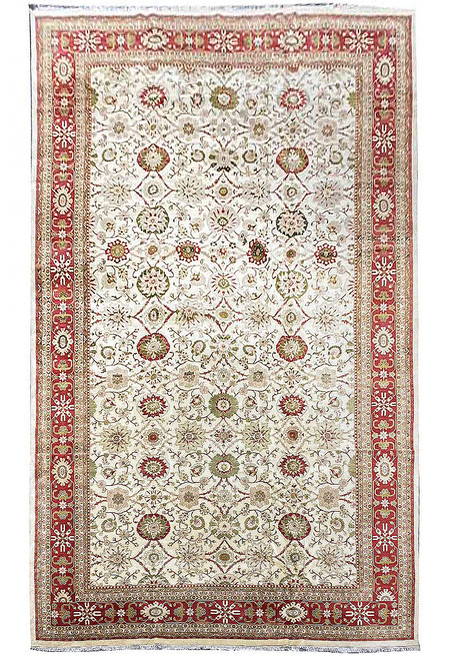
8'8" x 12'9" Ushak Design Oriental Rug | Khaki Ivory All-Over Floral Medallion | Hand-Knotted in India
This is a quiet rug that does a lot of work. At 8'8" x 12'9" it falls squarely into the large room-size rugs class, big enough to carry a full seating group or a 10 seat dining table, and the whole design is drawn in soft khaki, camel and faded brown rather than the strong reds most buyers expect from hand-knotted Oriental rugs. It is knotted entirely by hand on a cotton foundation with a low, tightly clipped wool pile, and the surface has the softly washed, lightly sun-faded look of an old Anatolian piece while the structure is sound and the pile is even edge to edge. Every rug we ship carries a certificate of authenticity confirming that it is a genuine hand-knotted piece, its size, materials and origin.
Please Note About the Photographs:
Some photos show faint fold lines and darker shaded areas across the field. These come from the rug being rolled and stacked on a pallet in the warehouse and from the studio lighting. They are not wear, not fading and not damage. The lines relax once the rug is laid flat, and every rug is professionally steamed and pressed before it leaves us.
Design and Motifs
The drawing follows the classic Ushak formula: a single lobed medallion at the center of an open field, anchored above and below by small pendant finials, with the rest of the ground filled by a loose all-over lattice of curling vines, serrated leaves, palmettes and small 8 petal rosettes. Nothing is crowded. Large sweeping vine scrolls arc through the 4 corners and leave generous areas of bare field between them, which is exactly what gives an Ushak its calm. The main border carries alternating palmettes and rosettes joined by a thin meandering vine, flanked on both sides by narrow guard stripes of repeating buds and a fine outer barber stripe. Look closely at the corners in the detail photo and you can see the weaver resolving the border pattern by hand rather than mechanically, with small variations where the repeat turns.
A Khaki Field With Camel, Taupe and Faded Rose
The field reads khaki: a warm greenish beige that shifts toward oatmeal in strong light and toward sand in shade. The vinework and medallion outlines are drawn in a deeper cocoa brown and a soft chestnut, just dark enough to keep the pattern legible without ever raising the contrast. Around the medallion the tones warm into camel and a dusty apricot, and along the borders there are passages of muted rose and mushroom pink that only show themselves up close, as in the pile detail photo. Gentle abrash, the natural banding that comes from hand-dyed yarn, runs horizontally through the ground and keeps the large open field from looking flat. Against pale oak, wide plank floors, white walls or a room of linen and natural textures, this palette disappears into the architecture instead of competing with it.
Hand-Knotted in India in the Ushak Tradition
Ushak is a weaving town in western Anatolia whose medallion and all-over vine designs have been copied and reinterpreted for centuries. This piece was knotted in India, which is where most of the world's best contemporary hand-knotted work is now produced, by weavers working on upright looms with a cotton warp and weft and a hand-spun wool pile. The knotting is even, the pile is clipped low so the drawing stays crisp, and the finished rug was given a soft wash to mellow the dyes and open up the wool, the step that produces the antique surface you see here. If you want the background on how a piece like this differs from a workshop weaving in Persia, our guide to what separates an Oriental rug from other traditions is worth reading before you buy.
8'8" x 12'9" Ushak Design Oriental Rug | Khaki Ivory All-Over Floral Medallion | Hand-Knotted in India
Ask about this rug
This piece is the only one of it, so the things worth knowing about it are particular to it. If you want to talk through the size, the colour in your own light, or the weave, speak to someone here first.