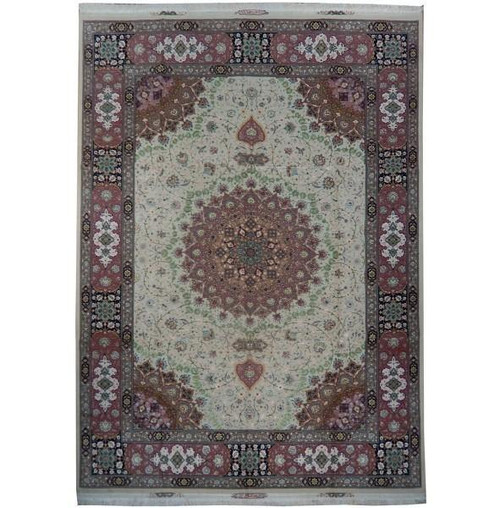
| Size in ft: | Width: 9'10" x Length: 13' |
| Size in Inch: | Width: 118" x Length: 156" |
| Size in meters: | Length: 3.96 x Width: 3.00 m |
| Colors: | Rust, Blue, Green, Ivory |
| Shape: | Rectangular |
| Woven: | 100% Hand-knotted | Handmade |
| Foundation: | Silk Foundation |
| Pile: | Wool and Silk |
| KPSI: | 70 Raj | Approx. 500 |
| Age: | 2000's |
| Signature: | Signed | Woven cartouche in the end border |
| Design: | Tabriz Floral Medallion | Ivory Spandrels | Sky Blue Main Border |
| Origin: | Persian Tabriz | Made in Persia |
| Condition: | Perfect |
9'10" x 13' Persian Tabriz Rug | Wool & Silk on Silk Foundation | 70 Raj Signed Workshop Piece
A Tabriz weaver works to a number, and this loom was set at 70 Raj, which is the top of the range the best city workshops attempt in a wool and silk pile. The result is a 9'10" x 13' rug where the vine scrolls stay thin and continuous instead of stepping, and where the silk in the pile catches light along the leaves while the wool holds the body of the field. It is knotted on a silk foundation, which keeps the rug light in the hand for its area and lets the drawing stay tight right through the small filler flowers. A woven cartouche sits in the ivory end border, the workshop's own mark on a piece it was willing to sign, and the rug dates to the 2000's in perfect condition. If you are shopping the format, it sits squarely in our 10x13 Persian rugs, and it ships with a certificate of authenticity.
Design and Motifs
The centre is a large round medallion built in rings: an 8 petal rose rosette at the core, an ivory band of thin arabesque scrollwork around it, then a deep navy collar packed with curled palmettes and serrated leaves that read almost like flame tips where they meet the field. Slender pendants drop from the medallion top and bottom into small urn shaped cartouches. Around all of it the rust field carries an all over lattice of curving vines, split leaves, and open bouquets, with tiny multi colored blossoms filling every gap so no area of ground is left plain. The 4 corners hold ivory spandrels drawn with mirrored quarter medallions and their own vine work, giving the field its oval reading. The wide sky blue main border alternates large frontal rosettes with boteh shaped palmette cartouches, framed on both sides by navy guard bands of scrolling vine and then by narrow ivory stripes. The border close up shows where the drawing really shows off: grape clusters hanging from a vine, a single bird in profile among the leaves, and looped ribbon stems outlined in dark brown.
Rust Field, Navy Medallion and Sky Blue Borders
The field is a rust that leans warm, closer to terracotta and soft salmon in the detail photographs than to a hard brick red, and it is the colour that decides the room. Against it the medallion collar is a near black navy, the deepest value in the rug, repeated in the two guard bands so the eye travels from centre to border on the same note. Between them the main border is a chalky sky blue, a genuinely unusual choice for a Tabriz and the reason this piece looks lighter than most rust ground rugs of the size. Ivory does the structural work: the spandrels, the medallion's inner ring, and the outer stripes all sit in a warm cream that stops just short of white. Inside the flowers the palette opens up, with rose pink, mauve, lilac grey, pale gold, and a soft leaf green on the vines and calyxes, plus small touches of burgundy outlining the arabesques. Green appears as accent rather than mass, which keeps the overall reading rust, blue, and ivory.
Tabriz Weaving and What 70 Raj Means
Tabriz sits in the northwest of Persia and has been a commercial and court weaving centre for centuries, which is why it measures fineness its own way. Raj counts the knots across one gereh, roughly 2.75 in of width: 40 Raj is commercial goods, 50 is fine, 60 Raj is the start of collector territory, and 70 Raj is the ceiling the strongest ateliers will even set up, because at that density a single weaver covers very little ground in a day. Getting there needs a silk foundation, since silk warps are thinner and stronger than cotton and let the knots pack closer without distorting the grid. That is what you are looking at on the back: even rows, no drift in the medallion's curve, and motifs a quarter the size of what a village loom could resolve. A signed 9'10" x 13' at this count is a workshop statement piece rather than production work, and the wool and silk blend means it still wears like a floor rug rather than a wall hanging.
9'10" x 13' Persian Tabriz Rug | Wool & Silk on Silk Foundation | 70 Raj Signed Workshop Piece
Ask about this rug
This piece is the only one of it, so the things worth knowing about it are particular to it. If you want to talk through the size, the colour in your own light, or the weave, speak to someone here first.