| Size in ft: | Width: 9'10" x Length: 13' |
| Size in Inch: | Width: 118" x Length: 156" |
| Size in meters: | Length: 3.96 x Width: 3.00 m |
| Colors: | Ivory, Beige, Green, Blue |
| Shape: | Rectangular |
| Woven: | 100% Hand-knotted | Handmade |
| Foundation: | Silk |
| Pile: | Wool and Silk |
| Age: | 2000's |
| Signature: | Woven cartouche in the end panel |
| Design: | Tabriz Allover Floral | Palmettes & Vine Scroll | No medallion |
| Origin: | Persian Tabriz | Made in Persia |
| Condition: | Perfect | Excellent |
9'10" x 13' Persian Tabriz Rug | Ivory Allover Floral | Wool & Silk on Silk | Signed
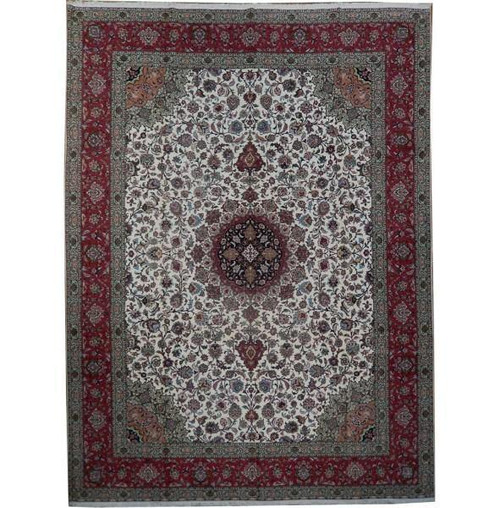
A workshop piece, not a village rug. This 9'10" x 13' Persian Tabriz carries a wool and silk pile knotted on a silk foundation, which is the combination Tabriz masters reserve for their best commissions, and the weaver signed it in a small cartouche at one end. The field is ivory and the drawing is allover rather than medallion, so the rug reads calm and light from across the room and only reveals how much work went into it when you stand over it. At just under 10 by 13 it sits in the most usable large proportion we sell, comfortable under a full dining set or floating a sofa group, and it is one of the cleaner pieces in our run of 10x13 Persian rugs. It ships with our certificate of authenticity documenting origin, materials and hand-knotted construction.
Design and Motifs
The field carries an allover composition of large fan shaped palmettes and split leaf forms strung on a thin curving vine, each blossom drawn differently in its interior shading so no two repeats look identical. Between the big flower heads sit small buds, rosettes, serrated leaves and tiny birds tucked into the scrollwork, which you can pick out in the close-up photographs. There is no central medallion, so the pattern runs uninterrupted from the inner guard stripe to the corners, and the layout stays symmetrical on both axes without ever becoming mechanical. The main border repeats a boteh and palmette rhythm on a light ground, framed by a narrow salmon toned secondary band of alternating cartouches and a pair of fine hair stripes that keep the edges crisp. The end panel closes with a small woven cartouche flanked by scrolling leaves, the weaver's mark on the piece.
Color: Ivory Ground With Salmon, Sage and Teal
The ground is a warm ivory that turns faintly creamy where the silk catches light, and the border runs a soft salmon rose that sits between blush and clay depending on the hour. Inside the flower heads the palette is deliberately quiet: sage and olive green in the leaves, muted teal and powder blue in the small buds, camel, honey and old gold in the petal fans, with burgundy and dusty rose used only as accents at the centers. Dark brown outlining, almost black in places, draws every petal edge and keeps the pale tones from washing together. The silk highlights are placed rather than scattered, so light travels across the vine scroll and the palmette hearts while the wool stays matte, and the rug shifts noticeably when you walk around it. For more on why that happens, see our guide to Persian silk rugs. It is an easy colorway to live with alongside ivory and beige Persian rugs, warm woods and pale plaster walls.
Woven in Tabriz, Northwest Persia
Tabriz has been the commercial and technical capital of Persian weaving in the northwest for centuries, and its reputation rests on drawing: curved line, flowing vine and precise floral detail, all of which only survive at a high knot count. Tabriz workshops measure fineness in Raj, the number of knots across a gereh of roughly 2.75 inches, and the finer grades demand a silk foundation because silk warps can be set closer together than cotton and hold the tension needed for delicate curves. That is exactly what this rug is built on, which is why the palmettes hold their shape at full size instead of stepping into blocks. The pile is clipped low so the drawing stays legible, the back shown against the ruler is even and tight with no pulling at the selvedges, and the signature cartouche tells you a named workshop stood behind it. Anyone comparing Persian Tabriz rugs at this size should look first at the foundation and the outlining, and this one holds up on both.
9'10" x 13' Persian Tabriz Rug | Ivory Allover Floral | Wool & Silk on Silk | Signed
Ask about this rug
This piece is the only one of it, so the things worth knowing about it are particular to it. If you want to talk through the size, the colour in your own light, or the weave, speak to someone here first.