Watch the film
| Size in ft: | Width: 9'9" x Length: 13'4" |
| Size in Inch: | Width: 117" x Length: 160" |
| Size in meters: | Length: 4.06 x Width: 2.97 m |
| Colors: | Ivory, Cream, Sage Green, Rose, Gold, Navy Blue, Brick Red |
| Shape: | Rectangular |
| Woven: | 100% Hand-knotted | Handmade |
| Foundation: | Cotton |
| Pile: | 3/8" | Wool |
| Design: | Tabriz Medallion | All-Over Floral Field | Stepped Corner Spandrels |
| Origin: | Persian Tabriz | Made in Persia |
| Condition: | Excellent |
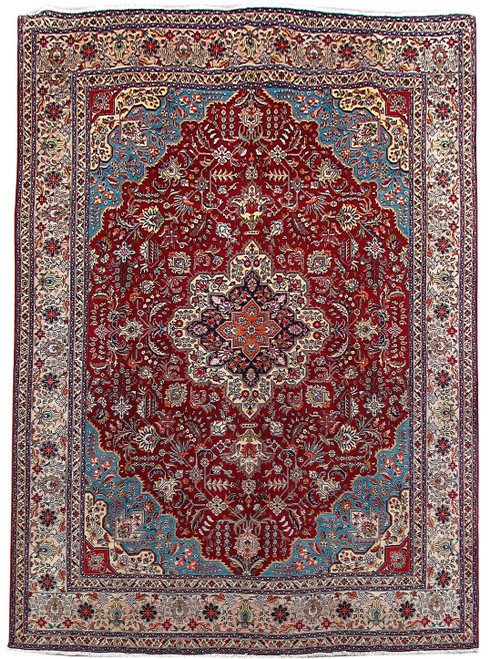
9'9" x 13'4" Persian Tabriz Rug | Ivory Floral Field with Sage Green Spandrels | Excellent Condition
This is a classic workshop Tabriz in the size most large American rooms are actually built for, a true 10x13 Persian rug measuring 9'9" x 13'4". The field is ivory and so densely drawn that from across the room it reads as a single pale, shimmering surface, with a layered medallion floating at the center and 4 sage green spandrels anchoring the corners. The pile is wool at 3/8", hand-knotted on a cotton foundation, and the condition is excellent with full, even pile from edge to edge. Every rug we sell ships with a certificate of authenticity stating origin, materials and construction.
Design and Motifs
The center medallion is built in rings. At its heart sits a deep green lozenge filled with fine white arabesque tracery and a single red diamond, framed by a rose ground carrying black curling vines studded with tiny turquoise dots. Outside that, buff and gold lobes hold small rosettes, and the whole shape is outlined in brick red before breaking into 8 petal points. Slender pendants rise and fall from the medallion along the long axis, each ending in a gold palmette and a small red bud. The field around it is a true all-over floral lattice: thousands of small navy blossoms, red buds and pale green leaves on hair-thin vine scroll, drawn small enough that the pattern never competes with the medallion. The 4 corner spandrels step inward in short right angles, a hallmark of Tabriz draftsmanship, each filled with its own scaled-down floral scheme. The main border runs cream, with alternating palmettes, blue tulip forms and leafy vine, flanked by narrow sage guard bands and fine red outlines.
The Ivory, Sage and Rose Palette
The ground color is a warm ivory, closer to unbleached cream than to white, which is what keeps this from feeling cold underfoot or under daylight. Against it the weaver worked a cool navy blue for the small blossoms, so the field reads faintly blue-grey from a standing distance and resolves into individual flowers only when you are close to it. The spandrels are a soft sage green, almost celadon, and the same green returns in the medallion core and in the thin guard stripes of the border, tying the corners to the center. Rose and salmon appear in the inner medallion ring and in scattered border blooms, gold and buff carry the outer medallion lobes and the larger palmettes, and brick red is used sparingly as outline and as small accent buds. It is a light, decorative reading of the Tabriz palette that suits ivory and beige Persian rugs collectors looking for something formal without weight.
Tabriz Weaving in Northwest Persia
Tabriz sits in the far northwest of Persia and has been the commercial and technical center of Persian weaving for centuries. Tabriz workshops measure fineness in Raj, the count of knots per gereh of about 2.75 in across the width, and they are the houses that trained much of the country in cartoon-based, curvilinear drawing. You can see that discipline here: the stepped corners meet cleanly, the medallion is symmetrical along both axes, and the vine scroll in the field keeps its rhythm across nearly 13 ft of length without drifting. The back photograph shows straight, regular rows of knots on a cotton foundation, the mark of a loom kept under tension and weavers working from a proper cartoon rather than memory. Wool from the Azerbaijan highlands takes dye well and wears hard, which is why a Tabriz of this size still shows full pile and crisp outlines after use.
9'9" x 13'4" Persian Tabriz Rug | Ivory Floral Field with Sage Green Spandrels | Excellent Condition
Ask about this rug
This piece is the only one of it, so the things worth knowing about it are particular to it. If you want to talk through the size, the colour in your own light, or the weave, speak to someone here first.