| Size in ft: | Width: 9'9" x Length: 13' |
| Size in Inch: | Width: 117" x Length: 156" |
| Size in meters: | Length: 3.96 x Width: 2.97 m |
| Colors: | Red, Navy, Ivory, Rose, Green, Gold |
| Shape: | Rectangular |
| Woven: | 100% Hand-knotted | Handmade |
| Foundation: | Cotton |
| Pile: | Wool and Silk |
| Age: | 1970's | Approx. 50 years old |
| Design: | Tabriz Star Medallion | 4 Corner Spandrels | All-Over Floral Field |
| Origin: | Persian Tabriz | Made in Persia |
| Condition: | Perfect | Full even pile |
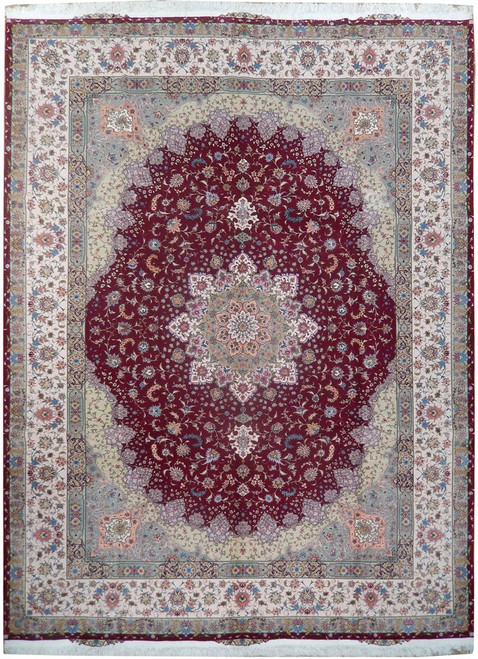
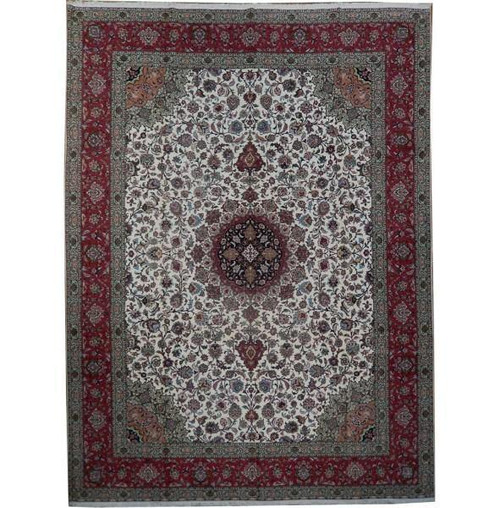
9'9" x 13' Persian Tabriz Rug | Wool and Silk Floral Medallion | 1970s Workshop Weave
A workshop Tabriz from the 1970s, hand-knotted in wool with silk worked through the highlights on a cotton foundation, and still in perfect condition with a full even pile. The drawing is the formula Tabriz built its name on: a single ivory star medallion floating on a densely flowered red field, 4 matching corner spandrels, and a deep navy main border carrying palmettes and blossom heads. At 9'9" x 13" the proportions read as a true room rug, and among 10x13 Persian Tabriz rugs this one is unusually crisp in its detail for its age. It ships with a certificate of authenticity.
Design and Motifs
The center holds an 8 petal rosette set inside a wine-red cartouche, ringed by an ivory band of scrolling vine and then by a saw-toothed navy outline that gives the medallion its star silhouette. Slender pendants reach out top and bottom along the long axis. Around all of that the field never rests: curling serrated leaves, lotus palmettes, carnations and small multi-petal blossoms are drawn on a fine continuous vine in strict mirror symmetry across both axes. The 4 corner spandrels break the rhythm deliberately, filled with a softer rose-taupe ground and their own arabesque tracery so the corners read as quiet panels against the busy field. The main border runs a navy ground with alternating cartouche palmettes and flowering sprays, flanked by ivory guard stripes of linked vine and rosette that repeat down every edge. This is drawing that depends on curve, and it only holds together at a fine knot count.
The Red Field and Its Navy Frame
The ground is a deep wine red, closer to claret than to tomato, and it stays even from end to end. Against it the palette is remarkably wide for a rug that reads as red from across the room: ivory and cream in the medallion ring and guard stripes, rose, dusty pink and pale mauve in the blossoms, olive and sea green in the leaves, tan and gold in the smaller sprays, with dots of pale blue for accent. The main border is a near-black navy that pulls all of that warmth back into a hard frame, and the spandrels sit between the two as a muted rose-taupe. Where silk has been used in the flower heads and vine outlines, the pile flashes lighter as you walk around the rug, so the field shifts between a dark oxblood and a brighter raspberry depending on where you stand and how the light falls.
Tabriz Weaving in Northwest Persia
Tabriz sits in the far northwest of Persia and has been the country's most organized weaving city for centuries, working from drawn cartoons in proper workshops rather than from memory. Fineness there is measured in Raj, the number of knots across a gereh of roughly 2.75 inches, and a rug like this one, with curved vine tracery this tight and silk used to outline individual petals, is the product of a loom set well above ordinary commercial weaving. The back confirms it: small, regular knots, clean color changes, and a firm cotton foundation with the design legible from the reverse. The 1970s output from these workshops is now the most sought-after modern Tabriz production, and if you want to understand the markers used to date an Oriental rug, this piece shows most of them clearly.
9'9" x 13' Persian Tabriz Rug | Wool and Silk Floral Medallion | 1970s Workshop Weave
Ask about this rug
This piece is the only one of it, so the things worth knowing about it are particular to it. If you want to talk through the size, the colour in your own light, or the weave, speak to someone here first.