| Size in ft: | Width: 9'9" x Length: 13'6" |
| Size in Inch: | Width: 117" x Length: 162" |
| Size in meters: | Length: 4.11 x Width: 2.97 m |
| Colors: | Ivory, Coral, Green, Blue |
| Shape: | Rectangular |
| Woven: | 100% Hand-knotted | Handmade |
| Foundation: | 100% Cotton |
| Pile: | Wool and Silk |
| Age: | 2000's |
| Design: | Tabriz Floral Medallion | Vine and Palmette Field | Spandrel Corners |
| Origin: | Persian Tabriz | Made in Persia |
| Condition: | Perfect | Excellent throughout |
9'9" x 13'6" Persian Tabriz Rug | Ivory Wool and Silk Floral Medallion | 2000s Workshop Weave
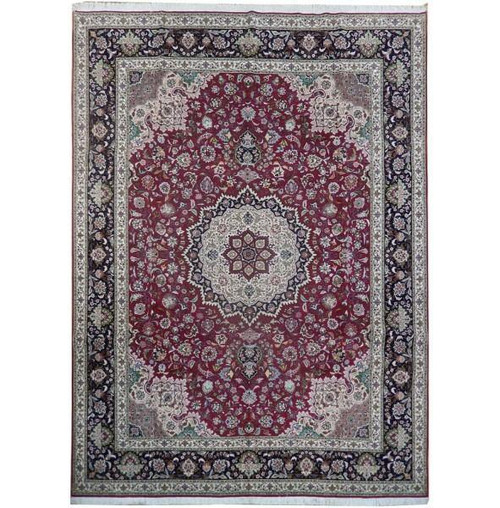
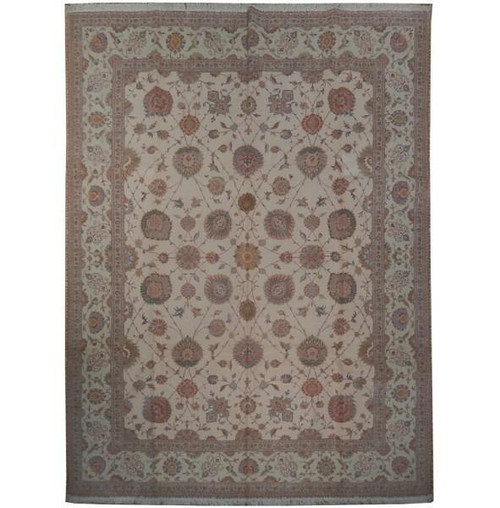
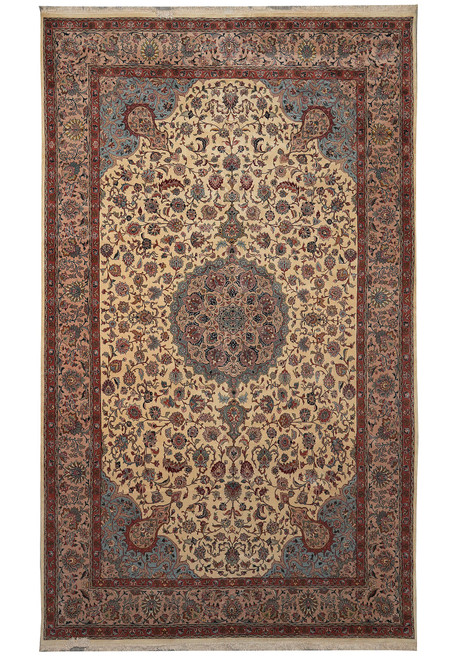
This is a workshop piece from the 2000s, hand-knotted in wool with silk drawn through the flowers and outlines, and it reads exactly as a good Tabriz should: an ivory ground covered edge to edge in fine vinework, a coral medallion set dead center, and a border that holds the whole thing together without shouting. At 9'9" x 13'6" it sits squarely in the 10 X 14 Persian rug class, which is the size most formal rooms with a large seating group or a full dining set actually need. The pile is even, the ends and sides are tight and original, and the rug has no wear, no repair and no discoloration. It ships with a certificate of authenticity documenting origin, materials and hand-knotted construction.
Design and Motifs
The center medallion is built in concentric rings around a small sunburst rosette, each ring carrying its own row of palmettes, split leaves and tiny blossoms, so the eye keeps traveling inward. Around it, 8 large heart-shaped boteh cartouches float on the ivory field, each one filled with its own miniature bouquet on a near-black ground, which is what gives the field its depth. Between them runs a continuous system of thin arabesque vines carrying Shah Abbas palmettes, rosettes, serrated leaves and small birds tucked into the scrollwork, all drawn in the curved line Tabriz is known for rather than the angular village style. The 4 corner spandrels break away into a soft sage ground with their own floral arrangement, framing the field cleanly. The main border repeats a rhythm of large fan palmettes and cypress-like sprays, flanked by guard stripes of small connected flowerheads, and the outermost ivory stripe keeps the whole composition from feeling heavy.
A Palette of Ivory, Coral, Sage and Blue
The field is a warm ivory, closer to unbleached cream than white, and it is the reason this rug lightens a room instead of darkening it. The medallion and the main border share a coral that photographs as a soft brick or terracotta red, muted rather than fire engine, with pale rose and apricot shading inside the medallion rings. Sage and olive green carry the corner spandrels and the leafwork throughout, and a dusty lavender runs through the blossoms and the boteh outlines, which is an unusual and very pretty note for a Tabriz. Blue appears in small, deliberate doses: sky blue centers in the border flowers, deeper navy in the inner petals, and a dark indigo that reads almost black in the boteh grounds and vine outlines. Mustard gold, ivory and touches of deep burgundy fill in the smaller flowerheads. The silk sits in the flower heads and the fine outlines, so the palette shifts as you walk past it and the coral lifts noticeably under lamp light.
Tabriz Weaving in Northwest Persia
Tabriz sits in the far northwest of Persia and has been the country's commercial and design capital for rugs for centuries, the city where cartoons are drawn on graph paper and followed knot for knot by weavers working in organized ateliers. Fineness there is measured in Raj, the count of knots per gereh across the width, and the drawing on this piece, particularly the unbroken curve of the vines and the legibility of the small blossoms inside the medallion rings, is only possible at a genuinely fine Raj count. The wool is spun tight and clipped low so nothing blurs, and the silk is used as a drawing tool rather than a filler, outlining petals and highlighting the cartouches. The back, visible in the detail photo, shows a clear, regular knot grid on a cotton foundation with flat, disciplined rows, along with hand-tied original fringe at both ends. That combination of cartoon-based design, low even clip and silk accenting is the signature of a proper Tabriz workshop weave rather than a village production.
9'9" x 13'6" Persian Tabriz Rug | Ivory Wool and Silk Floral Medallion | 2000s Workshop Weave
Ask about this rug
This piece is the only one of it, so the things worth knowing about it are particular to it. If you want to talk through the size, the colour in your own light, or the weave, speak to someone here first.