Watch the film
| Size in ft: | Width: 4'8" x Length: 6'5" |
| Size in Inch: | Width: 56" x Length: 77" |
| Size in meters: | Length: 1.96 x Width: 1.42 m |
| Colors: | Ivory, Coral, Green, Blue |
| Shape: | Rectangular |
| Woven: | Hand-Knotted |
| Pile: | Wool And Silk |
| Origin: | Persia |
| Design: | Tabriz |
| Age: | 1970's |
| Condition: | Perfect |
4'8" x 6'5" Persian Tabriz Rug | Ivory Wool & Silk Floral Medallion | 1970s Fine Weave
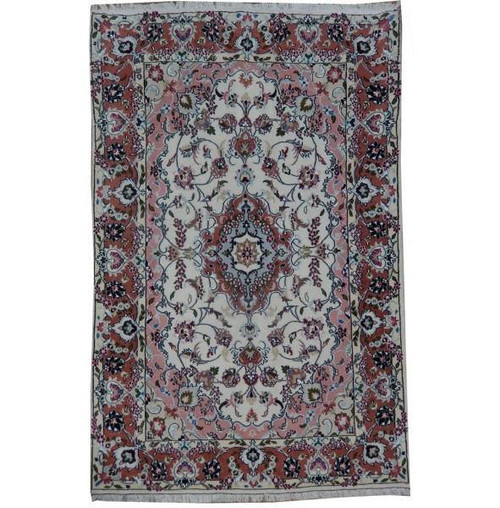
This 4'8" x 6'5" Persian Tabriz came off the loom in the 1970s, and it is the kind of small workshop piece that rewards close inspection more than a photograph can. The pile is wool with silk running through the drawing, so the vine work and the petal edges sit slightly brighter than the ground around them and shift as you walk past. The ivory field has stayed clean and creamy, the coral border has held its tone evenly from end to end, and the pile is full with no low spots or restoration. On a 56" by 77" footprint the full medallion, spandrels and triple border all read properly, which only works when the knot count is high enough to draw a curve this tight. Every rug we ship carries a certificate of authenticity listing origin, materials, age and measurements. If you are comparing pieces in this format, it sits squarely in the 5x7 Persian rugs group.
Design and Motifs
The layout is the classic curvilinear Tabriz formula: a lobed central medallion, 4 matching corner spandrels, and a field of arabesque vines filling everything in between. The medallion is built in layers, a coral outer lobe, a powder blue inner ring carrying a wreath of small ivory and wine rosettes, and at the dead center an olive 8 petal rosette on an ivory ground. Pale blue tendrils spiral out of the medallion across the ivory field, carrying split palmettes, serrated leaves and tiny 5 petal blossoms in wine red, olive and coral. The spandrels shift to a soft taupe and blue ground so the corners read as separate panels rather than extensions of the field. The main border is coral, drawn with alternating heart shaped tulip clusters and dark navy palmettes, each one outlined in a single dark line that keeps the shapes crisp. Narrow ivory guard stripes with a running vine of wine rosettes frame the border on both sides, and the whole design is perfectly mirrored on both axes, which is the mark of a cartoon drawn and followed properly rather than improvised.
The Ivory, Coral and Powder Blue Palette
The field is a warm ivory, closer to clotted cream than white, and it makes up most of the visible surface. Against it the border reads coral, a soft salmon pink with just enough orange in it to stay warm under lamplight rather than going cold or dusty. The secondary color is powder blue, used for the medallion ring, the inner spandrel grounds and the thin tendrils that web across the field, with a handful of deeper cobalt flower heads scattered through the border for weight. Olive and moss green carry the leaves and the central rosette, and small points of wine burgundy and near black act as the outlining and the accents that stop the pastels from blurring together. The silk is concentrated in the lighter drawing, the pale blue vines, the ivory petals and the cream guard stripes, so those elements pick up the light while the wool grounds stay matte. It is a genuinely light rug: it brightens a dark floor instead of anchoring it, and it sits comfortably with warm oak, cream walls, soft blues and faded reds. The wool and silk combination is also why the coral looks slightly different from each end of the room.
Tabriz Weaving and the Quality of This Piece
Tabriz sits in the far northwest of Persia and has been the commercial and technical capital of Persian weaving for centuries. Its workshops measure fineness in Raj, the number of knots across a gereh of about 2.75 inches, and the city is unusual in that it produces at every level, from 40 Raj commercial goods up to the 70 Raj work that is the ceiling of what any workshop will attempt. This rug belongs to the fine end of 1970s Tabriz production: the back shows small, tightly packed, square knots on a cotton foundation, and the drawing itself is the proof, since you cannot resolve a lobed medallion wreath or a 5 petal blossom this small on a coarse weave. Tabriz weavers work on a hook rather than with bare fingers, which is part of why the city's output is so consistent and why its rugs hold their shape and lie flat decade after decade. The selvedges are intact, the ends are secured and the original ivory fringe is present on both ends. For a buyer who wants genuine workshop drawing and silk accents in a format that fits a real room, this is exactly the piece the Tabriz ateliers were set up to produce.
4'8" x 6'5" Persian Tabriz Rug | Ivory Wool & Silk Floral Medallion | 1970s Fine Weave
Ask about this rug
This piece is the only one of it, so the things worth knowing about it are particular to it. If you want to talk through the size, the colour in your own light, or the weave, speak to someone here first.