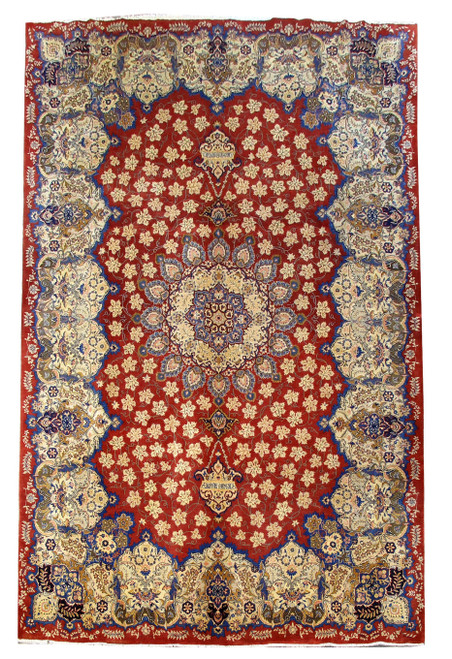
Madder and Indigo
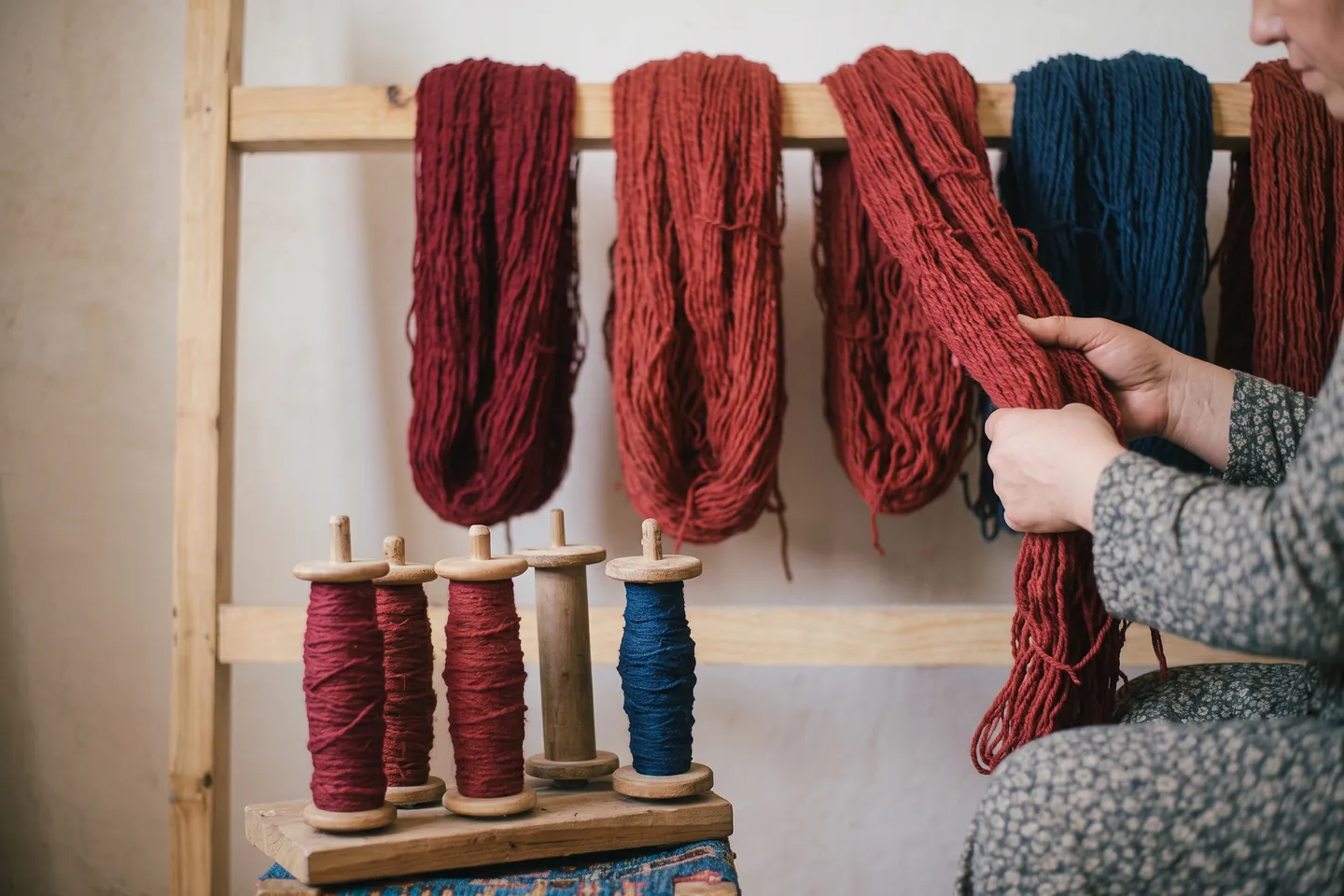
Colour goes in before the loom does
A rug is coloured months before it is a rug. The wool is spun, tied into skeins, and dropped into the dye pot loose, because a skein takes dye evenly in a way that a finished carpet never could. What comes out is wound onto bobbins and hung at the loom, and from that point the colour is fixed. There is no correcting it later. Every decision about the palette of a Persian rug was taken by a dyer standing over a pot, often a different person from anyone who touched the loom.
Almost all of it is mordanted. A mordant, usually alum, is a metallic salt that binds to the wool fibre and then binds the dye to itself. Without it most plant colour rinses straight back out. The mordant is not neutral: the same madder bath over an alum mordant gives red, and over an iron mordant gives something closer to plum or brown. Half of the dyer's craft is in the mordant rather than the plant.
Madder, and why no two reds match
The reds come from the root of the madder plant, dug up after two or three years in the ground, dried and ground to powder. The colouring agents in it are alizarin and purpurin, and they are unusually sensitive to conditions. Water chemistry, temperature and how long the bath is held all move the result, which is why madder covers everything from a hot orange-red through brick to a deep burgundy with blue in it. A dyer working with lime-rich water gets a different red from the same roots than one working with soft water twenty miles away.
Madder is not the only red. Cochineal, which is an insect rather than a plant, gives the cooler crimsons and purple-reds found in some weaving regions, and lac does something similar. The tidy version of the story has four plants in it. The real one has more, and two of them are beetles.
Indigo comes out of the vat green
Indigo behaves unlike anything else in the dye house. It is not soluble in water and it takes no mordant. It has to be reduced in an alkaline vat until it dissolves into a yellowish liquid, and the skein that is lifted out of that vat is yellow-green. It turns blue in the air, over perhaps a minute, as it oxidises. Depth is built by repeated dipping: a pale sky blue is two or three dips, a near-black navy is many.
Because indigo sits on the fibre rather than being locked into it by a mordant, it wears off the very tips of the pile over decades. That is the mechanism behind the softened, slightly mottled look of an old indigo ground, and it is not damage.
The yellows, and the greens that used to be green
Pomegranate rind is the one most often named, and weld, vine leaf and larkspur do similar work. The golds and yellows are the least lightfast colours in the natural palette by a wide margin, which has a consequence most people meet before they understand it.
There is no single-plant green in this tradition. Green is made by dyeing wool blue in the indigo vat and then yellow on top, or the other way round. When the yellow goes, and it goes first, the green drifts towards blue. An antique rug with a soft blue-green field very often started out a clear grass green. The blue is what is left. Knowing this changes how an old rug reads: the palette in front of you is a later state of the palette that was tied in.
Walnut husk, iron, and the sunken outlines
Walnut husk gives the browns and needs very little help to do it. Blacks are harder. They are generally built from something tannin-rich such as oak gall combined with an iron mordant, and iron is corrosive to wool. Over a long enough life the iron eats through the fibre it is holding the colour onto.
This is why the black and dark brown outlines in a genuinely old rug often sit lower than the colours on either side of them, so that the design has a faint relief you can feel with a palm. The trade calls it corrosion. It is a defect in the strict sense and a sign of an honest old dye in practice, and nobody would want it removed.
Some of the palette is not dyed at all. The ivories, the camel grounds, the greys and soft browns in tribal weaving are frequently the natural fleece colour of the sheep, sorted by hand at the shearing.
Plant dye against synthetic, said fairly
The first synthetic dyes reached the weaving regions in the second half of the nineteenth century, and the early ones deserved their reputation: they ran when washed and went pale or muddy within a generation. The reaction against them was severe enough to shape the trade's vocabulary to this day.
Modern chrome dyes are a different matter, and pretending otherwise is not useful. They are extremely colourfast. A rug dyed with good chrome dyes in the 1970s can look close to the day it was made, and for a room where the colours need to stay exactly as bought, that is an argument in their favour rather than against.
The difference is in how the two age. A natural dye bath colours every fibre in a hand-spun yarn slightly unequally, so as light works on it the yarn moves into a range of related tones and stays alive. A very even synthetic colour tends to hold, hold, hold, and then lose intensity as a flat sheet, arriving at a paler version of one colour rather than a family of them. That is the whole of the case for plant dye, and it takes thirty years to observe. Newer production woven deliberately on natural dyes and hand-spun wool, including much of the chobi and Ziegler weaving and a good deal of work from Afghanistan and Turkey, exists precisely because a revival of natural dyeing took hold from the early 1980s onward.
Abrash
Abrash is the horizontal drift in tone that runs across a field, usually a shade or two, sometimes more. It is horizontal because a rug is built one full row at a time: when a dye lot runs out, the join lands across the whole width at once.
The causes are ordinary. A village dyer makes up what is needed for a few weeks, and the next batch is a different day, different water, different roots. Hand-spun wool varies in twist and takes dye at slightly different rates. Fleece from two sheep is not the same fleece. On a piece that took two years, some drift is close to unavoidable, and its absence in an old rug is the thing worth asking about.
One honest qualification: abrash is now sometimes designed in on purpose, with lots deliberately varied, particularly in Gabbeh and in contemporary natural-dye production. That is not deception, but it does mean the presence of abrash by itself proves nothing about a rug's age. It tells you about the dye lot, not the decade.
The part that is not good news
Natural dyes are, as a class, less lightfast than good modern ones. A naturally dyed rug in front of a south-facing window will lose its yellows first and its reds next, and the part under the sofa will not. Turning the rug end for end once or twice a year spreads that evenly, which is the whole trick and the one most people are told after the fading has started.
The other useful test costs nothing. Press a damp white cloth firmly onto the pile and drag it. Nothing should come off on the cloth. Colour transfer means the dye was not properly fixed or not properly rinsed, and it has no bearing on whether the dye came out of a plant. Plenty of naturally dyed rugs have failed that test, and the lesson is that a good rug is well dyed rather than fashionably dyed. If a colour is what is driving the decision, it is worth seeing several wool pieces together rather than one, because the same nominal shade behaves differently across a rack of rugs, and it will go on behaving differently for the next eighty years.